Trunk comparison: Kia Ceed vs VW ID.4
Key Differences
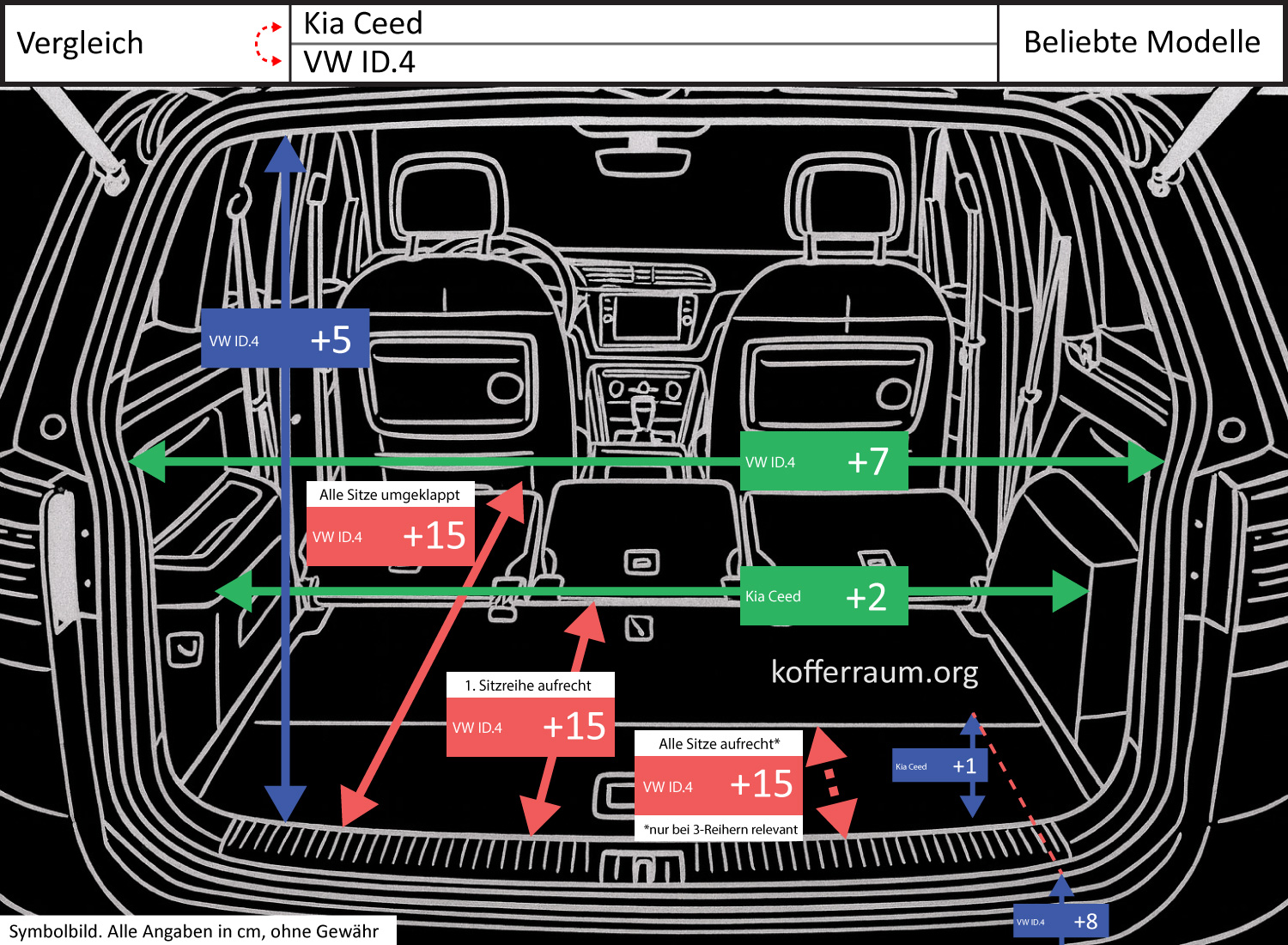
The VW ID.4 offers a cargo floor that is 5.9 in (19%) longer than the Kia Ceed with the first row of seats upright, which is the biggest difference. Additionally, the loading edge of the ID.4 is 3.1 in (12%) higher above the ground than that of the Ceed.
Other measurements: with the seats folded down, the ID.4 is also 5.9 in (10%) longer; the height of the trunk opening of the ID.4 is 2 in (7%) higher and the opening width is 2.8 in (7%) wider than the Ceed.
The Kia Ceed has a trunk depth (loading edge to ground) that is 0.4 in (10%) higher and a width at the narrowest point that is 0.8 in (2%) greater.
Impact on Usability
The larger cargo floor of the ID.4 with the seats upright (+5.9 in / 19%) makes it more practical when regularly transporting passengers with luggage, strollers, or sports equipment: longer or more pieces of luggage fit easily behind the seats.
The larger opening width (+2.8 in) and higher opening (+2 in) also make it easier to store wide or tall items.
The higher loading edge of the ID.4 (+3.1 in / 12%) makes lifting heavy items more strenuous and increases the effort required when loading and unloading. Those who often lift heavy boxes, furniture, or groceries have ergonomic advantages with the Kia Ceed due to its lower loading edge.
The Kia Ceed also scores with a slightly lower load floor (+0.4 in) and minimally more width at the narrowest point (+0.8 in). This helps when sliding in heavy, flat loads and can be practical when loading narrow items.
When the rear seats are folded down, the ID.4 also offers more length (+5.9 in / 10%), which is advantageous for very long cargo.
In summary: For regular transport of longer or bulky luggage with the rear seat occupied, the ID.4 is the better choice. For frequent lifting of heavy loads and ergonomically easier loading and unloading, the Kia Ceed is more practical.