
Trunk comparison: Kia Ceed vs VW Passat Wagon
Summary of the Main Differences
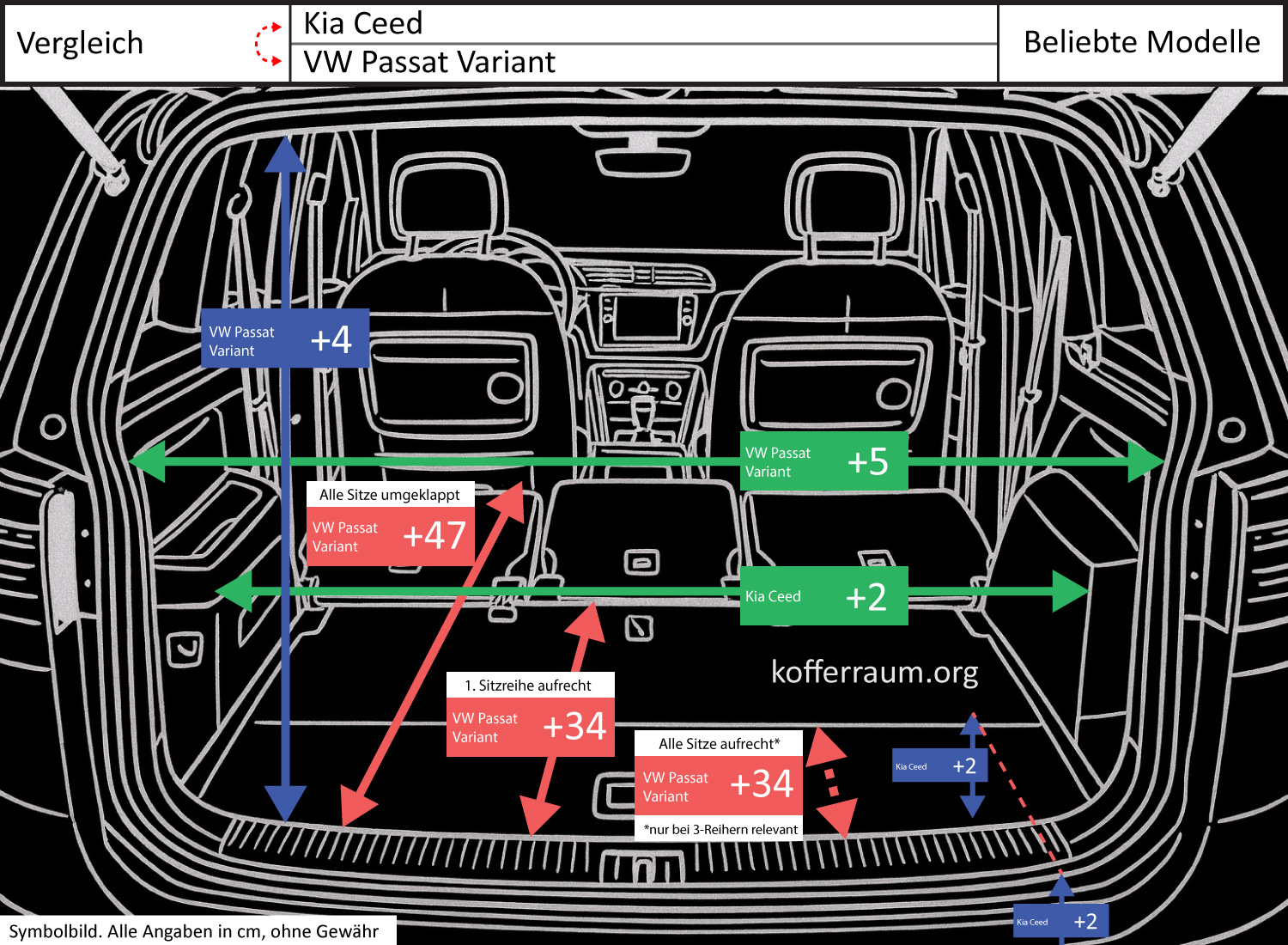
The VW Passat Wagon offers significantly more cargo length: with the seats folded down, the trunk is 18.5 in (31%) longer, and with the first row of seats upright, it is 13.4 in (43%) longer than in the Kia Ceed.
In the Kia Ceed, the depth from the loading edge to the trunk floor is 0.8 in (22%) greater than in the Passat.
Impact on Usability
The greater length advantages of the Passat specifically mean more flexibility for long or bulky items: furniture, ladders, long sports equipment, or lumber are easier to transport, both when the rear seats are folded down and in everyday use with the first row of seats in use.
For users who regularly transport longer loads or frequently travel fully loaded (craftsmen, families with lots of luggage), the Passat is therefore clearly more suitable in practice.
The greater depth in the Kia Ceed (loading edge → trunk floor) results in a deeper cargo area behind the loading edge. This can help store bulky or high-stacked loads more stably and prevents shifting forward with deeper loads.
At the same time, the loading edge of the Ceed is slightly higher above the ground, making lifting from the floor minimally more strenuous. Overall, this means: the Ceed can offer advantages for more compact, tall, or stably placed loads but is not as good for very long items as the Passat.
Other differences such as the height of the trunk opening (+1.6 in, 5% in favor of the Passat), the width of the opening (+2 in, 5% in favor of the Passat), or the narrowest width in the trunk (+0.8 in, 2% in favor of the Ceed) are relatively small (<10%) and have only minor practical effects on usability.