Trunk comparison: Kia Ceed vs VW T-Roc
Key Differences
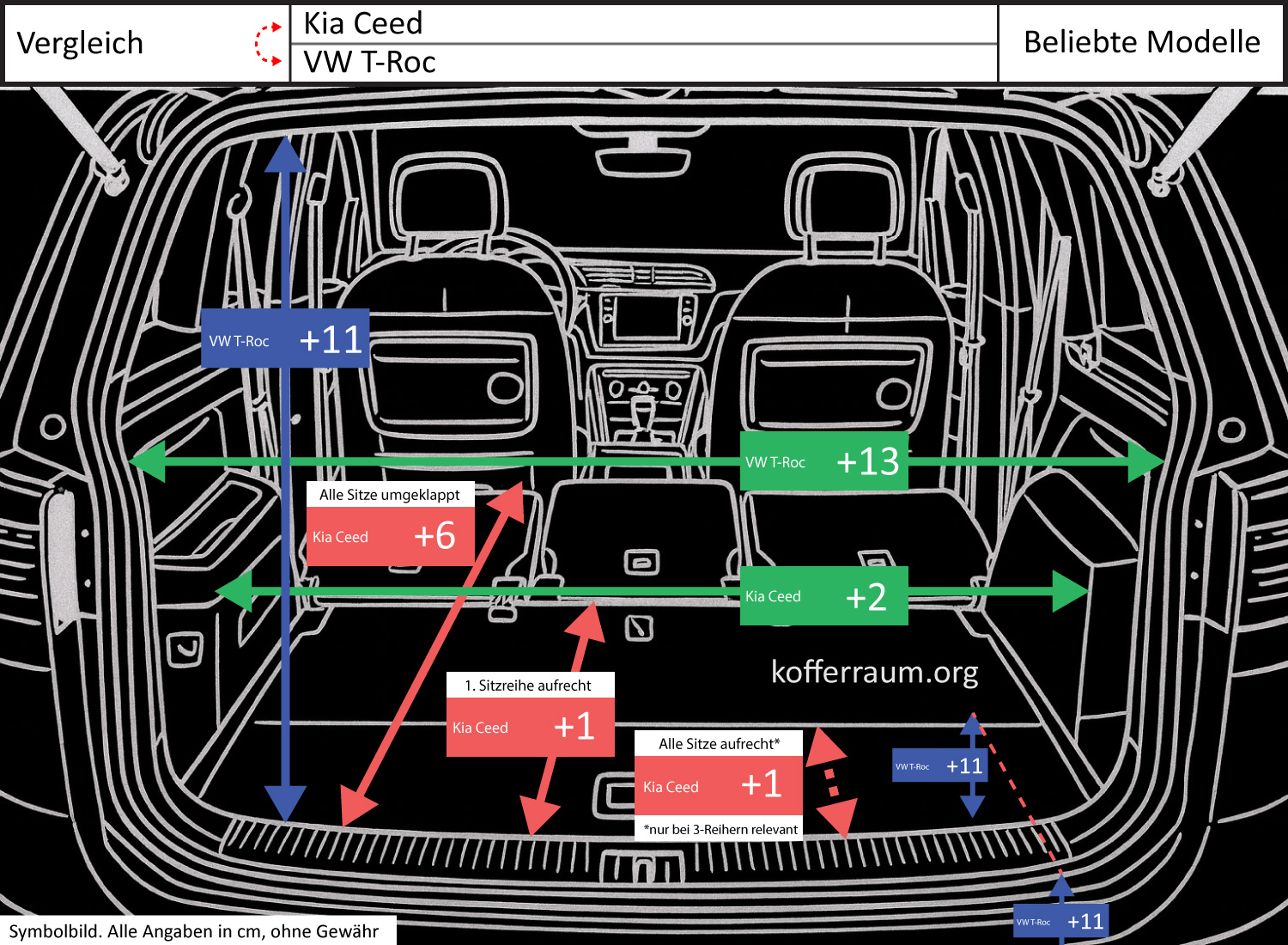
The most noticeable differences concern the cargo volume layout and the trunk opening: the VW T‑Roc has a trunk opening that is 4.3 in higher (+15%), a depth from the loading edge to the trunk floor that is 4.3 in greater (+100%), a loading edge height above the road that is 4.3 in higher (+17%), and a trunk opening that is 5.1 in wider (+13%) compared to the Kia Ceed.
Smaller deviations that hardly matter are: the Kia Ceed is 2.4 in longer (+4%) with the seats folded down and 0.4 in longer (+1%) with the rear seat upright; the narrowest interior width is only 0.8 in larger (+2%) in the Ceed.
Impact on Usability
The larger dimensions of the T‑Roc in opening height and width make it more practical in everyday use for bulky or tall items: boxes, kitchen appliances, or pieces of furniture can be more easily maneuvered through the larger opening.
The wider opening facilitates side loading, and the higher opening reduces the risk of hitting the roof edge.
At the same time, the higher loading edge of the T‑Roc means that heavy luggage or groceries must be lifted higher — this increases the effort required when loading compared to the lower Ceed.
The greater depth from the loading edge to the trunk floor in the T‑Roc partially offsets this: items can sit deeper and thus more stably, which is especially advantageous for tall, slender loads.
In combination, this means: the T‑Roc is better suited for tall and bulky cargo, while the Ceed is more convenient for frequently lifting heavy loads.
The slightly longer load floor length of the Ceed (with seats folded down +2.4 in) and the marginally greater interior width at the narrowest point (+0.8 in) are minor advantages for flat, elongated cargo but hardly affect everyday practicality.