
Trunk comparison: Kia Stonic vs Durchschnitt Subcompact


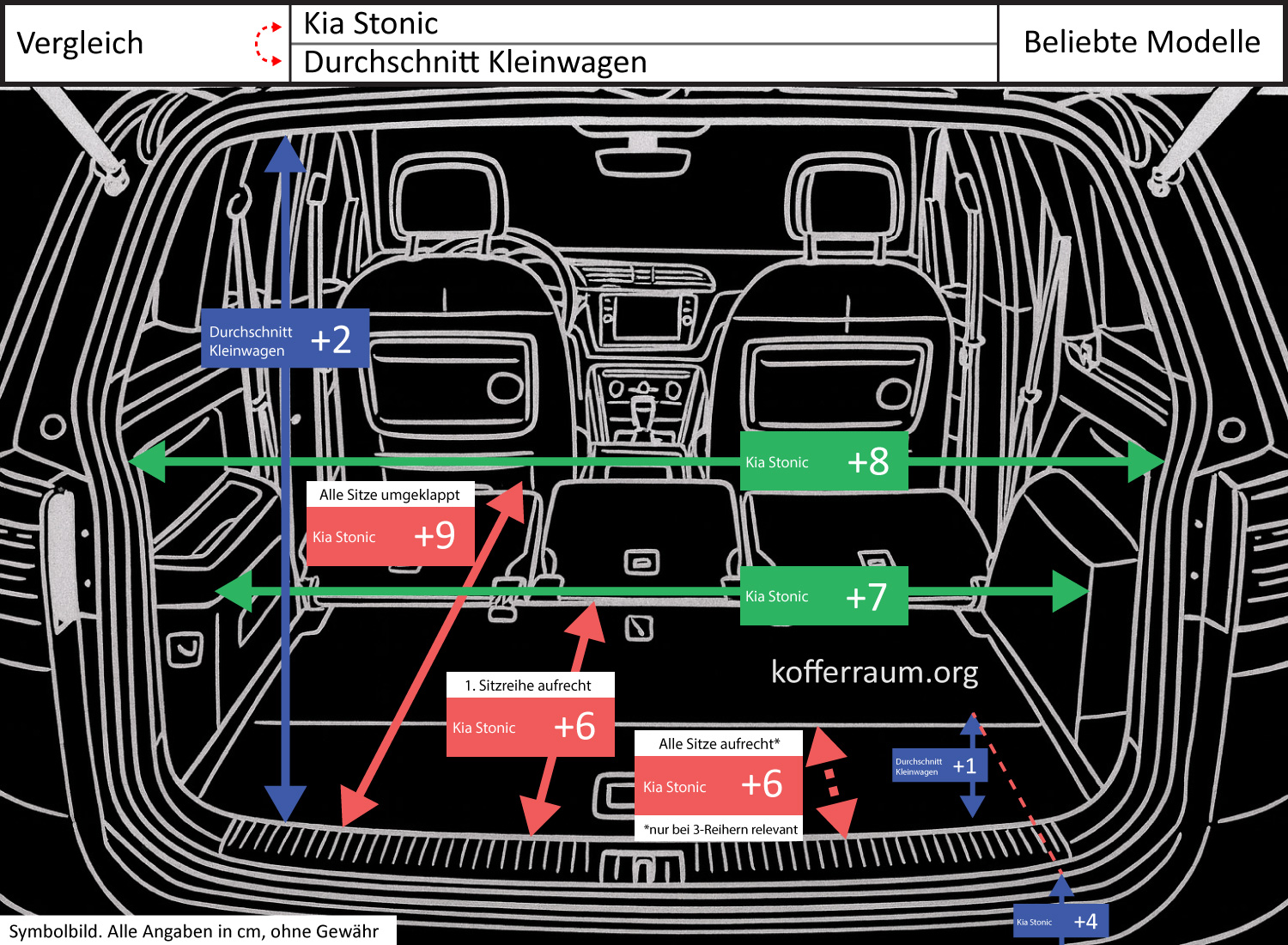
Summary of Differences
No measured difference exceeds the >10% threshold, so there are no explicitly highlighted values based on this criterion.
The most notable deviations are: longer trunk with folded seats (+3.5 in / +7%), longer trunk with upright first row seats (+2.4 in / +10% — exactly 10%), larger narrowest width in the trunk (+2.8 in / +7%), and wider trunk opening (+3.1 in / +9%).
Conversely, the trunk opening of the average car is +0.8 in (3%) higher, the depth from the loading edge to the trunk floor is +0.4 in (6%) greater, and the loading edge of the Kia Stonic is +1.6 in (5%) higher above the ground.
Impact on Usability
The longer cargo floor of the Kia Stonic with folded seats (+3.5 in) and with upright first row seats (+2.4 in / exactly 10%) makes it more practical for longer items such as furniture boards, skis, or longer boxes — such items are easier to store or lay crosswise.
The larger narrowest width (+2.8 in) and the wider trunk opening (+3.1 in) facilitate loading wider or irregularly shaped items; bulky parts are more likely to fit without complicated angled maneuvers.
On the other hand, the loading edge that is +1.6 in higher makes lifting heavy loads into the Stonic somewhat more difficult compared to the average — this is noticeable when frequently transporting heavy items.
The slightly lower opening height (-0.8 in) and somewhat smaller depth (-0.4 in) are hardly noticeable in most everyday situations but can become tight when transporting very tall loads (e.g., stacked crates) or when inserting long parts.
Conclusion: The Kia Stonic offers advantages when loading longer and wider items; for heavy lifting or very tall loads, the average subcompact has slight advantages.
For shopping, luggage, and occasional furniture transport, the Stonic is often more practical; for frequent handling of heavy, tall loads, the somewhat lower loading edge and higher opening of the average car are more comfortable.