
Trunk comparison: Kia Stonic vs Peugeot 208
Summary of the main differences
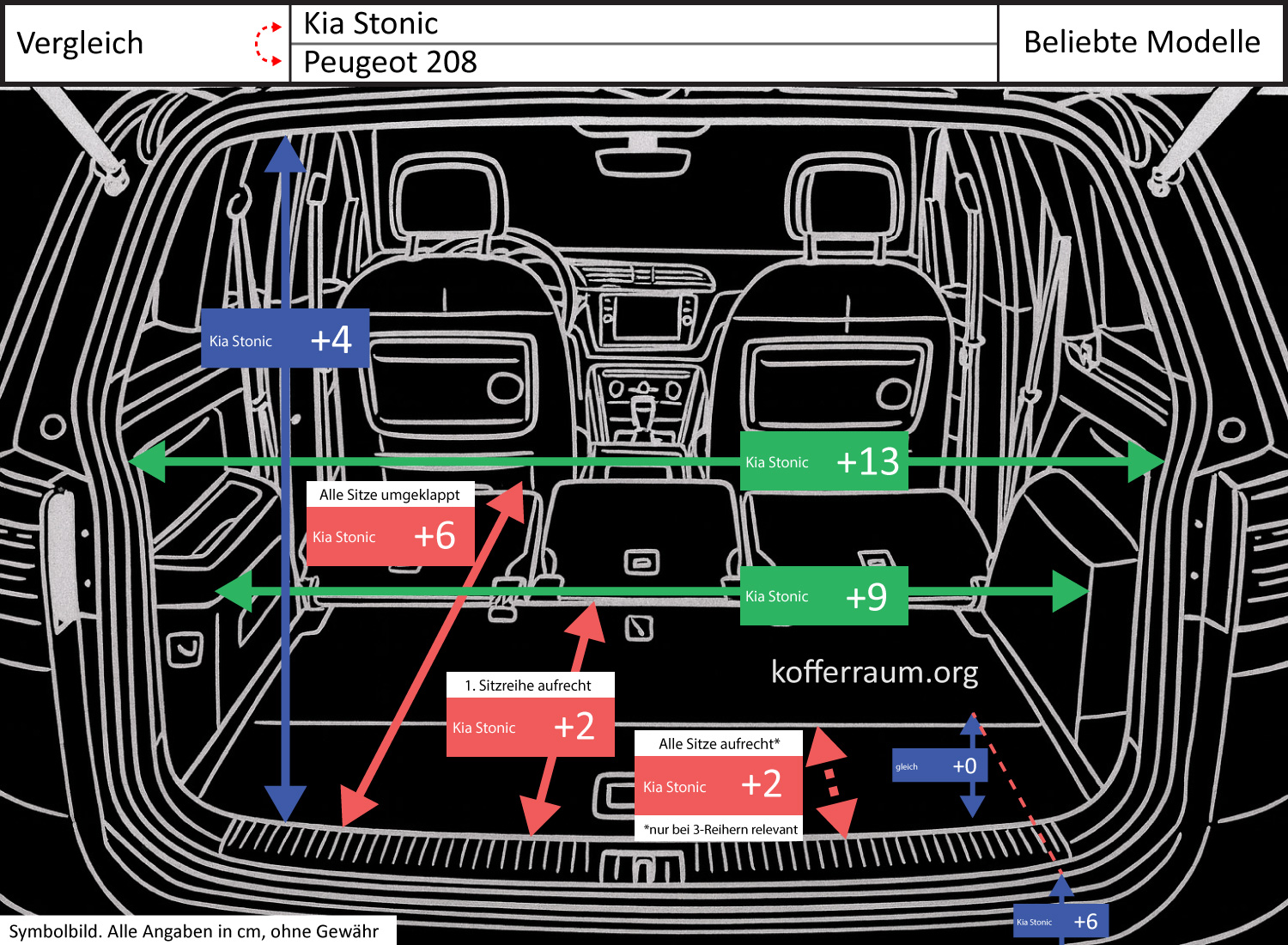
The most noticeable difference is the width of the trunk opening: in the Kia Stonic, it is 5.1 in (≈15%) larger than in the Peugeot 208. Other differences (below the 10% mark) are: with the rear seats folded down, the Stonic's trunk is 2.4 in (≈5%) longer, with the first row of seats upright it is 0.8 in (≈3%) longer, the height of the trunk opening is +1.6 in (≈5%) in favor of the Stonic, the loading edge is +2.4 in (≈8%) higher in the Stonic, the narrowest width in the trunk is +3.5 in (≈9%) larger, and the depth (loading edge to trunk floor) is the same in both.
Impact on usability
The 15% larger trunk opening of the Kia Stonic is a clear practical advantage: bulky or wide items can be loaded more easily, loading and unloading furniture, strollers, or large boxes becomes noticeably simpler.
This larger opening reduces the space needed for maneuvering and lowers the risk of hitting parts on the tailgate or bumper.
The longer dimensions of the Stonic (each +5% and +3%, respectively) increase the usable volume slightly but are minor and have less impact on everyday practicality.
The 9% larger narrowest width in the Stonic can help when transporting somewhat wider but not extremely bulky loads, but it is just below the significant threshold.
On the other hand, the higher loading edge of the Stonic (+2.4 in, ≈8%) can make lifting heavy items during loading more difficult. The same applies to the slightly greater opening height (+1.6 in), which facilitates handling tall cargo.
Overall, this means: the Kia Stonic offers better comfort when loading large or wide items due to the significantly wider opening, while the higher loading edge makes lifting somewhat more strenuous.
The Peugeot 208 may be more practical in tight, low-profile loading spaces due to the lower loading edge and more compact dimensions but offers less freedom for wide goods.