
Trunk comparison: Kia Stonic vs VW T-Cross
Key Differences
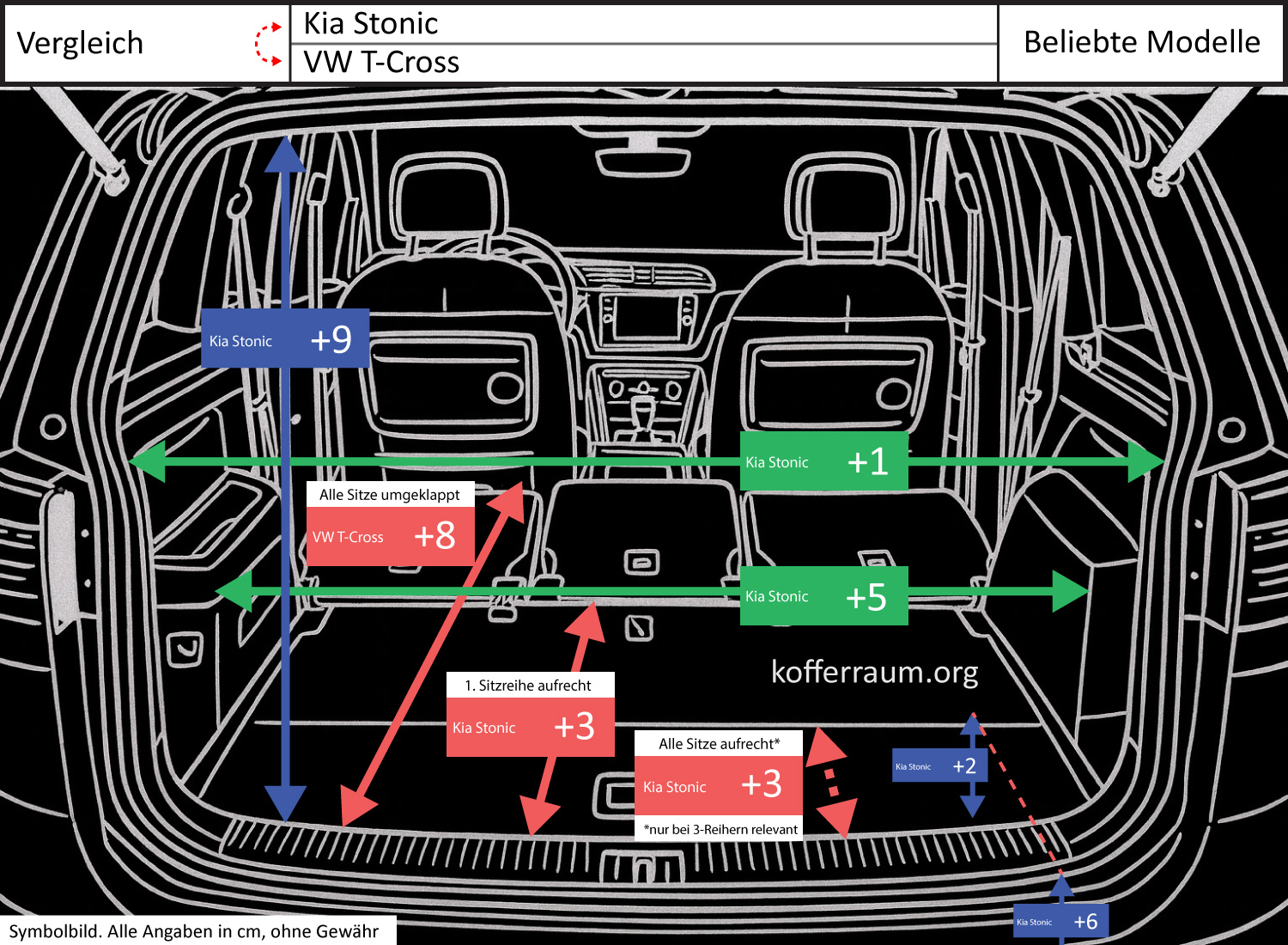
In short: The Kia Stonic offers better vertical and targeted interior dimensions in several areas, while the VW T‑Cross leads in overall length with the seats folded down.
Two differences over 10% stand out: the trunk opening of the Stonic is +3.5 in (13%) higher and the depth of the trunk (loading edge to trunk floor) is +0.8 in (13%) greater in the Stonic.
Other, smaller differences: the T‑Cross has +3.1 in (6%) more loading length with folded seats, the Stonic has +1.2 in (5%) more cargo space with the rear seat upright, the loading edge of the Stonic is +2.4 in (8%) higher, the narrowest width in the trunk is +2 in (5%) greater in the Stonic, and the opening width is +0.4 in (1%) larger.
Impact on Usability
The significantly larger opening height and greater depth in the Stonic improve handling of tall or bulky items: boxes, suitcases, or bulky furniture pieces can be stood upright more easily or loaded without strong tilting.
More depth also means more usable volume behind the loading edge, which facilitates stacking and storing awkward parts.
The T‑Cross wins in usable length with folded seats. This makes it more favorable for long, flat items like slats, skis, or long furniture parts, where loading length is more important than height.
A disadvantage of the Stonic is the higher loading edge (+2.4 in): heavier items require more effort to lift over the threshold, which can make loading and unloading more difficult. The T‑Cross, with its lower loading edge, is more practical when handling heavy loads.
Conclusion: For frequent transport of tall or bulky cargo, the Kia Stonic is better suited due to the higher opening and greater depth. For long items and easier lifting of heavy loads, the VW T‑Cross is the more practical choice.