
Trunk comparison: Mazda Mazda CX-60 vs Durchschnitt Subcompact


Key Differences (Summary)
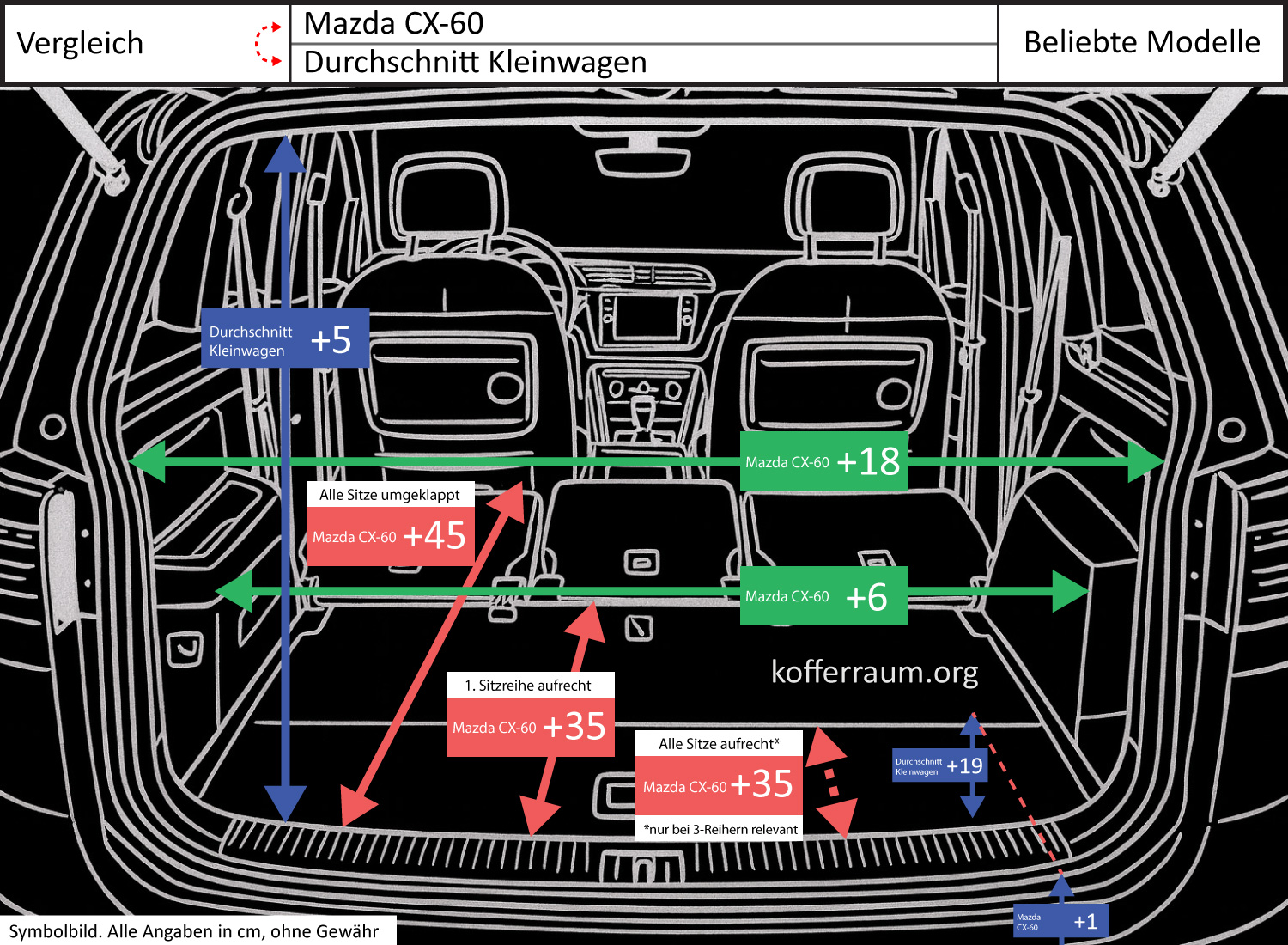
The Mazda CX-60 offers significantly more cargo length: with the seats folded down, the trunk is 17.7 in (35%) longer and with the first row upright, 13.8 in (56%) longer than the average subcompact.
Additionally, the width of the trunk opening on the CX-60 is 7.1 in (20%) larger, making it easier to load wider items.
Conversely, the average subcompact has a significantly greater depth between the loading edge and trunk floor (+7.5 in / 1800%) — meaning the loading edge→floor distance is much larger than on the CX-60.
What does this mean for usability?
The greater cargo length of the CX-60 specifically means: longer items (e.g., slats, skis, long boxes, or furniture parts) can be transported more easily, even when seats are partially or fully in use. For drivers who regularly carry bulky or long cargo, the CX-60 clearly offers advantages over a typical subcompact.
The wider trunk opening on the CX-60 facilitates loading and unloading wider luggage, strollers, or flat furniture; bulky items need to be rotated or angled diagonally less often, reducing loading time and effort.
The significantly greater depth in the average subcompact (distance from loading edge to trunk floor) means more "space below" the loading edge: this can help when storing lower, stackable items and provide more protected storage space.
At the same time, a larger distance over the loading edge can make lifting very heavy items more difficult because they must be lifted higher over the edge. The CX-60 has less depth here, which makes lifting short heavy loads over the loading edge easier but can reduce usable depth for very flat, stacked cargo.
Smaller differences (under 10%) such as the slightly higher trunk opening of the subcompact (+2 in / 7%) or the 2.4 in wider narrowest point on the CX-60 (6%) are usually less relevant in practice but can be noticeable in individual cases when loading very tall objects or very narrow cargo.