
Trunk comparison: Mazda Mazda CX-60 vs Durchschnitt Compact SUV


Key Differences and Impact on Usability
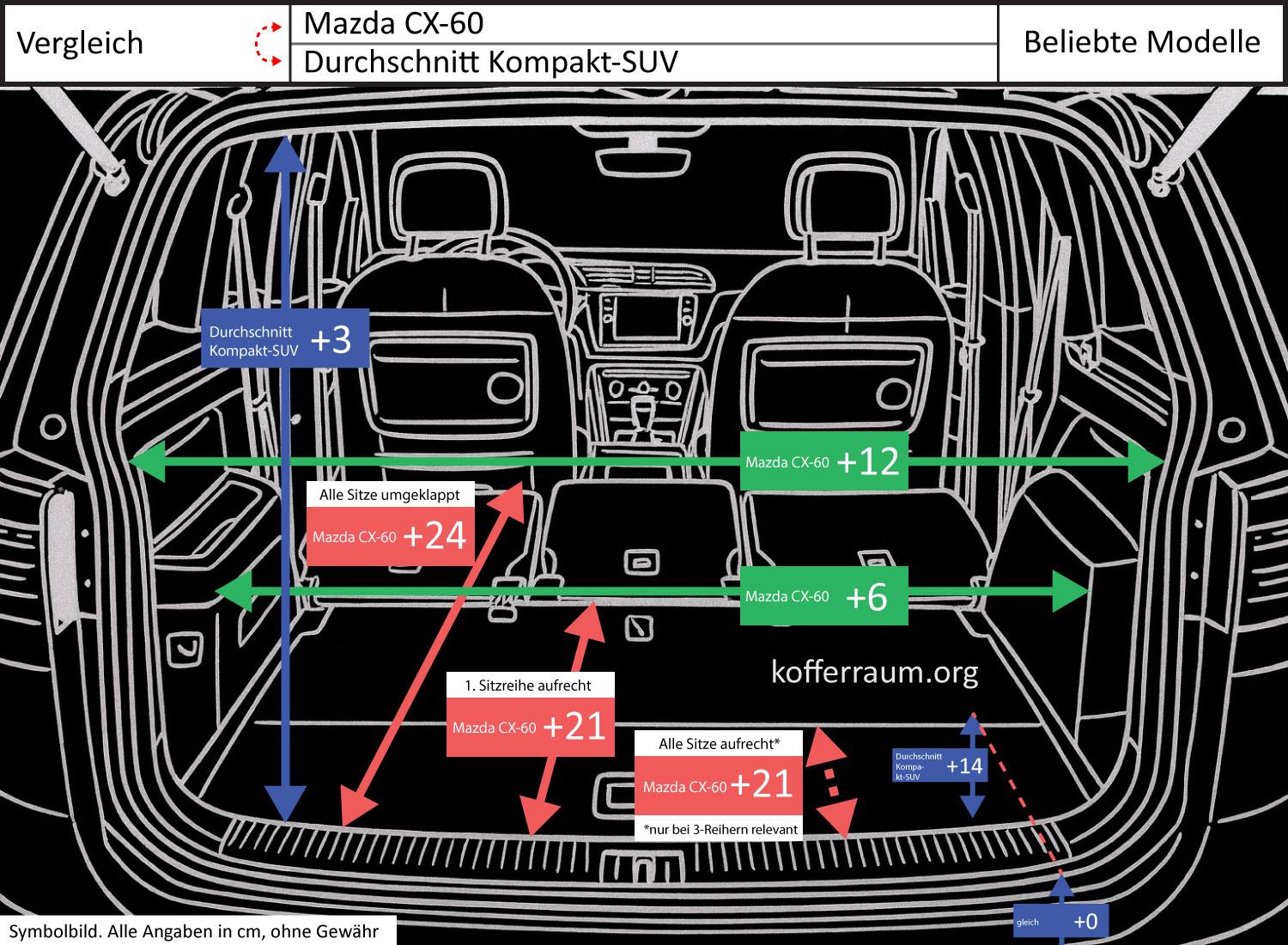
The Mazda CX-60 offers significantly more cargo length compared to the average compact SUVs: +9.4 in (16%) when all seats are folded down and +8.3 in (27%) with the first row upright.
Practically, this means the CX-60 can accommodate longer items (e.g., slats, skis, long furniture parts) more easily and is overall more flexible when transporting bulky, elongated cargo.
The width of the trunk opening is +4.7 in (12%) larger on the Mazda than the average, which simplifies loading wider items — less maneuvering, larger objects fit more easily through the opening.
A major difference favoring the average concerns the depth between the loading edge and the trunk floor: the average has +5.5 in (1300%) more here.
Practical consequence: the average offers significantly more volume near the floor and more space for taller or bulky items directly behind the loading edge. The Mazda has considerably less depth here, which can limit storing tall or very bulky items at floor level.
Smaller differences with less impact: the height of the trunk opening is only 1.2 in (4%) larger on the average, and the narrowest width of the trunk is 2.4 in (6%) larger on the Mazda — both minor advantages. The loading edge height is the same on both models, so the effort required to lift cargo is comparable.
In summary: For transporting long and wide items, the Mazda CX-60 is more advantageous in everyday use. Those who frequently transport tall or very bulky cargo near the loading edge will benefit more from the average compact SUV with its significantly greater depth between the loading edge and trunk floor.