
Trunk comparison: Mazda Mazda CX-60 vs Opel Grandland


Differences in the Trunk
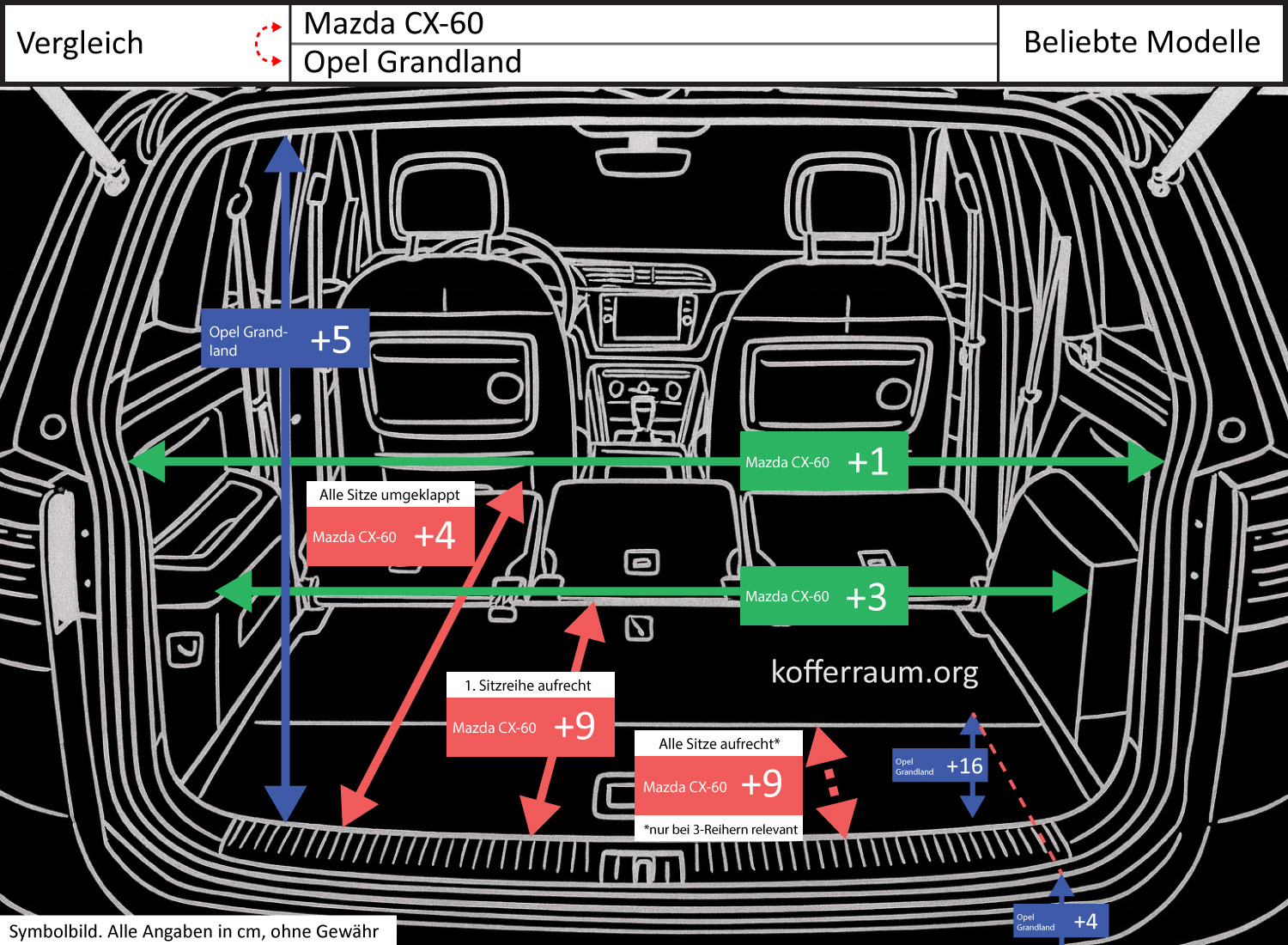
The most notable difference lies in the depth of the trunk (loading edge to trunk floor): the Opel Grandland is +6.3 in (+1500%) larger here than the Mazda CX‑60.
The Grandland offers significantly more vertical space and is therefore better suited for tall or stacked items, large boxes, or bulky cargo that relies less on length but more on height. The higher trunk opening of the Grandland (+2 in / +7%) additionally makes it easier to load tall items, but together with the higher loading edge (+1.6 in / +5%) increases the effort required to lift heavy loads. The Mazda CX‑60 has advantages in loading length: with the seats folded down, the difference is only +1.6 in (2%) in favor of the Mazda, and with the first row of seats upright, the advantage is +3.5 in (10%) in favor of the Mazda (this value is exactly 10%). Additionally, the narrowest point in the Mazda's trunk is +1.2 in (3%) wider, and the width of the trunk opening is +0.4 in (1%) larger. These smaller differences make the CX‑60 overall better for long, slender items or when usable loading length and a somewhat more consistent width matter. The lower loading edge of the Mazda also makes lifting heavy loads easier in everyday use.
Consequences for Usability
For users who frequently transport tall or bulky cargo (boxes, stacked suitcases, tall furniture parts), the Opel Grandland is clearly advantageous due to the significantly greater depth. For transports where length and narrow, straight cargo are important (skis, long moldings, bulky, flat items), or when heavy loads often need to be lifted, the Mazda CX‑60 is more practical thanks to the longer loading floor in certain configurations, the somewhat lower loading edge, and the slightly larger narrow width. In short: Opel Grandland scores with volume in height and storing tall/bulky items; Mazda CX‑60 is more advantageous for longer, slimmer cargo and ergonomic lifting of heavy loads.