
Trunk comparison: Mazda Mazda CX-60 vs Renault Austral


Key Differences
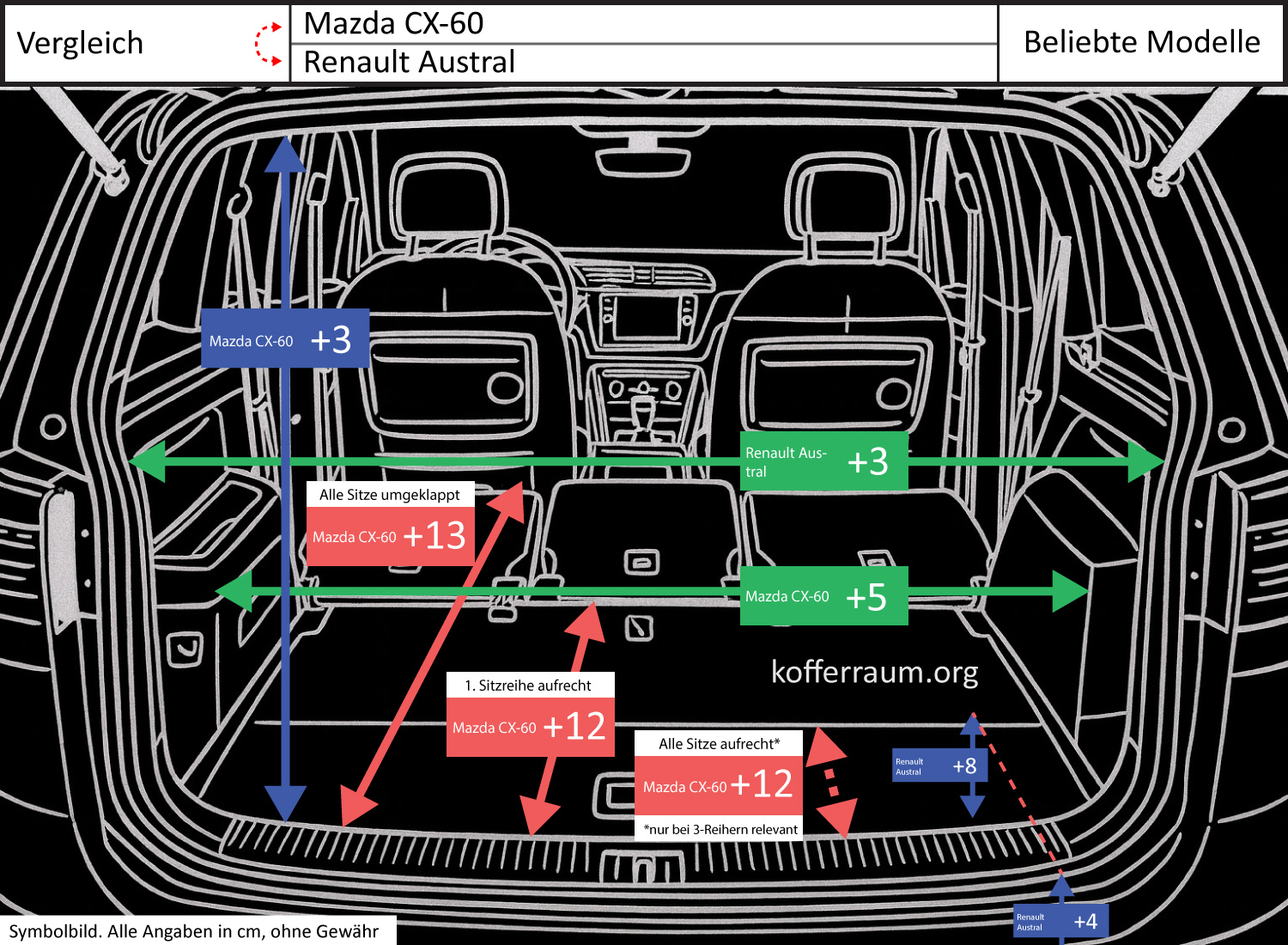
Both models mainly differ in usable loading length and vertical depth. With the first row of seats upright, the Mazda CX‑60 offers a significantly longer cargo space (+4.7 in / +14%), which better accommodates longer items. The depth of the trunk (distance from loading edge to trunk floor) is significantly greater in the Renault Austral (+3.1 in / +700%), providing more vertical space between the loading edge and floor in the Austral.
The other differences are smaller: Mazda has a 5.1 in longer cargo space with folded seats (+8%), a trunk opening that is 1.2 in higher, and at the narrowest point a width that is 2 in larger; the Austral has a 1.2 in wider opening and a loading edge that is 1.6 in higher above the road.
Implications for Usability
The >10% deviations have the greatest impact on everyday usability. The longer loading floor of the Mazda with upright seats makes it more practical for long, flat items (e.g., slats, skis, long boxes) without needing to fold down seats.
The significantly greater depth in the Renault, on the other hand, creates more space below the loading edge — useful for tall cargo or when items need to be recessed deeply (good for crates, toolboxes, or luggage that does not extend above the loading edge).
When loading and unloading, the slightly higher loading edge of the Austral (≈+1.6 in) plays a role: heavy cargo is easier to lift in the Mazda, while the Austral benefits from the larger depth volume but requires a bit more effort when lifting.
Smaller differences in opening width and narrowest width mean that wide items tend to fit more easily through the opening in the Austral, while the Mazda offers slightly more space inside at the narrowest point.
In summary: Mazda favors elongated cargo in everyday situations with upright seats and easier loading and unloading; Renault offers more vertical storage space below the loading edge, which is advantageous for tall or deeply stored cargo.