
Trunk comparison: Mazda Mazda CX-60 vs Renault Clio


Key Differences
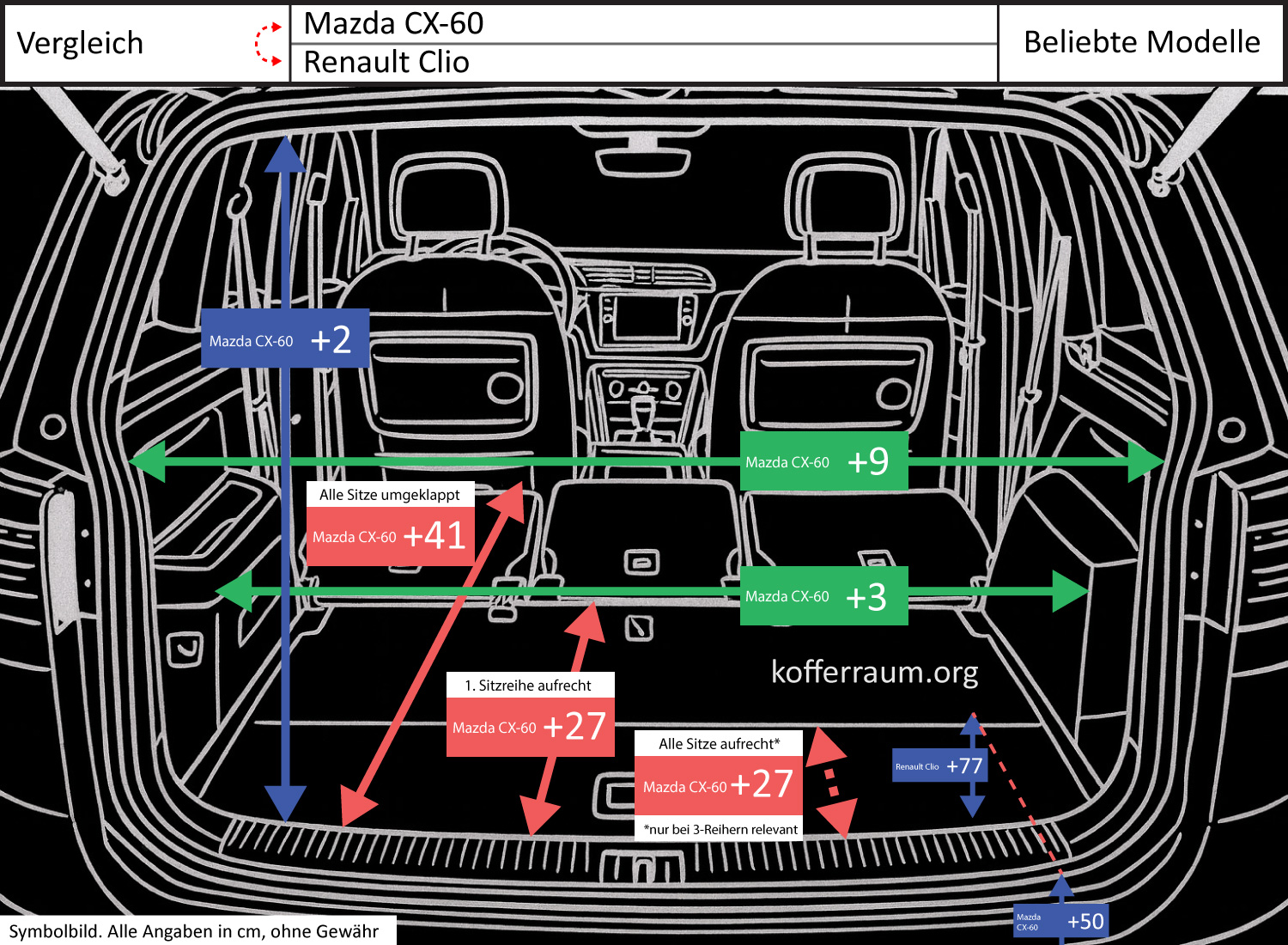
The Mazda CX‑60 offers significantly more cargo length: +16.1 in (31%) with seats folded down and +10.6 in (38%) with the first row upright. The loading edge of the Mazda sits considerably higher above the road: +19.7 in (208%).
Conversely, the Renault Clio has a much greater depth between the loading edge and the trunk floor: +30.3 in (7600%). All other stated values (opening height +0.8 in/3%, narrowest width +1.2 in/3%, opening width +3.5 in/9%) are under 10% and thus comparatively marginal.
Impact on Usability
Longer cargo volume in the Mazda: The significantly longer cargo area (both with folded seats and upright rear bench) makes the CX‑60 more practical for long items (e.g., skis, furniture parts, long boxes) and luggage on trips.
For buyers who regularly need to transport longer or bulky items, the Mazda is clearly advantageous.
Higher loading edge in the Mazda: The considerably higher loading edge means heavy cargo must be lifted into the CX‑60 — this complicates frequent loading/unloading of heavy items and is less comfortable with less body strain.
For users who often load heavy loads frequently, the Clio is more favorable due to the lower loading edge.
Deeper trunk well in the Clio: The large depth of the Clio’s trunk suggests a deeper cargo well. This can offer more usable vertical volume and allows items to be recessed deeper (better rear visibility, more stable load).
Combined with the lower loading edge, the Clio has an advantage for easy loading and unloading of heavy or bulky but not too long items.
Summary briefly: Mazda CX‑60 = better for long/bulky transport tasks. Renault Clio = more practical for easy, frequent loading and for items to be stored in a deeper cargo well. Small width and opening differences are secondary.