
Trunk comparison: Mazda Mazda CX-60 vs Tesla Model 3

Key Differences
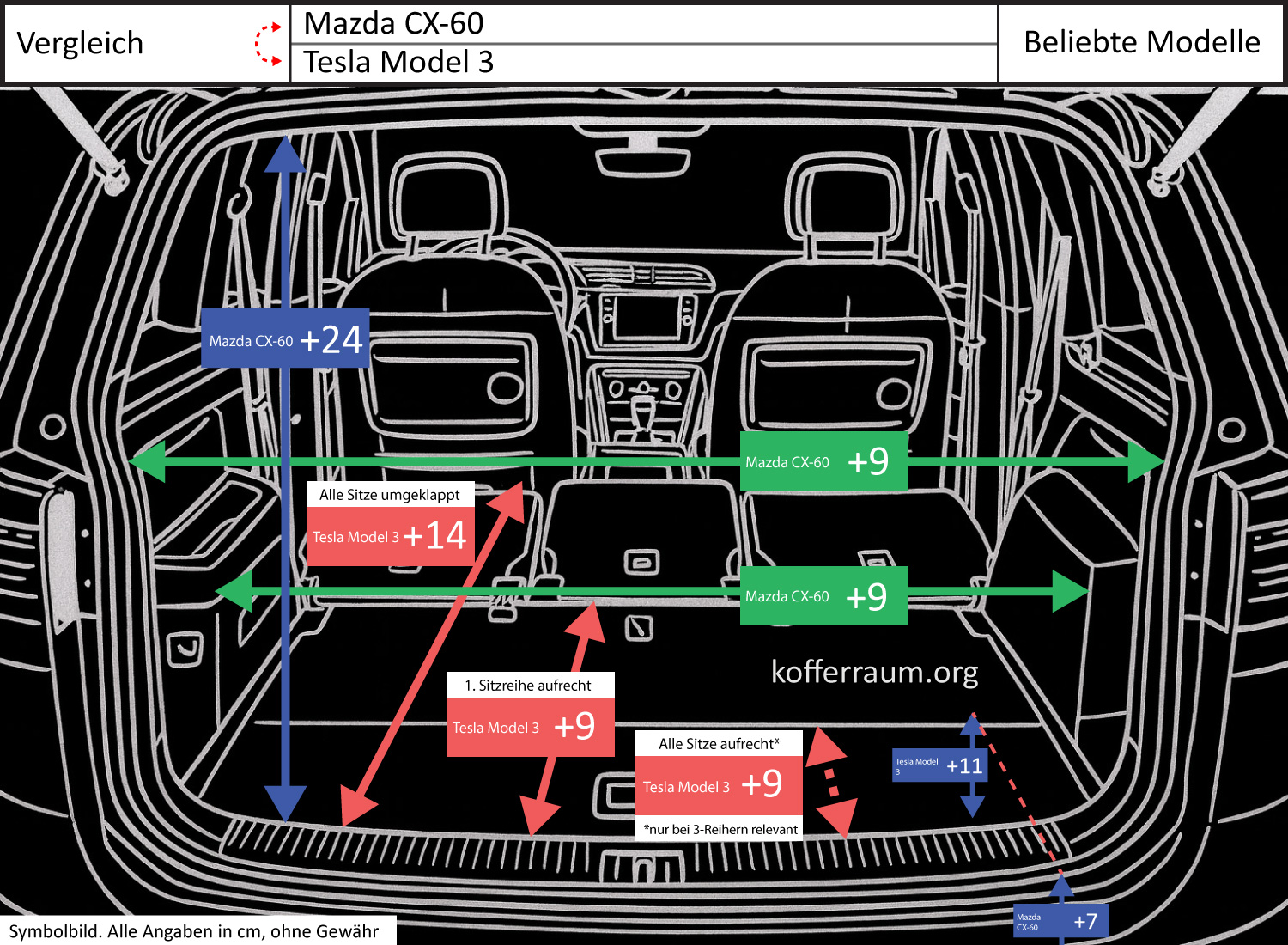
The Mazda CX-60 and the Tesla Model 3 mainly differ in the shape and accessibility of the trunk. The trunk opening of the Mazda CX-60 is 9.4 in (46%) higher than that of the Tesla Model 3, which means that larger/taller items can be loaded more easily and without much tilting through the opening. The depth of the trunk (loading edge to trunk floor) is 4.3 in (1000%) greater in the Tesla Model 3, indicating a significantly deeper loading floor behind the loading edge and more space in depth for flatter, long, or stackable cargo.
Besides these clear differences, the Tesla Model 3 also has a longer cargo area with the seats folded down (+5.5 in, 8%) and with the front row upright (+3.5 in, 9%), while the Mazda is about +3.5 in (9%) wider at the narrowest point and at the opening width.
The loading edge of the Mazda is about 2.8 in (10%) higher above the road than that of the Tesla.
Impact on Usability
Due to the higher trunk opening of the Mazda CX-60, tall, bulky items (e.g., boxes, furniture parts, plants) can be loaded upright more easily; less angle and less tilting are needed when inserting tall cargo.
The wider opening of the Mazda additionally supports loading wider items. However, the cargo sits flatter relative to the road (higher loading edge), which can make heavy lifting over the edge somewhat more strenuous.
The Tesla Model 3 offers more volume in depth due to the significantly deeper cargo area behind the loading edge: long or flat items can be loaded further in, and stacked cargo fits better below the window line.
The lower loading edge of the Tesla makes it easier to lift heavy items over the edge. However, due to the lower opening height, the Model 3 is less suitable for tall, bulky parts that cannot be loaded tilted or inclined; wide items may also be limited by the slightly narrower width.
In short: Mazda CX-60 = better for tall and wide, bulky cargo and convenient upright loading; Tesla Model 3 = better for deep, long, or flat cargo and easier lifting over the loading edge. Which advantages are more relevant depends on the typical cargo profile.