
Trunk comparison: Mazda Mazda CX-60 vs Volvo XC60


Key Differences (Summary)
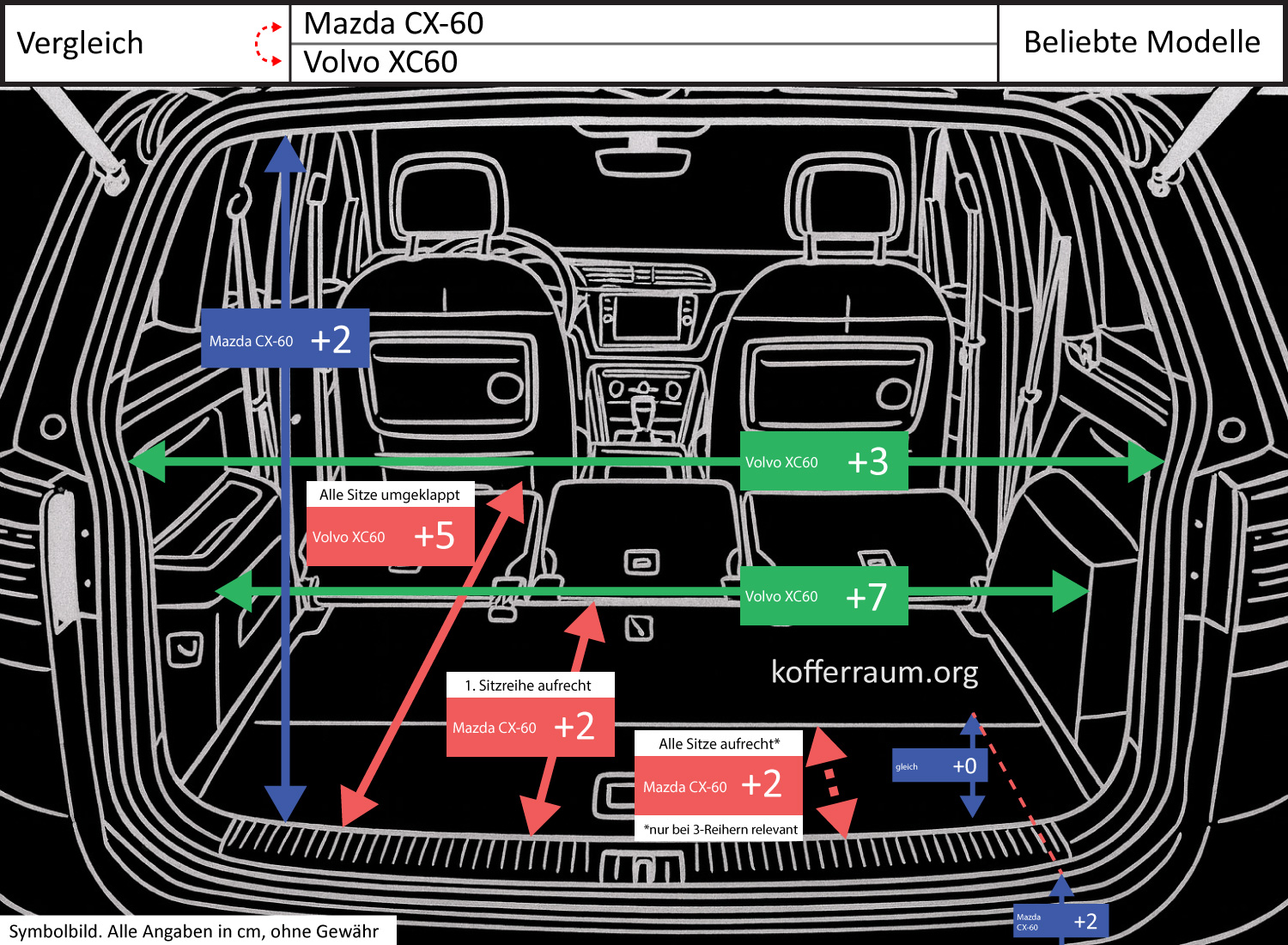
There are no differences greater than 10%. All deviations are in the range of 2–7% and are therefore rather minor. The most notable points are:
- Volvo XC60: Trunk with folded seats is 2 in (≈3%) longer than the Mazda.
- Mazda CX‑60: Trunk with upright first row of seats is 0.8 in (≈2%) longer than the Volvo.
- Mazda: Trunk opening height and loading edge are each 0.8 in (≈3%) higher than the Volvo.
- Volvo: narrowest trunk width is 2.8 in (≈7%) larger; width of the trunk opening is 1.2 in (≈3%) larger.
- Depth (loading edge to trunk floor) is the same for both.
Impact on Usability
Since no difference exceeds 10%, only minor practical differences arise:
- Loading height/opening (Mazda): The 0.8 in higher opening offers slightly more vertical clearance for tall items. However, the 0.8 in higher loading edge also means slightly more lift when loading heavy items. In practice, neutral to slightly noticeable with very tall or heavy loads.
- Length with folded seats (Volvo): +2 in length helps accommodate very long items (e.g., long boxes, individual furniture parts) somewhat better. For most everyday items, the advantage remains marginal.
- Width (Volvo): With up to 2.8 in more width at the narrowest point, wider cargo can be placed more easily sideways (e.g., strollers, wide boxes). This is the clearest advantage in favor of Volvo, but remains moderate.
- Everyday usability: For groceries, suitcases, and typical leisure cargo, the differences are negligible.
Those who regularly transport very wide or significantly longer items benefit more from the Volvo; those who occasionally have tall items and appreciate a bit more opening height have a small advantage with the Mazda.
Conclusion
Both models offer very similar loading functionality. There are no significant (>10%) differences, so the decision should not be based solely on these trunk dimensions but also consider other criteria (seat comfort, versatility, fuel consumption, price).