
Trunk comparison: Mazda Mazda CX-60 vs VW ID.3
Key Differences
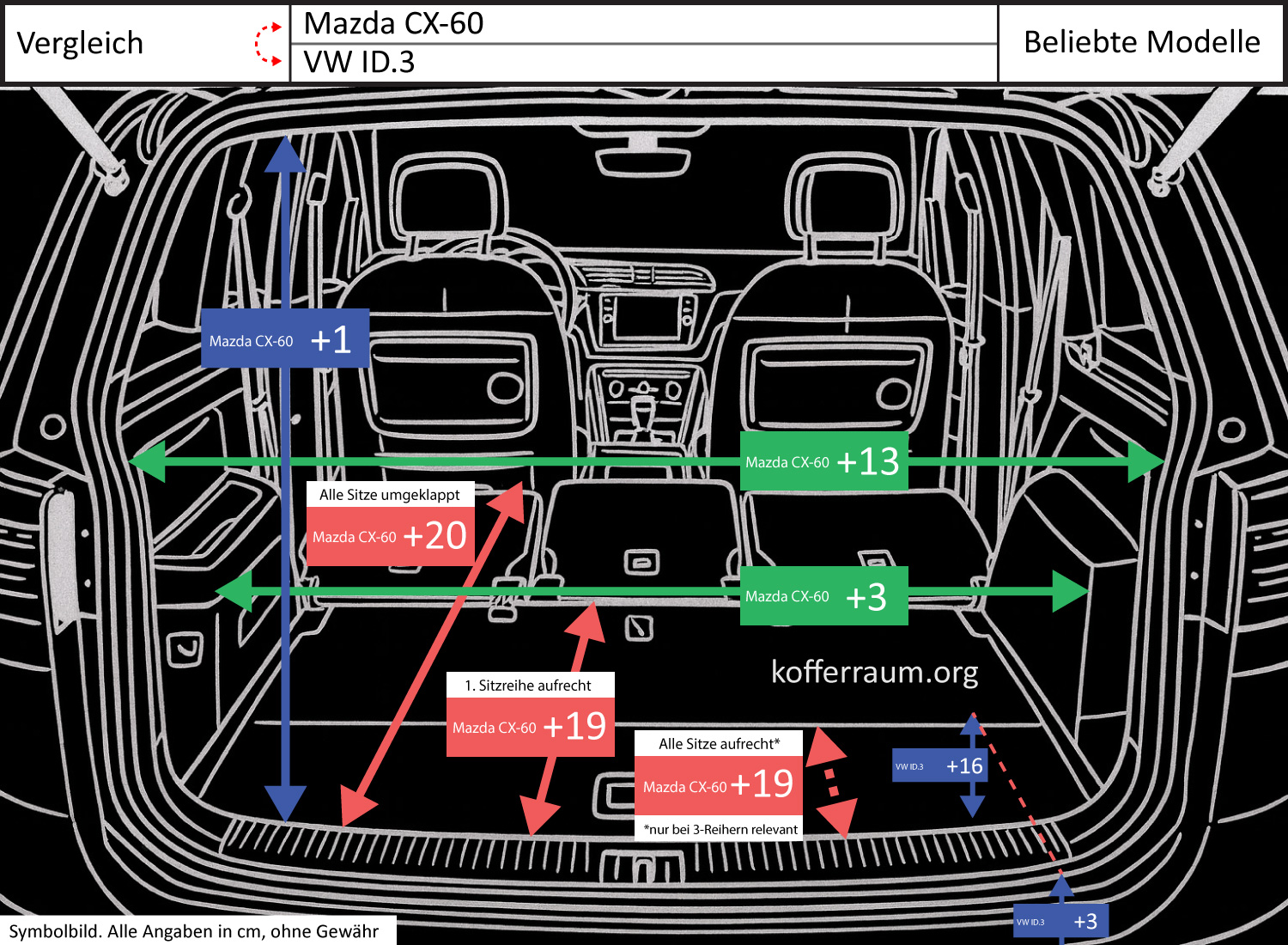
Regarding the relevant dimensions, it is noticeable that the Mazda CX‑60 offers a significantly longer cargo space: with the seats folded down, the Mazda is 7.9 in (≈13%) longer, and with the first row of seats upright, it is even 7.5 in (≈24%) longer than the VW ID.3. The width of the trunk opening on the Mazda is 5.1 in (≈14%) larger, which makes loading wider items easier.
On the other hand, the VW ID.3 has a significantly deeper cargo well: the depth from the loading edge to the trunk floor is 6.3 in (≈1500%) greater on the ID.3 than on the Mazda.
Smaller differences (≤10%) such as the height of the opening (+0.4 in), the loading edge height (+1.2 in), and the narrowest width (+1.2 in) are negligible.
Impact on Practical Usability
For users who frequently transport long or bulky items (e.g., slats, boards, skis, long boxes), the Mazda CX‑60 clearly has the advantage due to the greater interior length both with folded seats and with the first row upright.
The wider opening makes loading and unloading wider cargo easier and protects edges and bumpers. Additionally, the Mazda’s comparatively flatter cargo floor results in a more practical, more accessible cargo volume for large, flat objects.
The VW ID.3 scores with its significantly deeper cargo well. This offers advantages when securing loose or smaller items that can settle into the cargo recess and shift less.
The deeper cargo floor can also provide more vertical containment but negatively affects loading and unloading bulky items because they must be lifted or set down higher. For frequent transport of very long items, the ID.3 is less suitable due to the shorter loading length and narrower opening.
In summary: Those who often transport long or wide cargo benefit more from the Mazda CX‑60. Those who prefer smaller, irregular, or frequently secured cargo in a deep cargo well find a practical advantage in the VW ID.3.