
Trunk comparison: Mazda Mazda CX-60 vs VW Polo

Key Differences
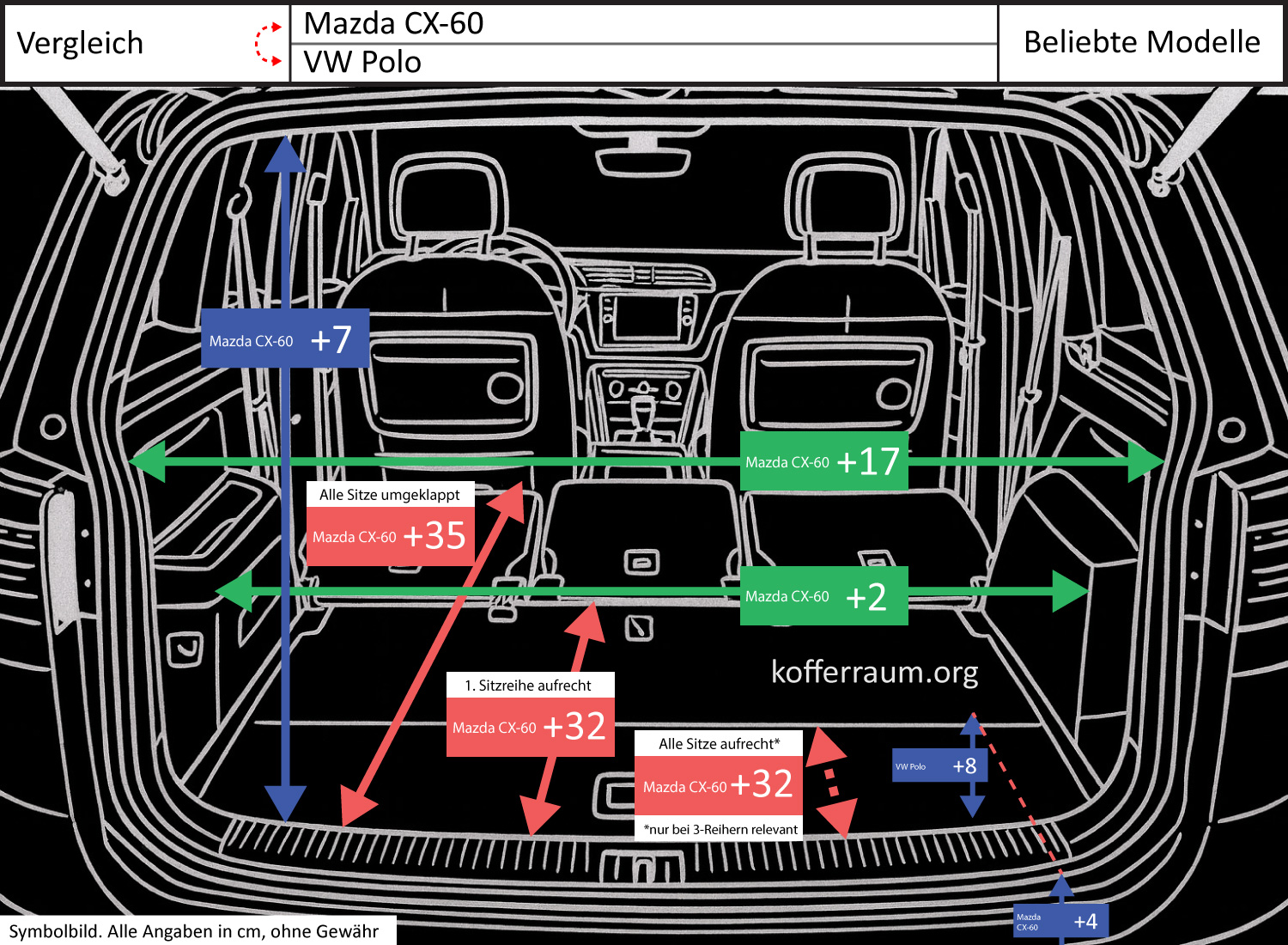
The Mazda CX‑60 offers significantly more loading length: with the seats folded down, the trunk is +13.8 in (≈+25%) longer, and with the first row of seats upright, even +12.6 in (≈+48%) longer compared to the VW Polo.
The opening of the Mazda is also wider: the width of the trunk opening is +6.7 in (≈+18%) greater than that of the Polo. Notably, the depth (loading edge → trunk floor) is where the VW Polo has a +3.1 in (≈+700%) larger value than the Mazda.
Impact on Usability
Due to the significantly greater loading length, the Mazda CX‑60 is better suited for long items (e.g., slats, skis, long boxes) and larger amounts of luggage, both with folded seats and in normal operation.
The wider trunk opening makes loading and unloading bulky or wide items easier and reduces the risk of getting caught while stowing.
The strong difference in trunk depth favoring the VW Polo indicates a different cargo space geometry: a lower trunk floor relative to the loading edge can create more "vertical" space immediately behind the loading edge but is usually associated with a deeper view into the trunk or a stronger curvature of the floor.
This can help when storing smaller, bulky items but often makes lifting heavy loads less comfortable and can limit loading large, flat items.
Smaller differences such as the Mazda's 2.8 in higher opening height (+10%) and the 1.6 in higher loading edge (+6%) only moderately affect practical use: the higher opening can be slightly advantageous when passing very tall items, while the somewhat higher loading edge of the Mazda requires a bit more effort when lifting heavy loads.
Conclusion: For regular transport of long or wide cargo, the Mazda CX‑60 is the more practical choice. The VW Polo, with its greater depth, shows a different, partly advantageous interior layout for compact or lower loads but has significantly less length and a narrower opening for bulky items.