
Trunk comparison: Mazda Mazda CX-60 vs VW T-Roc

Main Differences
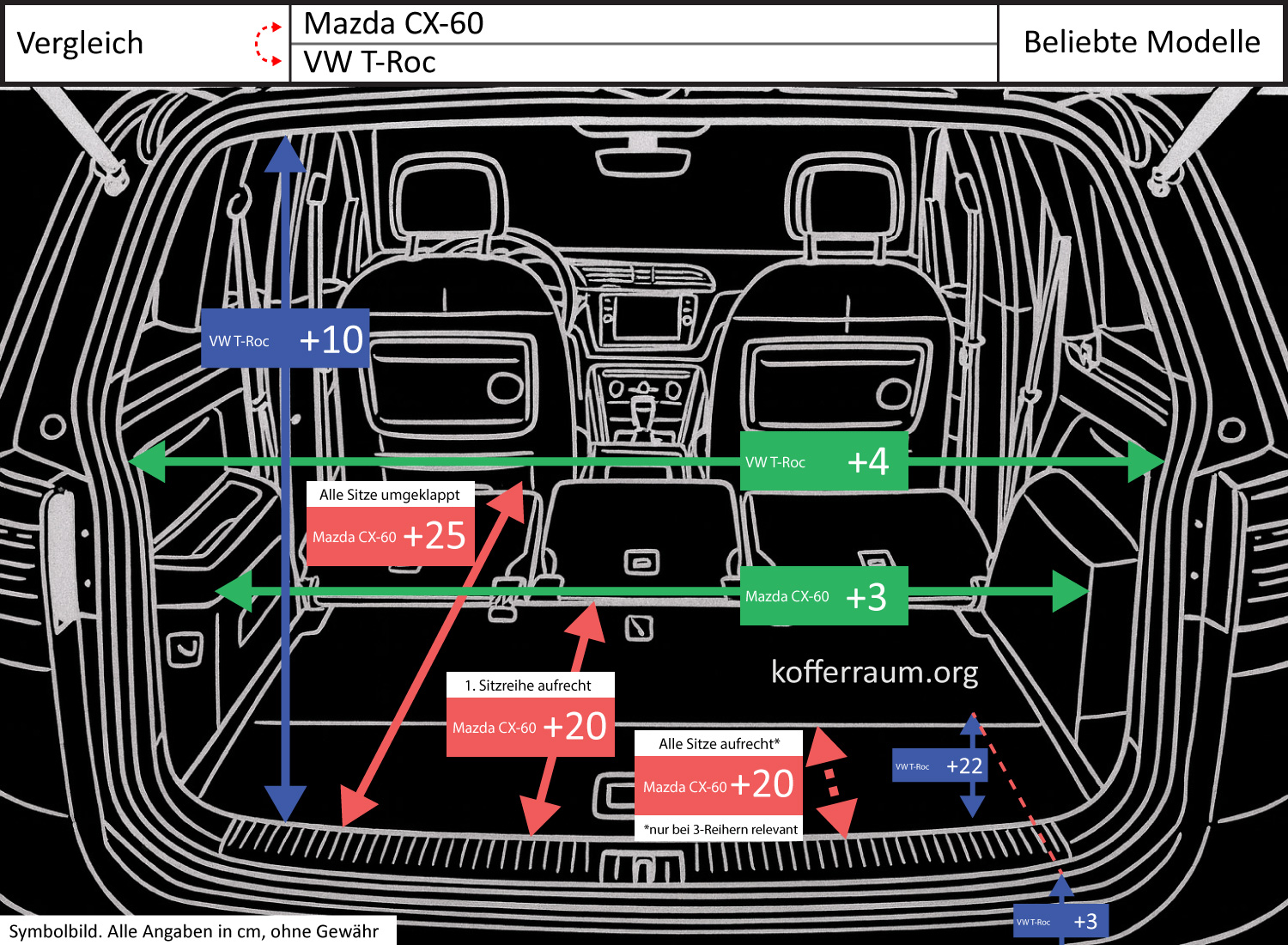
The Mazda CX‑60 offers a significantly longer loading length: with the seats folded down, it is +9.8 in (17%) longer, and with the first row of seats upright, it is even +7.9 in (26%) longer than the VW T‑Roc.
The VW T‑Roc has larger vertical dimensions: the height of the trunk opening is +3.9 in (13%) higher and the depth (loading edge to trunk floor) is significantly greater at +8.7 in (2100%).
Smaller differences under 10% concern the loading edge height (+1.2 in, 4% in favor of the T‑Roc), the narrowest trunk width (+1.2 in, 3% in favor of the CX‑60), and the width of the trunk opening (+1.6 in, 4% in favor of the T‑Roc).
Impact on Usability
The greater loading length of the Mazda makes it more practical for long items such as slats, furniture parts, skis, or long boxes — both with fully folded seats and in everyday use with the first row upright. Those who regularly transport long or flat cargo have a clear advantage with the CX‑60.
The VW T‑Roc scores with vertical volume: the higher trunk opening and significantly greater floor depth create more space for tall or bulky items and make vertical adjustment or stacking easier (e.g., crates, tall boxes, plants).
However, the greater floor depth and slightly raised loading edge mean that heavy items need to be lifted a bit higher — which can make loading physically more demanding.
In summary: Mazda CX‑60 is better for long, flat cargo and regular transport of elongated items; VW T‑Roc is better for tall or voluminous/vertical cargo, with slightly more effort required when lifting heavy loads. Smaller differences in width and loading edge height are usually negligible in practice.