
Trunk comparison: Mercedes Benz GLB vs Durchschnitt Compact SUV


Key Differences
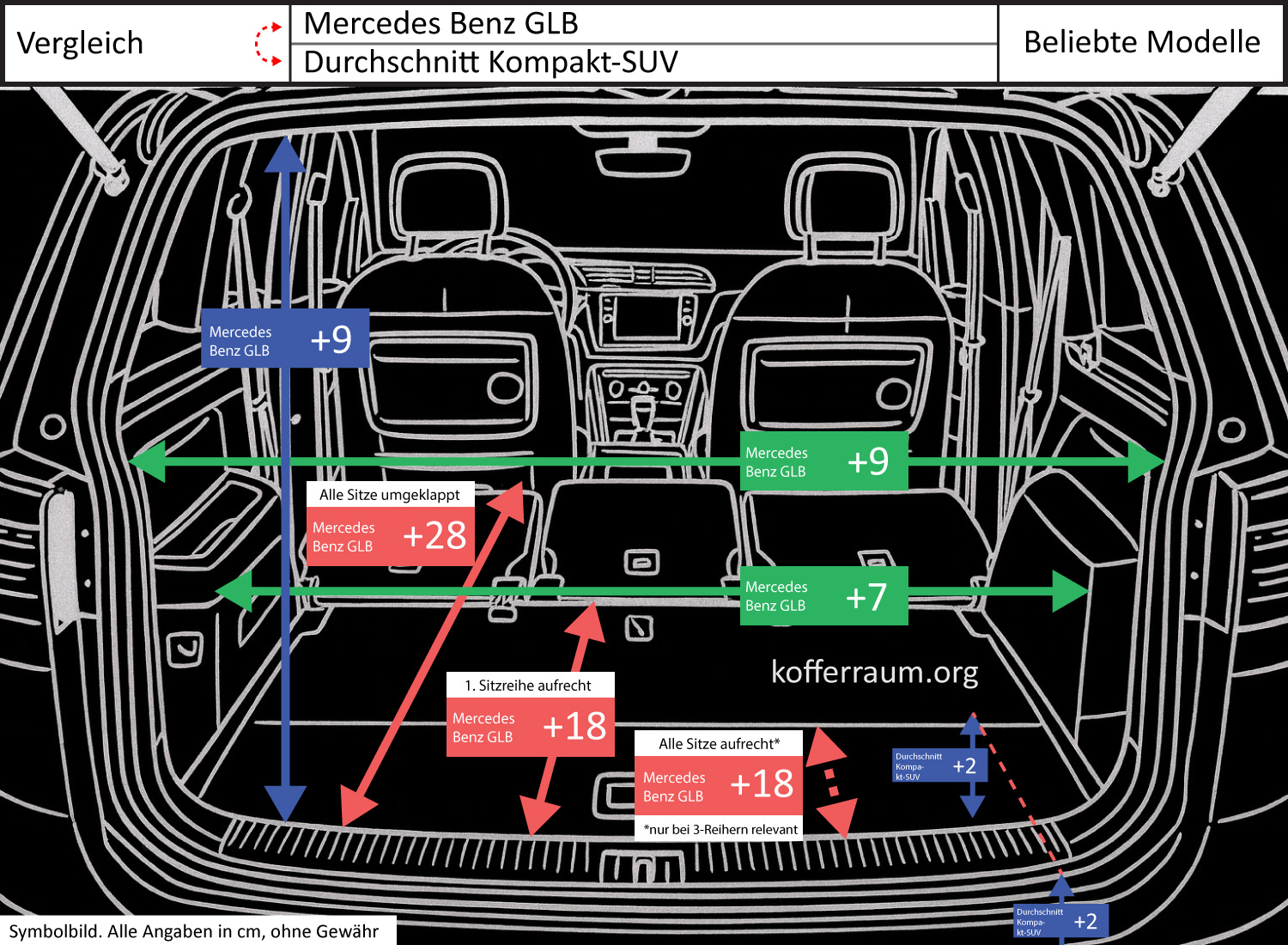
The Mercedes‑Benz GLB offers significantly more usable loading length: when all seats are folded down, the GLB is +11 in (19%) longer and when the first row is upright, +7.1 in (23%) longer than an average compact SUV.
The trunk opening of the GLB is +3.5 in (11%) higher, which makes loading tall or bulky items easier. In contrast, the trunk depth (loading edge to trunk floor) of the average SUV is +0.8 in (17%) greater than that of the GLB — here the GLB has a slight disadvantage.
Implications for Usability
More loading length (both with folded seats and with the first row upright) makes the GLB clearly more practical for long or flat cargo such as furniture parts, slats, skis, or several large suitcases. The higher trunk opening reduces tilting and maneuvering when loading tall items and facilitates loading bulky parts.
The greater depth in the average compact SUV means there is somewhat more vertical space directly behind the loading edge — this can be helpful when stacking very tall items near the loading edge or storing boxes with greater height.
However, this disadvantage is relatively small and is usually offset by the GLB’s larger longitudinal dimensions and higher opening.
Other dimensions (loading edge height above road, narrowest trunk width, width of the opening) differ only slightly (<10%) and have minimal practical impact: the GLB’s loading edge is slightly lower, which eases lifting, and the opening width is somewhat larger, which supports loading wider items sideways.
Conclusion: The GLB is the more practical choice when frequently transporting long or bulky loads; for very tall items stacked directly behind the loading edge, an average compact SUV offers minimally more depth.