
Trunk comparison: Mercedes Benz GLB vs Opel Grandland
Key Differences
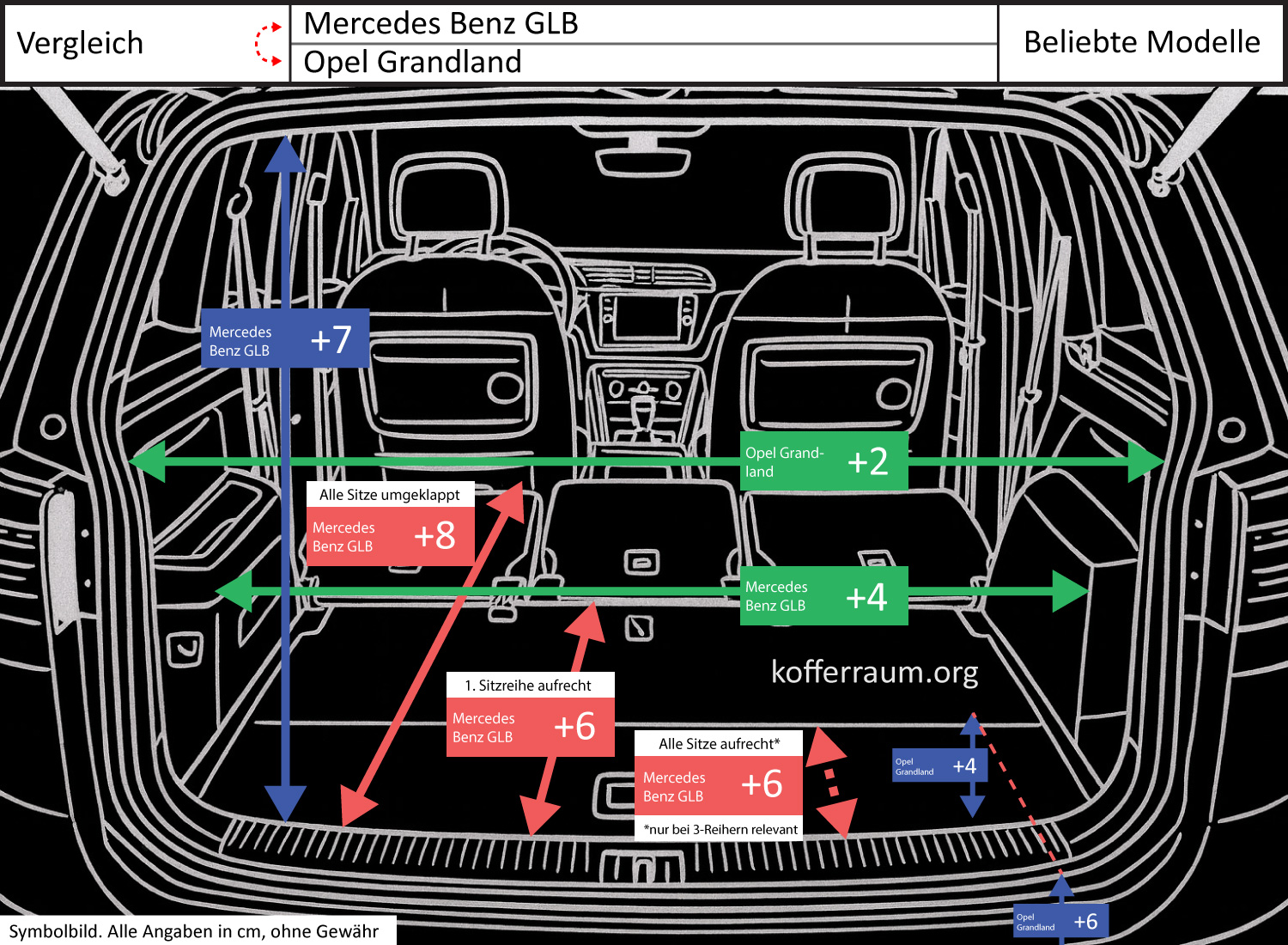
In the measured values, the Mercedes‑Benz GLB has slight advantages in length and width: with the seats folded down, its trunk is 3.1 in (5%) longer, and with the first row of seats upright, it is 2.4 in (7%) longer.
The trunk opening is 2.8 in (9%) higher on the GLB, and the narrowest trunk width is 1.6 in (4%) larger on the GLB. The width of the trunk opening is 0.8 in (2%) larger on the Opel Grandland, and the loading edge of the Grandland is 2.4 in (8%) higher above the road.
The most notable difference is the depth of the trunk: the depth (loading edge → trunk floor) is 1.6 in (33%) greater on the Opel Grandland.
Impact on Usability
The 33% greater trunk depth of the Opel practically means more "vertical space" in the cargo area below the loading edge: bulky or taller items can be recessed deeper, and loose cargo can be set lower, which overall allows for more usable space utilization.
This is especially advantageous when transporting stacked goods or when items inside the vehicle should protrude less into the passenger compartment.
At the same time, the Grandland has a loading edge 2.4 in higher above the road. Together with the deeper loading floor, loading heavy or bulky items can be more strenuous: higher lifting height when loading from the road and deeper reaching into the trunk.
The GLB, with slightly larger length dimensions and a higher trunk opening, generally offers easier loading of long or taller items and more comfortable access (lower loading edge, greater opening height). The slightly larger narrowest width also makes it somewhat more flexible for wide items.
Overall, the differences are moderate, except for the significantly larger trunk depth of the Grandland, which can strongly influence the choice if deeper usable cargo space is more important than easy accessibility when loading.