
Trunk comparison: Mercedes Benz GLB vs Tesla Model 3
Key Differences (>10%)
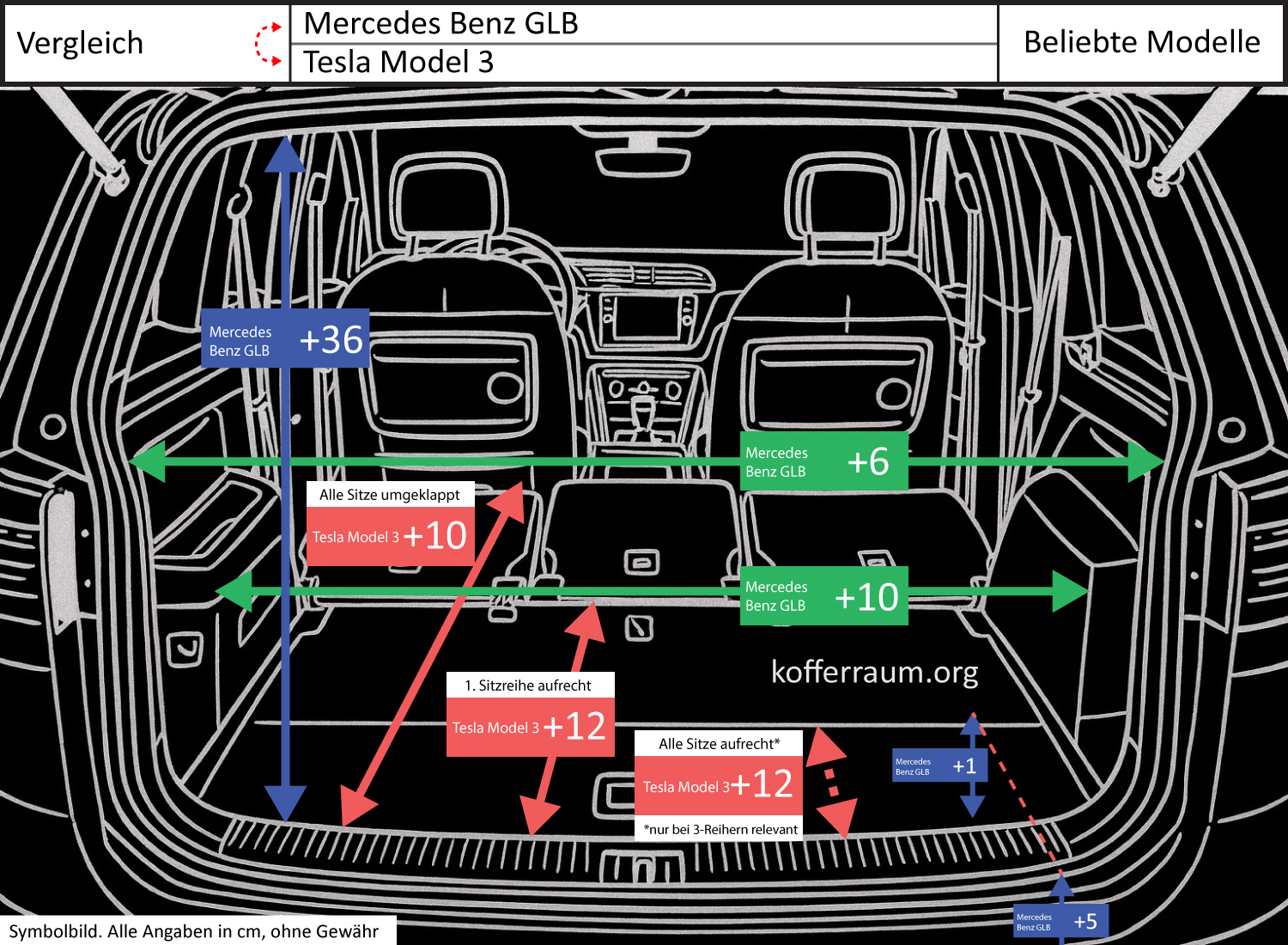
In the comparison, it is particularly noticeable that the Tesla Model 3 offers a cargo space that is 4.7 in (13%) longer with the front seats upright than the Mercedes-Benz GLB.
This makes the Model 3 more practical in everyday use when transporting long items while using the front seats (e.g., skis, long boxes, or furniture parts).
On the other hand, the GLB has a significantly higher trunk opening: +14.2 in (69%) compared to the Model 3. This means the GLB can accommodate much more in vertical direction — tall boxes, large plants, or bulky luggage can be loaded more easily without tilting or squeezing them at an angle.
Additionally, the narrowest point in the GLB's trunk is 3.9 in (11%) wider than in the Model 3. Wide or irregularly shaped cargo (e.g., strollers, wide boxes) can be loaded more easily in the GLB without needing to tilt or rotate the items.
Impact on Everyday Usability
In summary, a clear usage pattern emerges: The Model 3 is advantageous when transporting longer items without folding down the front seats. The GLB, on the other hand, is better suited for tall and wide cargo thanks to the significantly larger opening height and greater width at the narrowest point.
For frequent transport of bulky, tall, or wide goods, the GLB is more practical; for longer, flat objects with passengers onboard, the Model 3 remains the more practical choice.
Other Differences (under 10%)
Smaller differences also have an impact but are less decisive: The Model 3 offers a cargo space that is 3.9 in (6%) longer with seats fully folded down, the GLB has a 0.4 in (9%) greater depth (loading edge to trunk floor), a 2 in (7%) higher loading edge above the road, and a 2.4 in (6%) wider trunk opening.
These values slightly affect handling (e.g., loading position, lifting effort) but do not change the fundamental usage profile.