Trunk comparison: Mercedes Benz GLB vs VW Passat Wagon
Key Differences
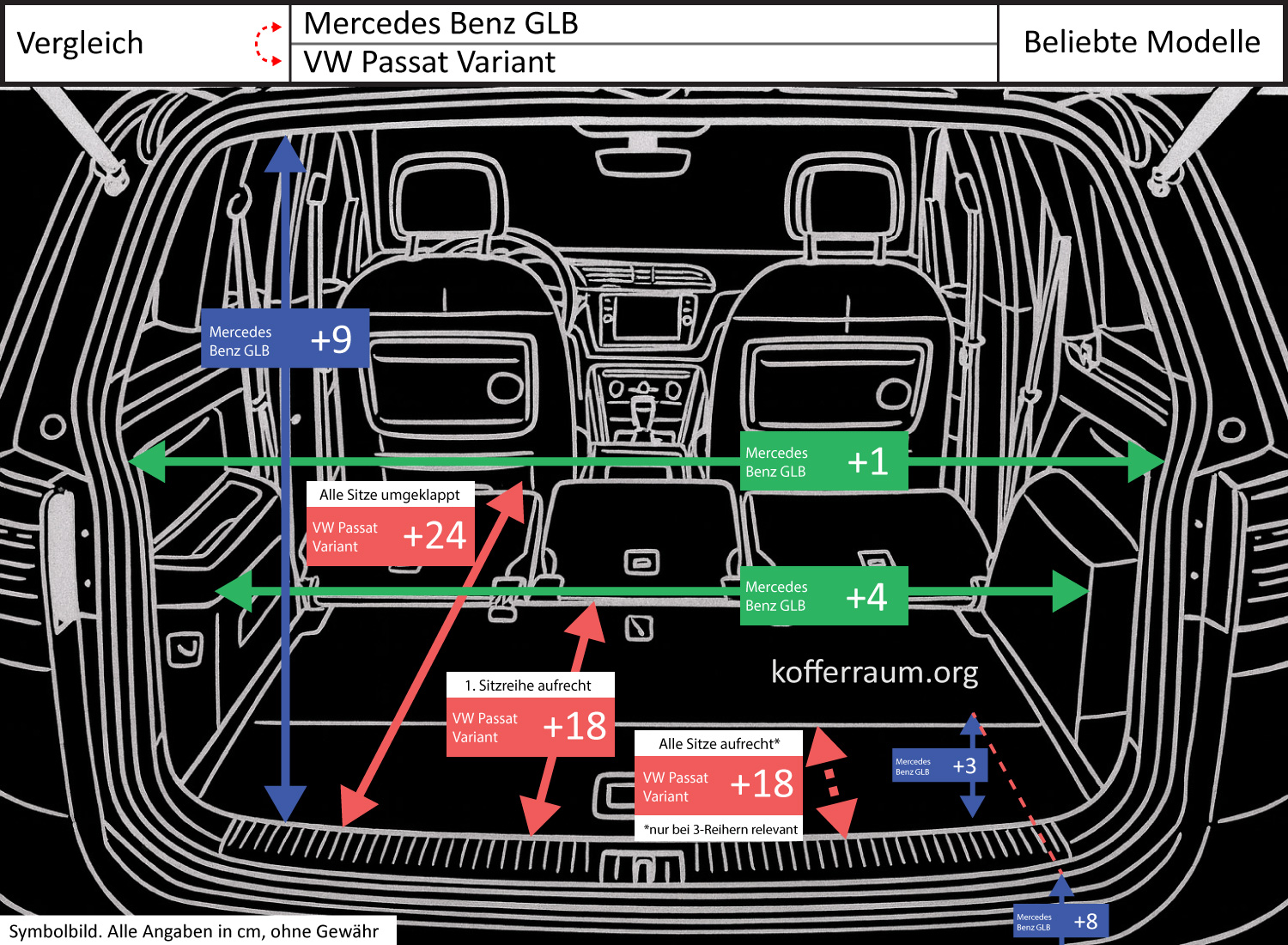
Clear strengths emerge on both sides in terms of cargo volume and dimensions. The VW Passat Wagon offers a longer loading length: with the seats folded down, the Passat is 9.4 in (14%) longer, and with the first row upright, it is 7.1 in (19%) longer than the Mercedes‑GLB.
On the other hand, the GLB has advantages elsewhere: the height of the trunk opening is 3.5 in (11%) larger on the GLB, the depth of the trunk (loading edge to trunk floor) is 1.2 in (33%) greater, and the loading edge on the GLB sits 3.1 in (13%) higher above the ground.
The differences in width (narrowest point +1.6 in / opening width +0.4 in in favor of the GLB) are each around 1–4% and thus minor.
Impact on Usability
The longer loading area of the Passat Wagon makes it significantly more suitable for long items (e.g., slats, furniture panels, skis) and transport tasks where maximum loading length is required. If long cargo or a flat loading floor with plenty of length is regularly needed, the Passat is the more practical choice.
The GLB scores with the loading height and interior profile: the larger opening height makes it easier to slide in tall, bulky items, and the greater depth means a bit more space behind the loading edge vertically.
This can pay off with tall boxes, suitcases, or bulky but not very long items. However, the loading edge being 3.1 in higher makes lifting heavy loads into the trunk more strenuous and less comfortable than in the Passat.
In summary: For transports where length is decisive, the VW Passat Wagon has the advantage. For frequent loading of tall or bulky items (where opening height and interior depth matter), the Mercedes‑GLB offers benefits but pays for these with a significantly higher loading edge and thus increased lifting effort.