
Trunk comparison: Mercedes Benz GLB vs VW T-Roc
Key Differences
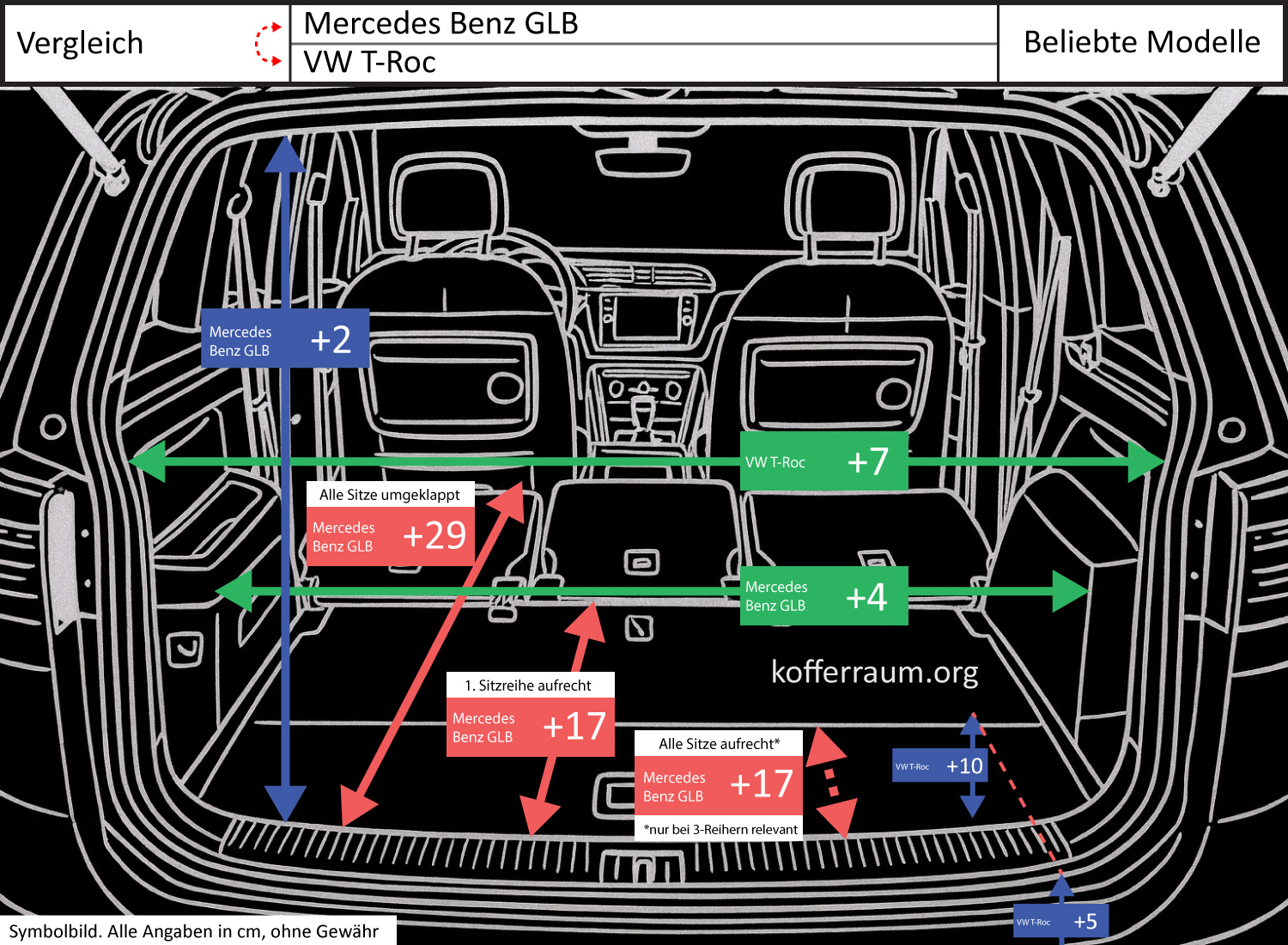
Mercedes‑Benz GLB offers +11.4 in (20%) more trunk length with seats folded down and +6.7 in (22%) more length with the first row upright than the VW T‑Roc. The VW T‑Roc, on the other hand, has a significantly greater depth between the loading edge and trunk floor: +3.9 in (83%) compared to the GLB.
Other, smaller differences (under 10%): The GLB’s trunk opening is +0.8 in higher, the T‑Roc’s loading edge is +2 in higher above the road, the narrowest trunk width is +1.6 in larger in the GLB, and the opening width is +2.8 in larger in the T‑Roc.
Implications for Usability
The longer loading surfaces of the GLB (each about ≈20% longer) make it more practical for long items like skis, slats, boards, or longer boxes and increase flexibility with full or partial loading. Those who regularly transport long cargo or frequently fold down the rear seats clearly benefit from the GLB.
The greater depth of the T‑Roc means cargo sits deeper in the trunk and is thus better "recessed" — this protects from view and can reduce shifting. This is practical for bulky, not necessarily very long items.
At the same time, the higher loading edge of the T‑Roc (even if <10%) increases the effort required to lift heavy loads compared to the lower GLB load floor.
Smaller width and opening differences are rarely decisive: the slightly larger opening width of the T‑Roc makes loading wide items easier, the slightly larger narrowest width of the GLB helps fit bulky shapes.
Overall: GLB is the better choice for longer, frequently foldable cargo; T‑Roc scores with a deeper load well and more discreet storage of bulky items, at the cost of a somewhat higher lifting load when loading.