
Trunk comparison: Mercedes Benz GLC vs Durchschnitt Subcompact


Summary of the Biggest Differences
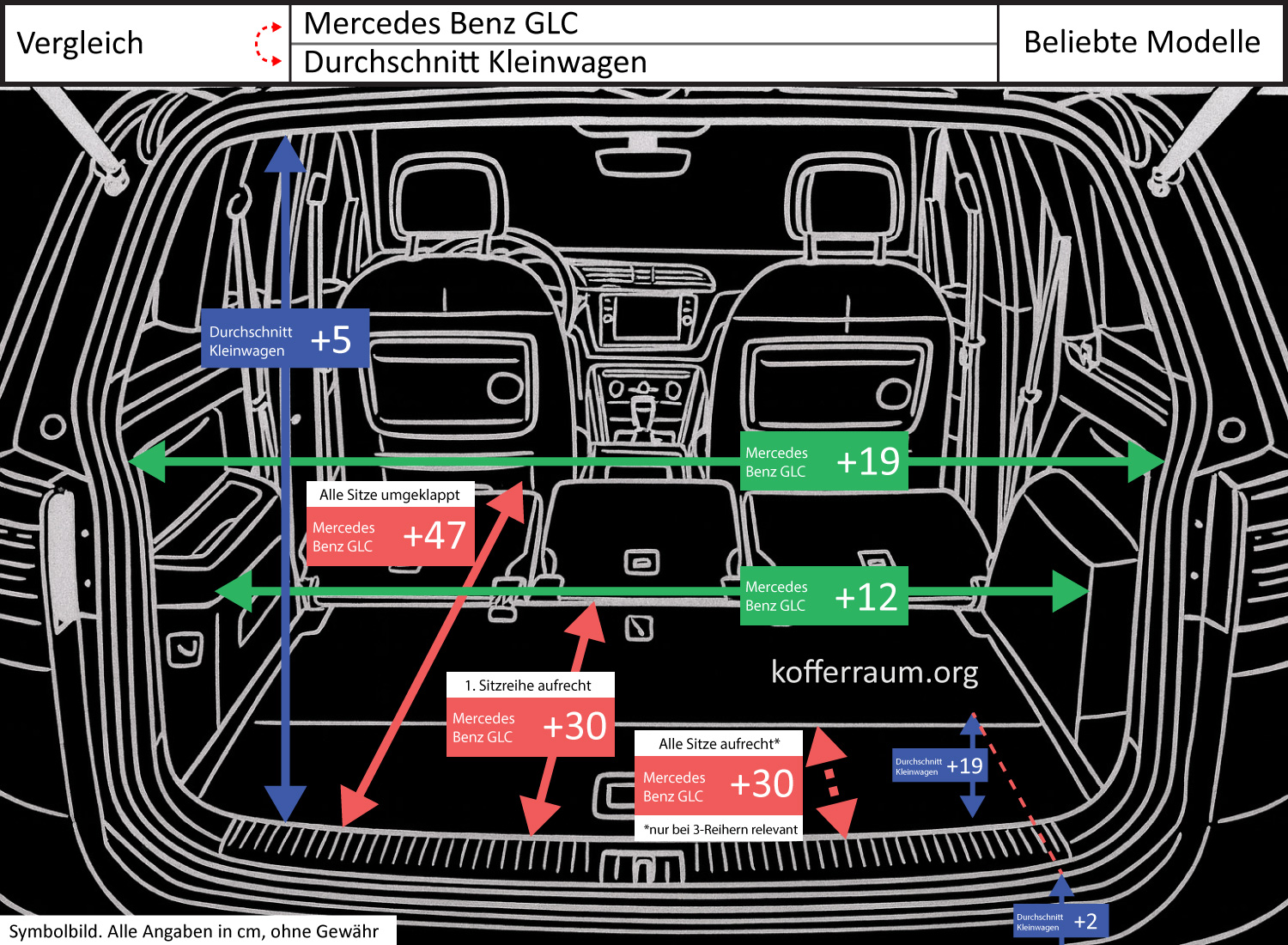
The greatest advantages of the Mercedes‑Benz GLC lie in the length and width of the trunk: With the seats folded down, the GLC's trunk is 18.5 in (37%) longer, and with the first row of seats upright, it is 11.8 in (48%) longer than the average subcompact.
The narrowest point in the cargo area is 4.7 in (12%) wider in the GLC, and the width of the trunk opening is 7.5 in (21%) larger.
Also notable is the significantly greater depth (loading edge to trunk floor) of the subcompact by 7.5 in (1800%) — the very high percentage indicates a very small reference value for the GLC; practically, this means a noticeably deeper cargo floor in the subcompact.
What Are the Effects of These Differences on Usability?
Due to the significantly greater length and width, the GLC is more practical for long and bulky loads (e.g., furniture, long skis, larger suitcases, or bulky shopping).
The wider opening makes it easier to load wide items, and the greater interior width at the narrowest point increases the likelihood that bulky objects will fit without rearranging. With the seats folded down, the GLC offers more flat cargo space and flexibility for larger transport tasks overall.
The subcompact scores with the greater "depth" of the cargo area (7.5 in more): Items can lie deeper below the loading edge, which makes storing smaller or taller items less conspicuous and helps with load securing.
However, the loading edge of the subcompact is only slightly higher (+0.8 in / 3%) and the opening slightly taller (+2 in / 7%), which overall provides only minor ease when lifting items in or with very tall cargo.
Conclusion: For regular transport of longer or wider items, the GLC is clearly advantageous. Those who mainly want to store small, deeper cargo and drive very compact urban vehicles can benefit from the greater depth of the subcompact — but overall, the GLC offers the significantly more versatile cargo space.