
Trunk comparison: Mercedes Benz GLC vs Opel Grandland

Key Differences and Their Impact on Usability
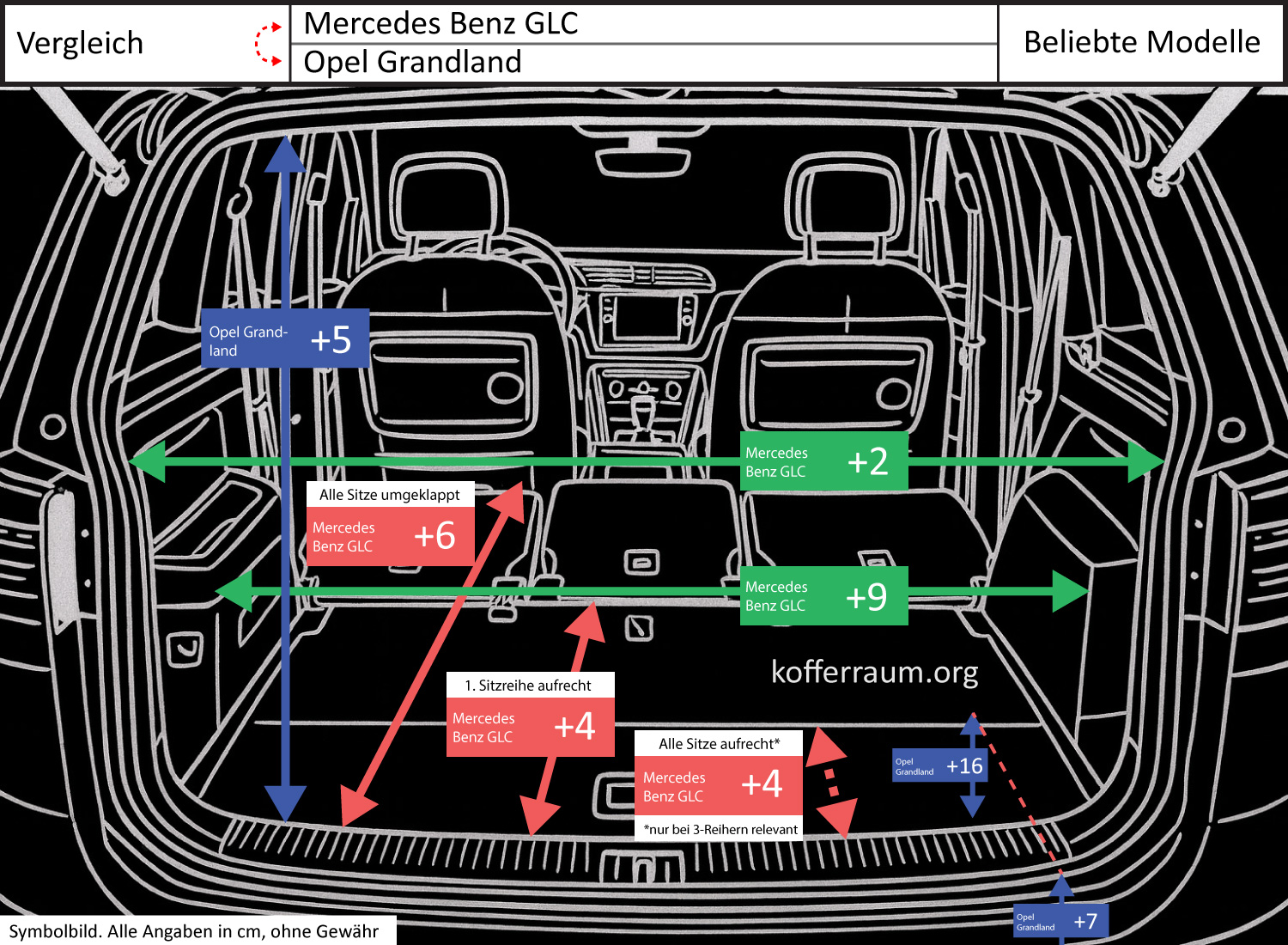
The most noticeable difference lies in the depth of the trunk: the Opel Grandland has a trunk depth from the loading edge to the trunk floor that is 6.3 in (1500%) greater than the Mercedes-Benz GLC.
Practically, this means: in the Grandland, the cargo floor sits significantly lower below the loading edge, providing more volume in a deeper recess.
This is advantageous for bulky or irregularly shaped items that can be better stacked or "recessed" in a deep space.
At the same time, small items can more easily become out of sight, and loading bulky, heavy loads can become less practical because they must first be lifted over the loading edge and then lowered into the recess.
Other, though proportionally smaller, differences affect everyday usability: the Opel has a loading edge 2.8 in (10%) higher above the road, which makes lifting heavy loads from the ground more difficult; the trunk opening height of the Grandland is 2 in (7%) larger, which facilitates loading tall items.
The Mercedes-Benz GLC offers 3.5 in (9%) more width at the narrowest point and 0.8 in (2%) more width at the trunk opening, as well as a few centimeters more interior length (4–2.4 in).
This makes the GLC overall more favorable for wide or elongated items and for easier handling when loading—especially with bulky, flat, or wide cargo.
In summary: Those who frequently transport voluminous but not necessarily heavy items and benefit from additional volume in a deeper cargo floor will find advantages in the Opel Grandland.
Those who often load wide, flat, or heavy items and prefer lower loading edges and more usable width are better served by the Mercedes-Benz GLC.