
Trunk comparison: Mercedes Benz GLC vs Peugeot 208
Key Differences
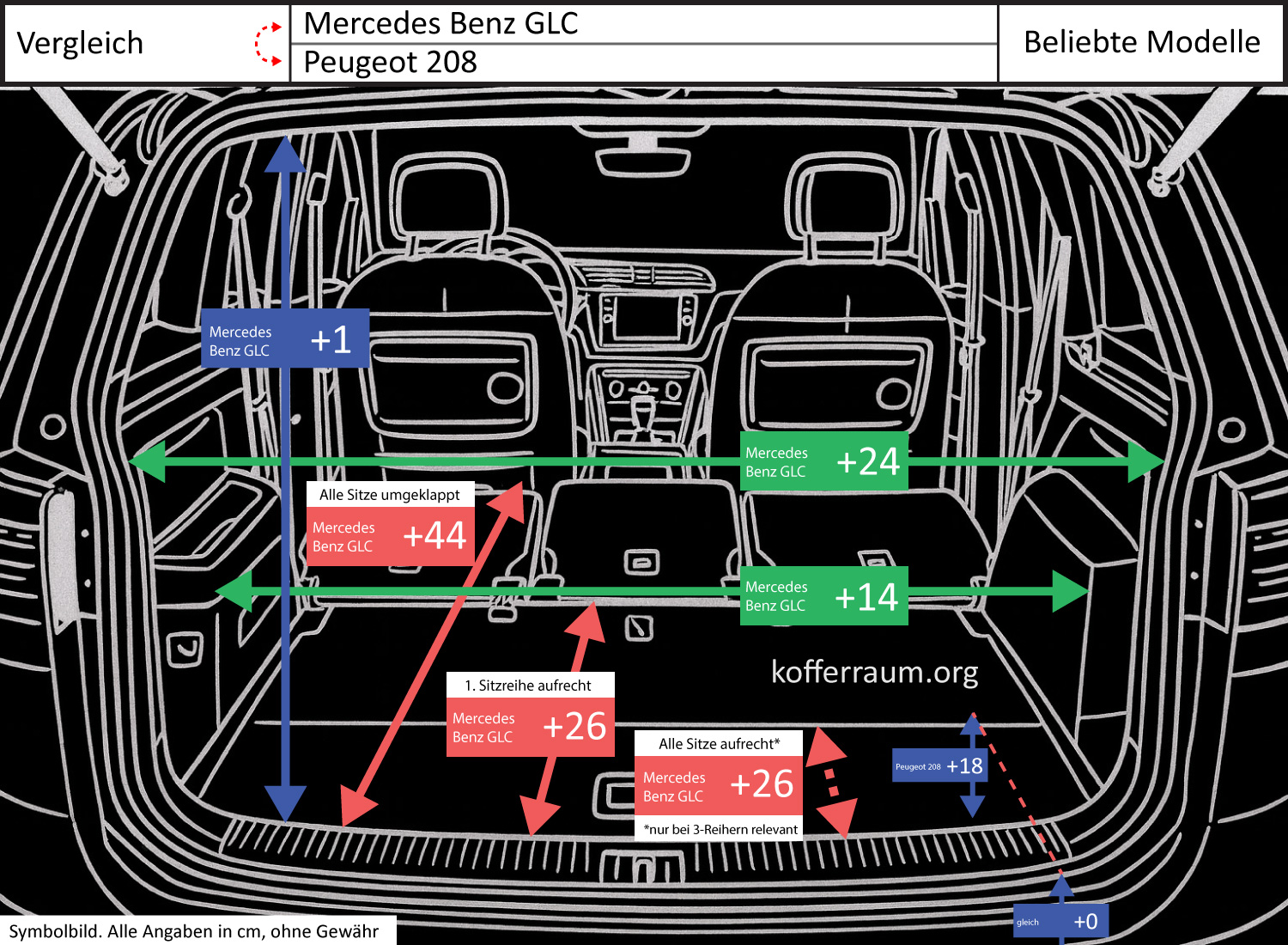
The Mercedes‑Benz GLC offers a significantly larger cargo area in length and width: with the seats folded down, the trunk of the GLC is 17.3 in (34%) longer than that of the Peugeot 208, and with the front seats upright, it is 10.2 in (39%) longer.
Additionally, the narrowest width of the trunk in the GLC is 5.5 in (15%) larger, and the width of the trunk opening is 9.4 in (28%) wider compared to the 208. The height of the trunk opening differs by only 1% in favor of the GLC (negligible).
In contrast, the Peugeot 208 has a significantly greater depth between the loading edge and the trunk floor: it exceeds the GLC's value by 7.1 in (1700%). The loading edge heights of both vehicles are the same.
What does this mean for usability?
The longer cargo area and greater width of the GLC make it clearly more practical for long or wide items (e.g., furniture parts, long luggage, skis) and facilitate loading with the seats folded down. The wider opening supports lifting in wider objects and reduces maneuvering or angle issues when loading.
The greater "depth" value in the Peugeot 208 indicates a more pronounced trunk well or a floor set deeper relative to the loading edge. This creates additional, concealed storage space for taller items within the well or allows discreet storage of luggage under a cover at the same loading edge height.
At the same time, a deep well can make lifting heavy items more difficult when loading and unloading and can bundle bulky, flat items (e.g., long boxes), since the 208 is significantly limited in length and width.
In practical summary: For regular transport of longer or wider goods, the GLC is clearly advantageous.
For users who want more deep, subordinate storage space or a larger "recess" in the cargo floor (e.g., for secure lashing or discreet storage of smaller luggage), the 208 can offer benefits — but at the expense of the length and width of the cargo area.