
Trunk comparison: Mercedes Benz GLC vs Seat Leon


Biggest Differences
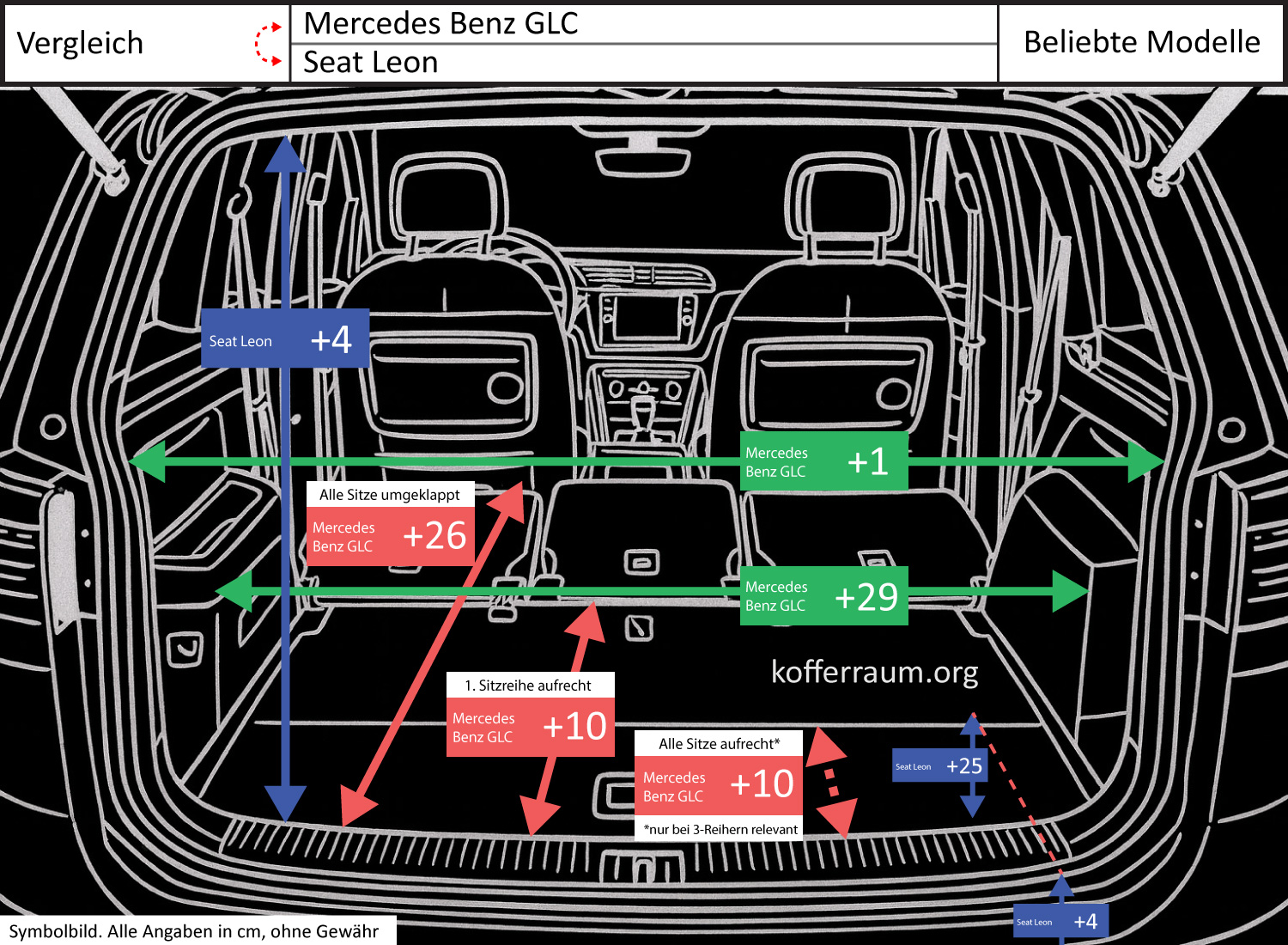
Clear advantages for the Mercedes‑GLC are evident in usable cargo volume and dimensions: With the seats folded down, the GLC offers a significantly longer cargo area — 10.2 in or 17% more length.
Even with the front seats upright, the GLC remains longer: plus 3.9 in (12%). The narrowest point in the trunk is significantly wider in the GLC — 11.4 in (36%) more space at the tightest spot.
Impact on Usability
The longer lying surfaces of the GLC (both with folded and upright seats) make it more practical for transporting long items such as furniture parts, slatted frames, or skis without complicated folding or makeshift solutions.
The greater narrowest width means bulky or angular items fit more easily and require less tight packing — reducing damage risk and handling effort.
The SEAT Leon scores on some dimensions, which are however smaller or less significant in practice: The trunk opening is slightly higher (+1.6 in), and the loading edge is marginally higher (+1.6 in), making lifting heavy loads somewhat more strenuous.
Notably, the trunk depth (loading edge to trunk floor) is said to be 9.8 in (2400%) greater in the Leon — practically meaning the Leon can have a deeper recess inside, thus offering more usable vertical height below the loading edge.
In practice, this means more space for bulky but not too wide cargo, but also a higher loading edge above the road, which complicates lifting heavy items.
In summary: For wide, long, or bulky cargo and easier loading thanks to a lower loading edge, the Mercedes‑GLC is the more practical choice.
The SEAT Leon offers specific advantages in interior depth and opening height, which are noticeable mainly with certain vertically bulky items, but the narrower width and shorter length significantly limit transporting large or wide items.