
Trunk comparison: Mercedes Benz GLC vs VW Tiguan
Key Differences
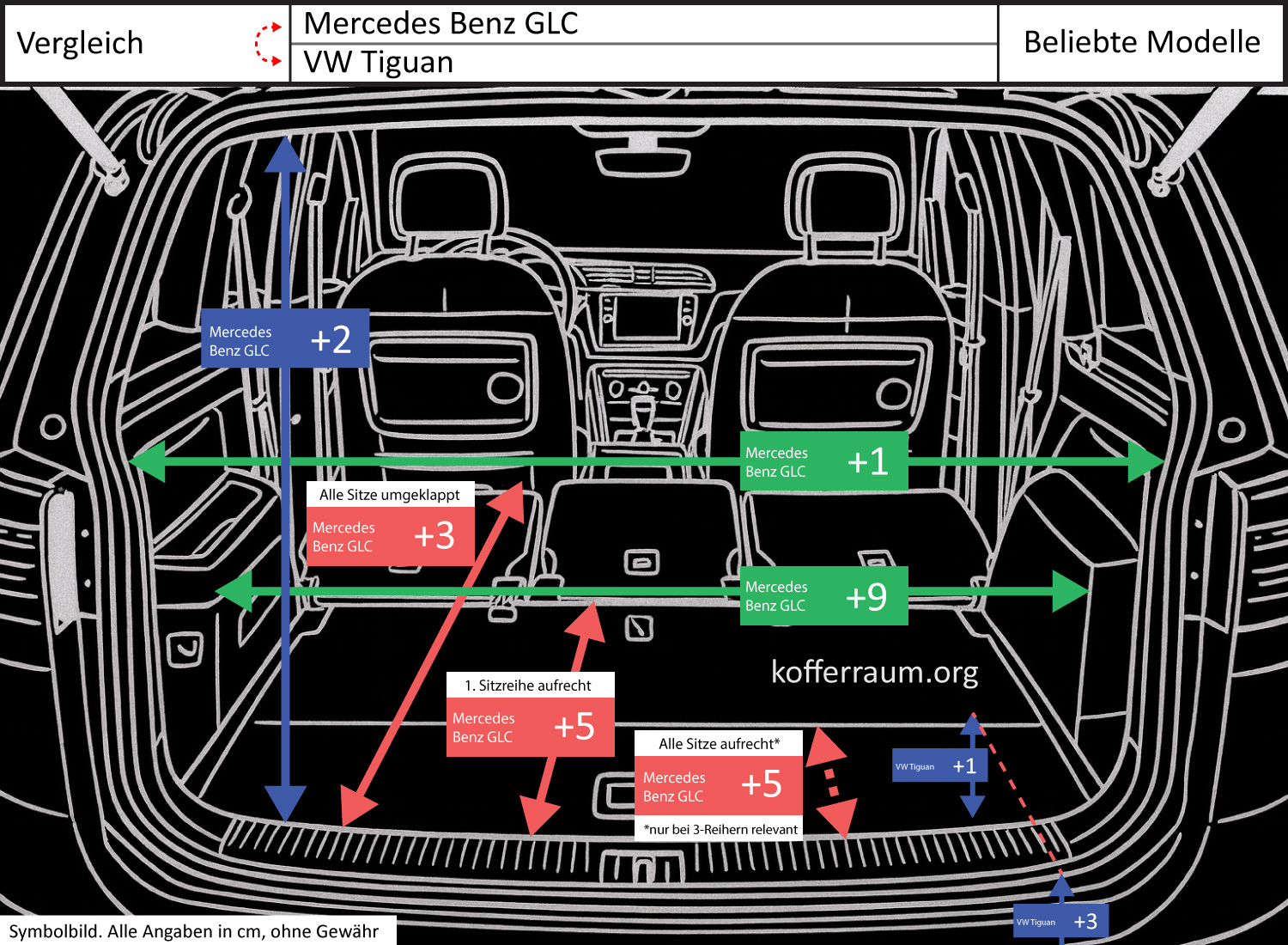
No measured difference exceeds the 10% threshold you specified, so there are no points to highlight based on this criterion. Overall, the differences are minor. The Mercedes‑Benz GLC has a trunk that is 1.2 in (2%) longer with the seats folded down and 2 in (6%) longer with the first row of seats upright. The height of the trunk opening is 0.8 in (3%) greater on the GLC, the width at the narrowest point is 3.5 in (9%) greater on the GLC, and the width of the trunk opening is 0.4 in (1%) greater. The VW Tiguan has a trunk depth (loading edge to floor) that is 0.4 in (0%) greater and a loading edge that is 1.2 in (4%) higher above the road.
Impact on Usability
Because all differences are small, both vehicles remain very comparable in everyday use. The most practically important deviations are the greater narrow width of the GLC (+3.5 in / 9%) and its slightly longer cargo length with the first row of seats upright (+2 in / 6%). This makes the GLC somewhat better suited for bulky, relatively wide items (e.g., larger boxes, wide sports equipment) and for cargo that does not need to be transported fully folded down. The slightly higher trunk opening on the GLC also minimally facilitates lifting tall items. In the Tiguan, the differences favor a slightly greater loading depth and a higher loading edge. However, the 1.2 in higher loading edge means that lifting heavy items requires a bit more effort; a lower load floor like in the GLC is advantageous for frequent lifting. The 0.4 in greater depth of the Tiguan is practically unnoticeable. Conclusion: Neither model offers a clear, practical advantage — the GLC scores slightly in width and accessibility, while the Tiguan offers marginally more depth and a slightly different loading height. For users regularly carrying very wide or bulky cargo, the decision tends to favor the GLC; in normal everyday use, both models are equivalent.