
Trunk comparison: Mercedes Benz GLE vs Opel Astra Wagon
Key Differences and Impact on Usability
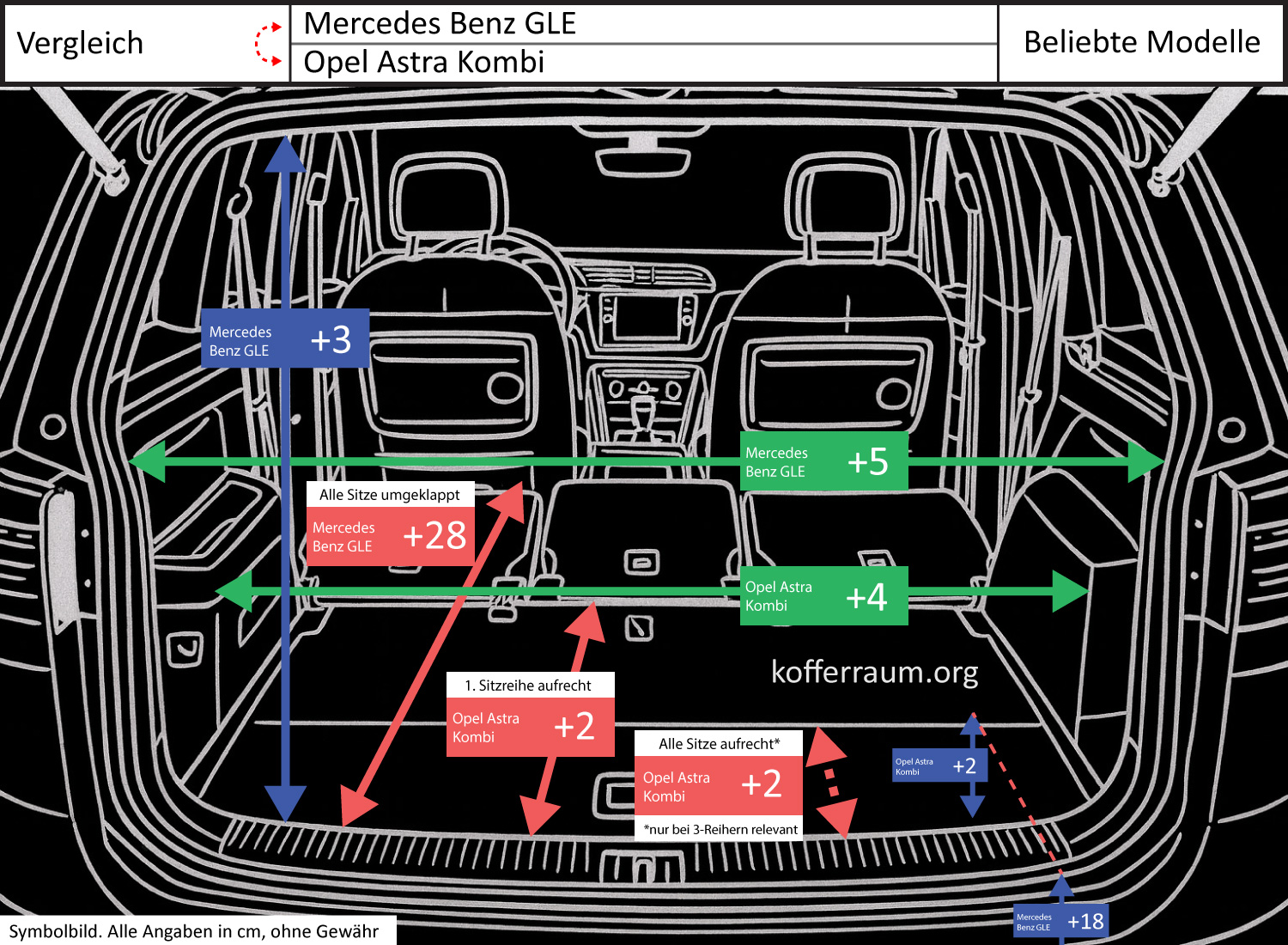
When comparing, three differences stand out that are greater than 10% and significantly affect practical usability. The Mercedes-Benz GLE offers a cargo floor that is 11 in (17%) longer with the rear seats folded down, making it clearly better for longer items (e.g., slats, long packages, or skis).
This means: Those who often transport long, bulky loads face fewer restrictions with the GLE and less often need to load diagonally or disassembled.
The loading height (load edge) of the GLE is 7.1 in (31%) higher above the road. Practically, this means: Loading and unloading heavy or bulky items is more strenuous in the GLE because they must be lifted higher.
For people who frequently load heavy cargo or prefer lower access (e.g., suitcases, shopping boxes, strollers), the Astra is more practical. Conversely, the higher load edge on the GLE often offers more ground clearance and thus advantages off paved roads.
The depth of the trunk (distance from load edge to trunk floor) is 0.8 in (100%) greater in the Opel Astra Wagon.
In practice, this means a deeper cargo well in the Astra: small items sit more securely in the "trunk floor" and roll less, while placing large, flat loads can be slightly more difficult because they must be lowered deeper.
For transport tasks where securing small or round items is important, the deeper cargo well of the Astra is advantageous.
Other, Smaller Differences
The remaining differences are below the 10-percent threshold: The Astra has a trunk that is 0.8 in (2%) longer with the first row of seats upright; the trunk opening of the GLE is 1.2 in (4%) higher; the narrowest width in the trunk is 1.6 in (4%) larger in the Astra; the width of the trunk opening is 2 in (5%) larger in the GLE.
These deviations are insignificant in most everyday situations but can become relevant when loading very wide items (cabinets, pallets) or when precise loading is required.