Trunk comparison: Mercedes Benz GLE vs Peugeot 208

Key Differences and Impact on Usability
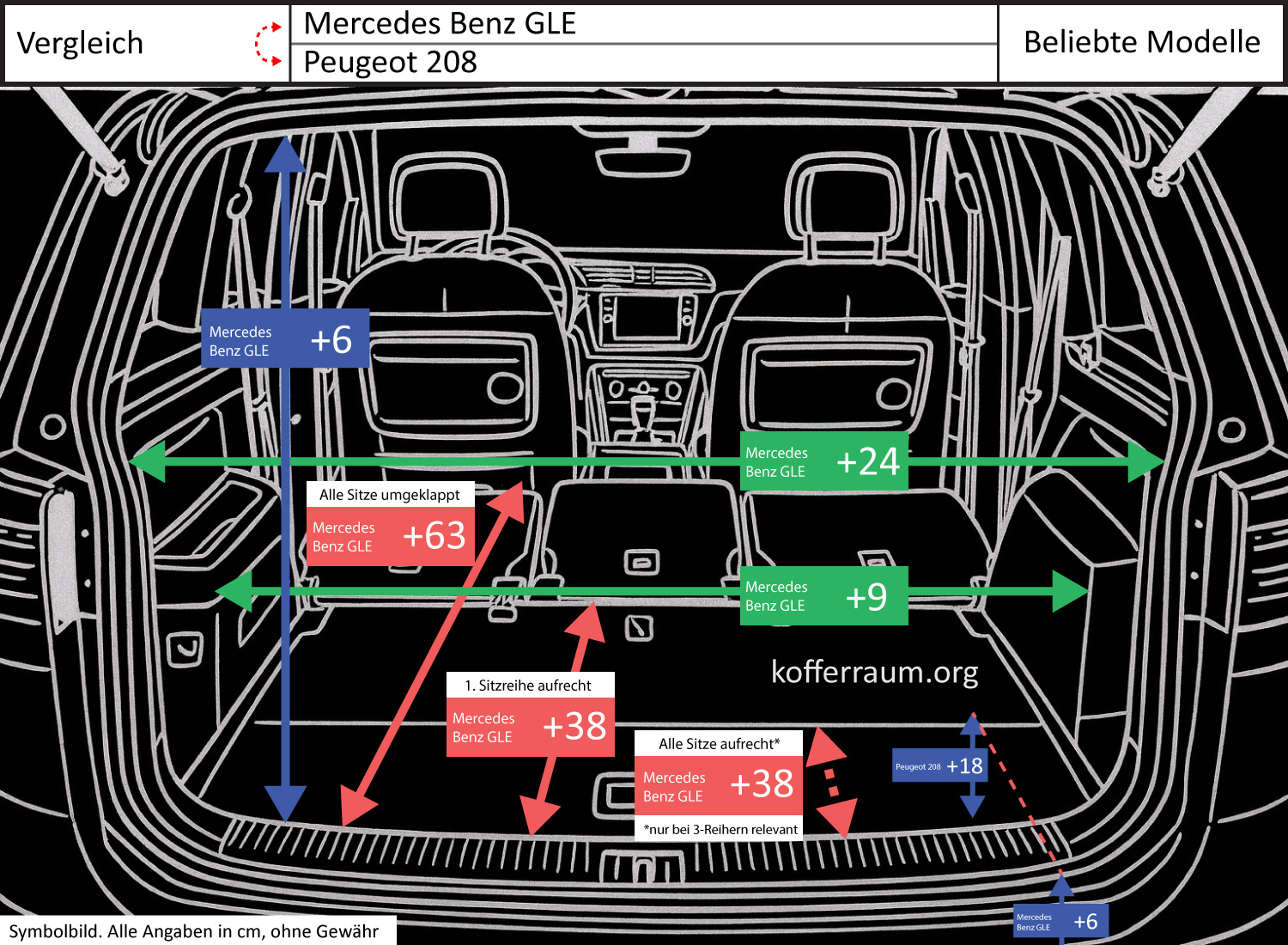
With the seats folded down, the GLE offers a cargo space that is 24.8 in longer (+48%). Practically, this means the GLE can accommodate significantly longer items (e.g., furniture parts, long sports equipment, boards) without complicated angling or storing over multiple trips.
With the rear seats upright, the GLE's trunk is 15 in larger (+57%). For everyday use, this means more usable volume even when seats are occupied: more suitcases, shopping bags, or luggage with passengers can be easily accommodated.
The width of the GLE's trunk opening is 9.4 in larger (+28%). A wider opening makes loading bulky or irregularly shaped items easier; less maneuvering and tilting is needed, allowing large items to be loaded more conveniently.
The depth between the loading edge and trunk floor is 7.1 in greater (+1700%) in the Peugeot 208. Practically, this means items can lie deeper in the cargo space.
Advantages: better securing and less shifting for flat or elongated loads. Disadvantages: smaller accessibility window for heavy, small parts—they lie further inside and are harder to lift out.
Smaller Differences (under 10%)
The height of the trunk opening (+8% in the GLE), as well as the higher loading edge of the GLE (+8%) and the narrowest trunk width (+9%), are present but have smaller practical effects.
A slightly higher loading edge in the GLE makes lifting heavy items marginally more strenuous; the slightly higher opening height can slightly facilitate loading taller items.
Conclusion — Which Use Cases Benefit from Which Model
If you regularly transport long or wide loads or value maximum loading flexibility (furniture, sports equipment, occasional transports), the Mercedes‑Benz GLE is clearly superior: longer cargo space and wider opening make loading significantly easier.
The Peugeot 208 scores with its deeper loading floor (better securing of lower-lying items) and overall more compact dimensions—advantageous in city traffic and for infrequent use of large loads.