
Trunk comparison: Nissan Rogue Sport vs Skoda Superb Wagon
Key Differences
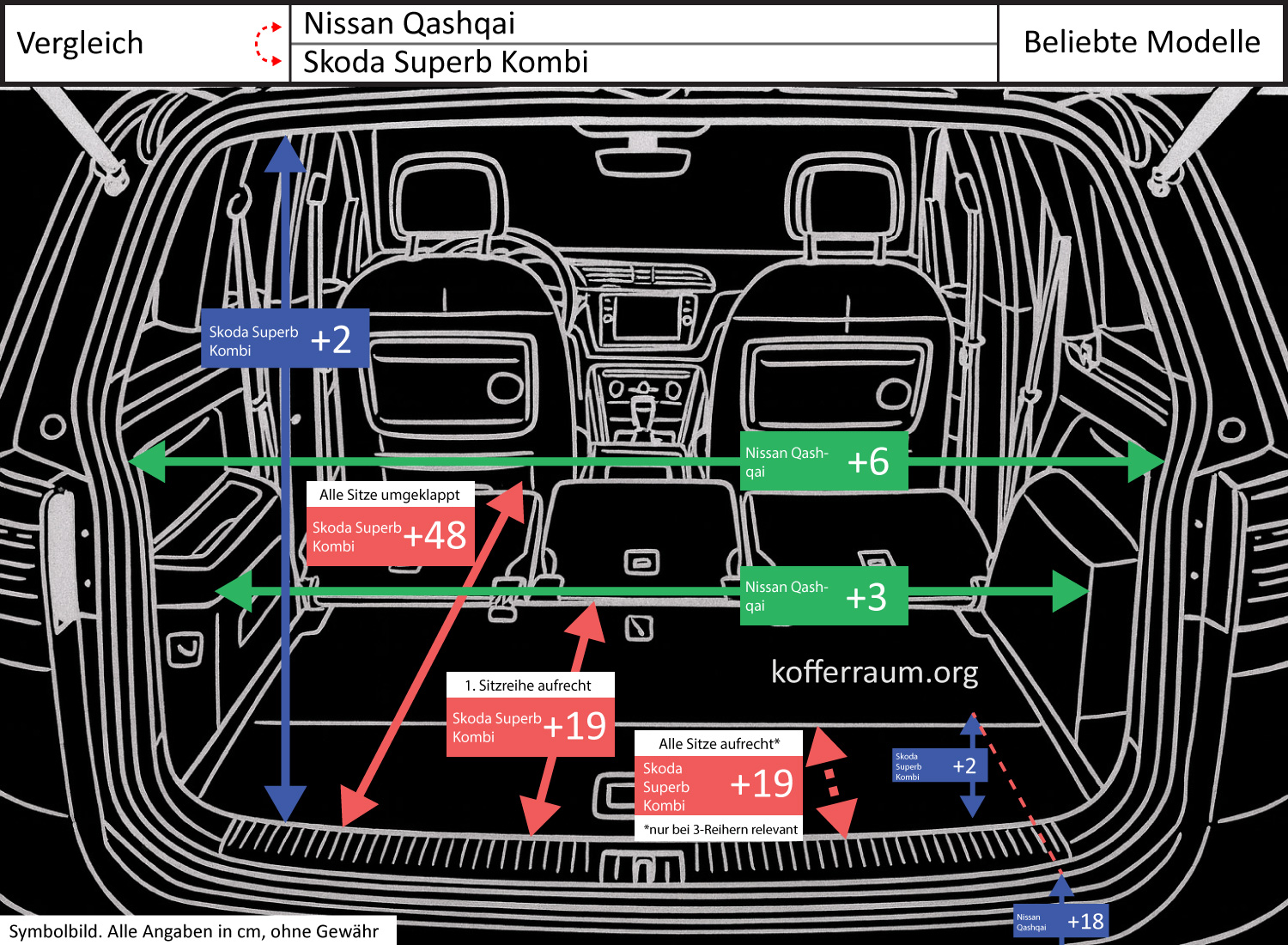
The Škoda Superb Wagon offers significantly more cargo length: +18.9 in (29%) with seats folded down and +7.5 in (22%) with the front seat row upright compared to the Nissan Rogue Sport.
The depth of the trunk (loading edge to floor) is only 0.8 in greater in absolute terms in the Superb, but this corresponds to a relative advantage of 33%.
Conversely, the loading edge of the Nissan sits 7.1 in (31%) higher above the road than the Superb.
Smaller differences: the trunk opening of the Superb is 0.8 in higher (+3%) and the Rogue Sport has +1.2 in (3%) more width at the narrowest point as well as +2.4 in (6%) more opening width — these values are under 10% and thus less decisive.
Impact on Usability
For transport tasks requiring long or many items (folded seats or many pieces of luggage), the Superb Wagon is clearly more practical: the significantly greater cargo length and depth allow for longer loads and better stacking.
The lower loading edge of the Superb makes lifting heavy or bulky loads considerably easier, while the Rogue Sport’s loading edge, which is 7.1 in higher, makes loading more strenuous.
The Rogue Sport has a slightly greater width at the narrow point and a somewhat larger opening width, which helps when loading wider but not very long items — however, the differences are minor and often negligible in everyday situations.
Likewise, the 0.8 in higher trunk opening of the Superb is practically unnoticeable.
In short: Those who primarily need cargo volume, length, and easy lifting (e.g., for furniture, long packages, or many suitcases) are better served by the Škoda Superb Wagon.
Those who prefer more compact SUV characteristics and a marginally wider passage find small advantages in the Nissan Rogue Sport, but lose significantly in usable cargo space and loading convenience.