
Trunk comparison: Opel Corsa vs Peugeot 3008


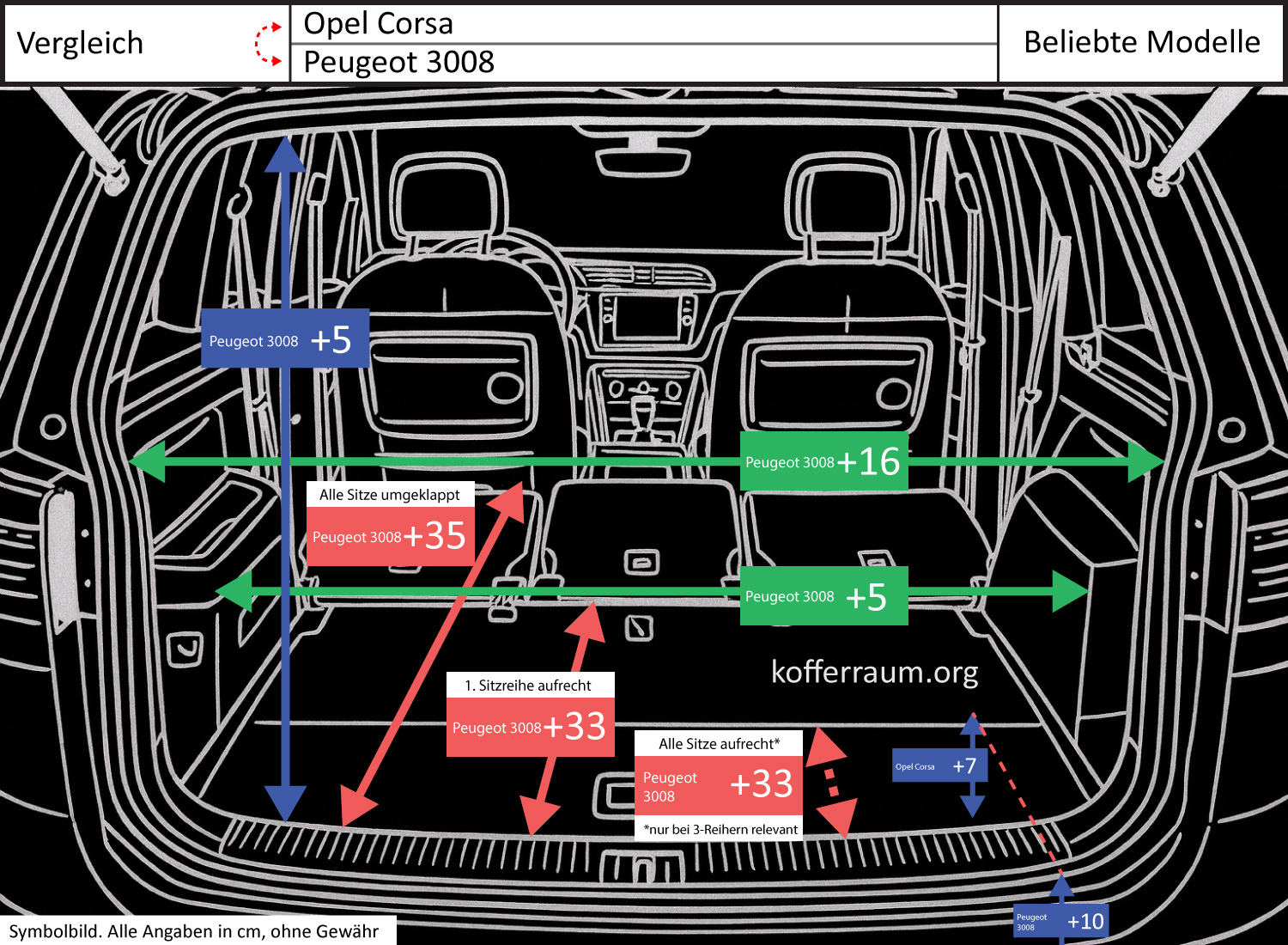
Main Differences (>10%)
The Peugeot 3008 offers significantly more cargo space in length: with the rear seats folded down, the trunk is 13.8 in (+27%) longer, and with the front seats upright, 13 in (+50%) longer than in the Opel Corsa.
This makes the 3008 clearly better suited for long items (skis, furniture parts, long boxes) and for larger overall loads, especially when the rear seats are folded down.
Additionally, the trunk opening of the Peugeot is 6.3 in (+19%) wider, which makes loading wider items easier and maneuvering bulky cargo into the trunk more practical.
A contrasting advantage of the Corsa is the greater depth between the loading edge and the trunk floor: the Corsa is 2.8 in (+64%) deeper here. This means that loads can sit deeper in the Corsa (larger "vertical niche"), allowing stacking of lower, heavier items and making the cargo less protruding.
Finally, the loading edge of the Peugeot sits 3.9 in (+14%) higher above the road than that of the Corsa. For the user, this means the 3008 requires more effort when lifting heavy items into the trunk, while the Corsa’s lower loading edge makes loading and unloading physically easier.
Impact on Usability
In practice, this results in a clear usage profile: The Peugeot 3008 is the better choice when volume, length, and width of the cargo are important — it accommodates longer and wider items and offers more flexibility with folded seats.
The higher loading floor makes it less comfortable for frequently transporting bulky but lighter items, as heavy loads must be lifted higher.
The Opel Corsa is better suited for users who often load heavy or compact loads: the lower loading edge makes lifting easier, and the greater floor depth allows for deeper storage of items. However, the Corsa is significantly more limited for long or wide parts.
Other, Less Decisive Differences
The height of the trunk opening is 2 in (+7%) greater in the Peugeot, and the narrowest width of the trunk is only 2 in (+5%) larger — both small differences that are less likely to be decisive in everyday use than the points mentioned above.