
Trunk comparison: Opel Corsa vs Volvo XC40

Key Differences
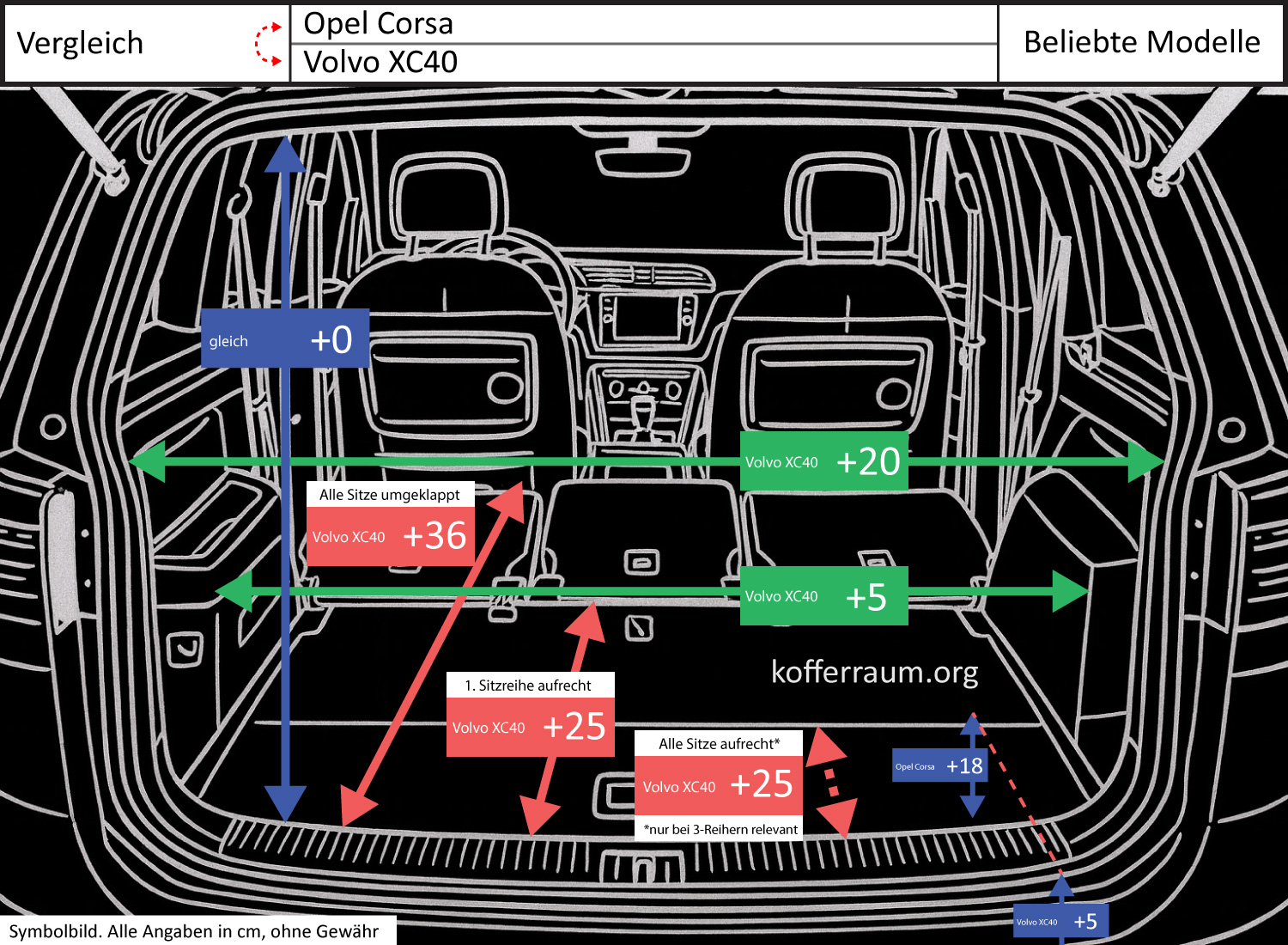
The Volvo XC40 offers significantly more cargo length: with seats folded down, about 14.2 in (≈27%) longer and with the front row upright, about 9.8 in (≈38%) longer than the Opel Corsa.
The width of the trunk opening is about 7.9 in (≈23%) larger on the XC40, while the narrowest trunk width is only slightly larger (+2 in / 5%).
The height of the trunk opening is the same. Also notable is the trunk depth (loading edge → trunk floor): according to the text, the Opel Corsa is about 7.1 in (≈1700%) "higher" than the Volvo – indicating a significantly different floor position or step depth between the loading edge and trunk floor.
Implications for Usability
For transporting long items and when volume is needed without folding seats, the Volvo XC40 clearly has the advantage: the longer cargo areas and significantly larger opening width make it easier to load long and wide objects (e.g., furniture, slats, bicycles with the front wheel removed).
The larger opening width also reduces the risk of catching on the side wall.
The Opel Corsa scores ergonomically when loading from the curb because the loading edge is lower (the loading edge measurement shows a 2 in lower value for the Corsa) – this reduces the lifting effort when loading heavy items.
The indicated greater depth between loading edge and trunk floor in the Corsa suggests a stronger step or a deeper cargo compartment; this can offer more usable volume in the lower area but may also make storing bulky, flat cargo more difficult because the shelf is deeper.
In summary: Those who frequently transport long or wide cargo and need more volume without folding seats are better served by the Volvo XC40. Those who mostly lift smaller to medium loads from the ground and value a lower loading edge benefit from the Opel Corsa.
Smaller differences like the narrower tight spot (+2 in on the XC40) are usually less relevant in practice.