
Trunk comparison: Opel Grandland vs Durchschnitt Wagon
Key Differences
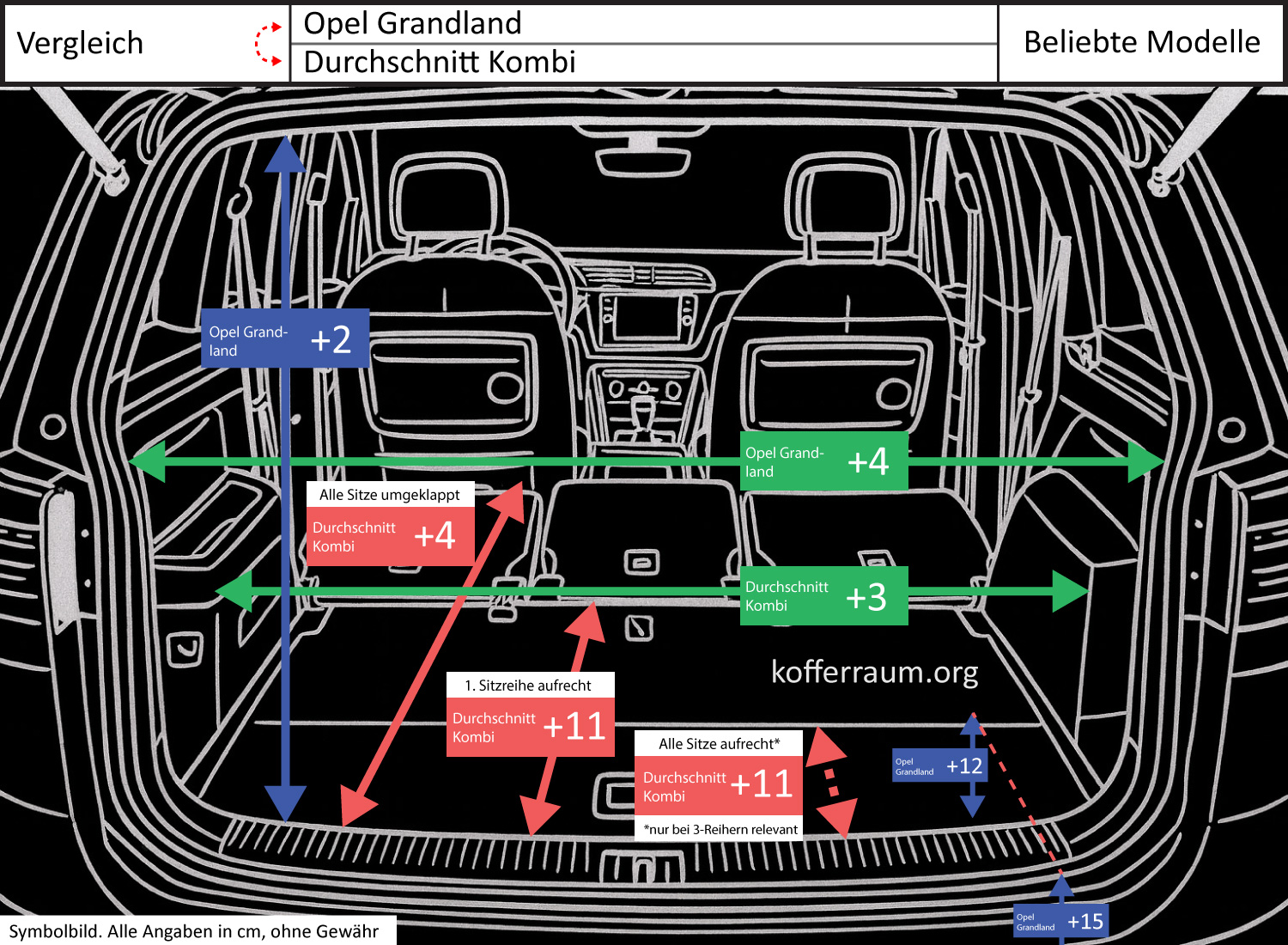
In most dimensions, the Opel Grandland and the average wagon are close to each other. However, two differences stand out clearly: the interior space behind the loading edge is 4.7 in (+300%) deeper in the Grandland and the loading edge itself is 5.9 in (+24%) higher above the road in the Grandland.
Additionally, the average wagon has a 4.3 in (+12%) longer cargo floor than the Grandland when the first row of seats is upright.
Implications for Usability
Longer cargo floor in the wagon (seats upright): For loaded items that cannot be placed behind the folded seats (e.g., long boards, skis, furniture parts), the wagon offers noticeably more room with 4.3 in more usable length. For users who often transport long items without folding seats, the wagon is more practical.
Depth of the trunk in the Grandland (loading edge → trunk floor): The significantly greater depth means more usable volume below the loading edge — practical for storing bulky or tall items deeply or to "sink" luggage.
Downsides: items lie deeper and are harder to reach; smaller, low-lying cargo can be more easily overlooked when loading and unloading.
Higher loading edge in the Grandland: The loading edge being 5.9 in higher makes loading and unloading harder, especially with heavy boxes or groceries.
Together with the greater depth, this results in a trade-off: more space below the loading edge but more lifting effort when loading and poorer accessibility of low-lying contents.
Other differences are small (<10%) and have only minor practical impact: The trunk opening of the Grandland is slightly wider (+1.6 in), which slightly eases loading wider items; the narrowest interior width is minimally greater in the wagon at the front (+1.2 in). When the rear seats are folded, the lengths differ by only 1.6 in (2%), so they are practically the same.
Conclusion: For frequent transport of long items with the rear seat upright, the wagon is better suited. For users who value more "deep" storage volume and a larger opening, the Grandland offers advantages — but at the cost of more lifting effort and poorer accessibility of low-lying cargo.