
Trunk comparison: Opel Grandland vs Toyota Corolla Wagon

Key Differences and Their Impact on Usability
Both models show strengths in trunk design that affect everyday usability differently.
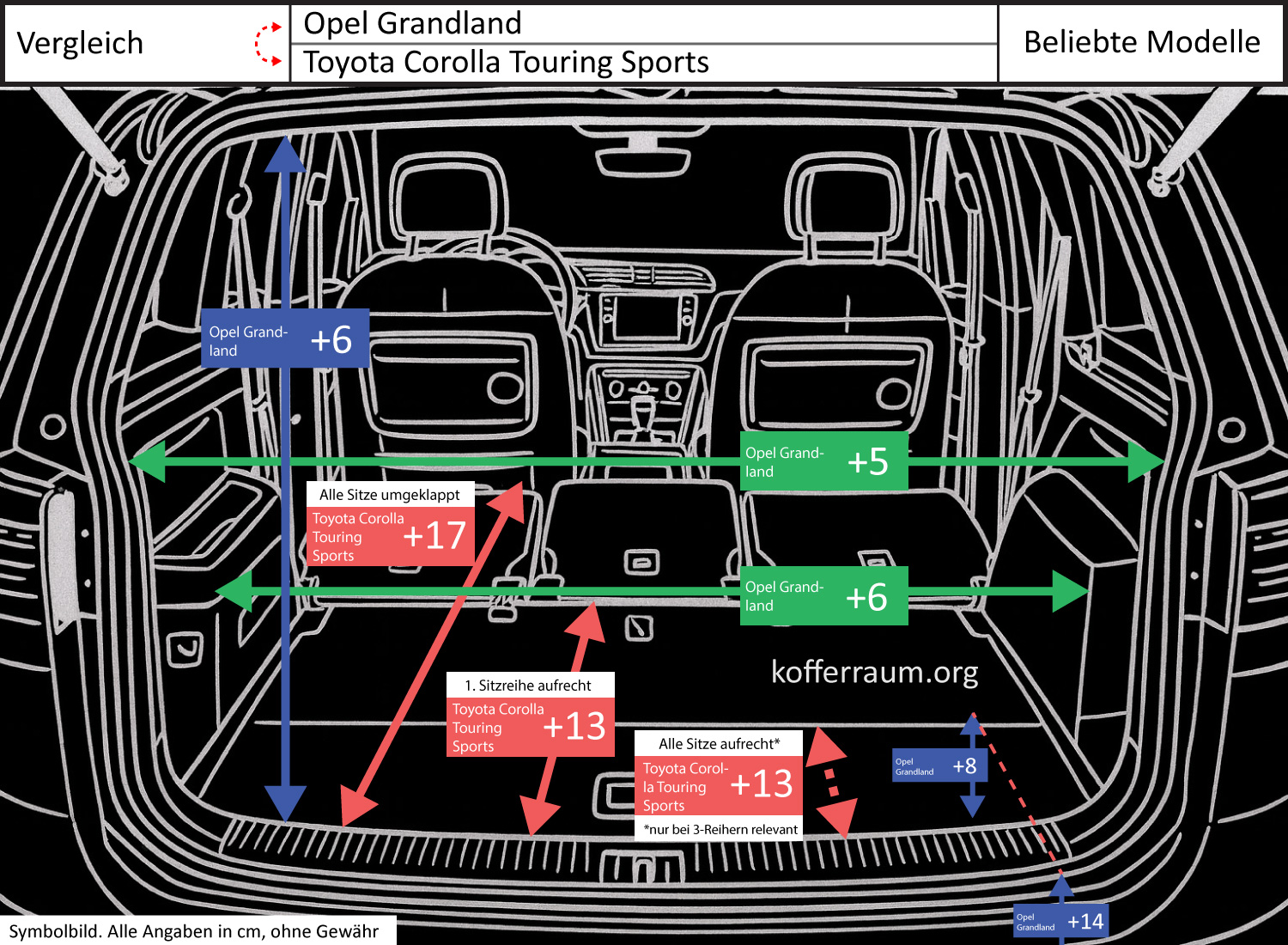
The Toyota Corolla Touring Sports offers more cargo length: with the first row of seats upright, it has a trunk that is 5.1 in (15%) longer than the Opel Grandland, which is clearly advantageous when transporting longer items (skis, furniture boards, longer luggage).
With the rear seats fully folded down, the Toyota is also longer (+6.7 in / 10%), but this difference is exactly 10% and is not highlighted here.
The Opel Grandland scores with other advantages: the depth of the trunk (loading edge to trunk floor) is 3.1 in, or 100%, greater, and additionally, the loading edge is 5.5 in (22%) higher above the ground than on the Toyota.
This practically means that in the Opel, the trunk floor lies deeper relative to the loading edge, providing more vertical space directly behind the edge—useful for stacking or for tall items immediately behind the hatch.
At the same time, the higher loading edge makes lifting heavy loads into the trunk more strenuous and less back-friendly than with the Toyota.
Other differences are moderate: the Opel’s trunk opening is 2.4 in higher and 2.4 in wider at the narrowest point; the opening width is 2 in larger on the Opel. However, these width and height advantages are relatively minor and only affect usability with very wide or bulky items.
In summary: Those who frequently transport long items or prefer a lower loading height (easier lifting) are better served by the Toyota Corolla Touring Sports.
Those who need more usable depth directly behind the loading edge, slightly wider narrow points, and more vertical space for tall or stackable cargo will find advantages in the Opel Grandland—albeit at the cost of a higher, more physically demanding loading edge.