
Trunk comparison: Opel Grandland vs Volvo XC60


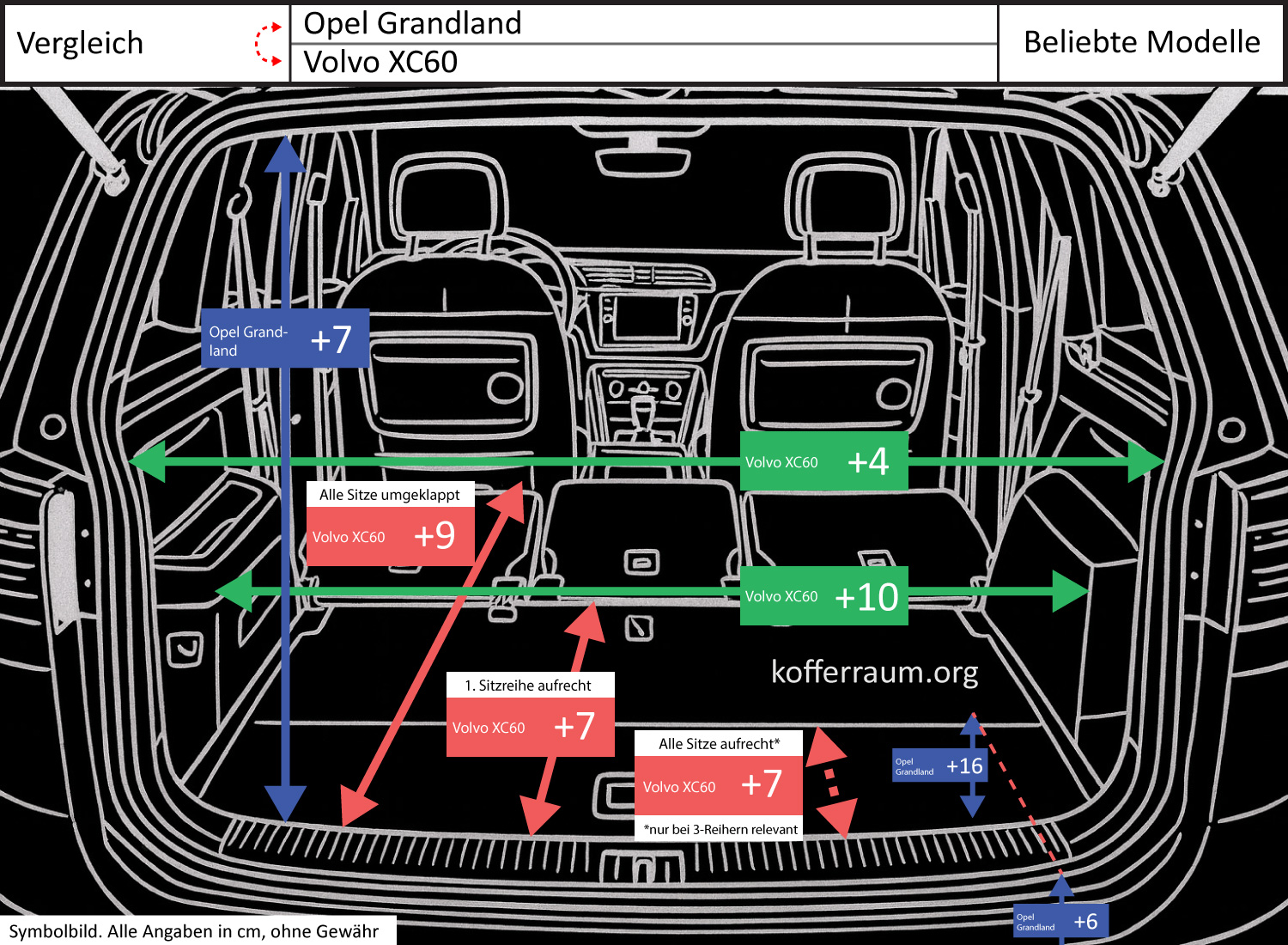
Summary of the main differences
The most noticeable difference concerns the depth of the trunk (loading edge to trunk floor):
here than the Volvo XC60. Other measurable differences (without emphasis, because ≤10%) are: the Volvo has a 3.5 in (5%) longer cargo area with the seats folded down and 2.8 in (8%) more loading length with the first row upright. The width at the narrowest point is 3.9 in (10%) larger on the Volvo, and the width of the trunk opening is 1.6 in (4%) larger. The Opel has a trunk opening height that is 2.8 in (9%) larger and a loading edge 2.4 in (8%) higher above the road.
Impact on usability
The significantly greater trunk depth in the Grandland practically means more vertical and internal storage space: bulky or tall items can be placed deeper and often stored more stably, and with the same external dimensions, more volume can be utilized inside. This makes the Grandland especially practical for bulky shopping, moving boxes, or large suitcases, but due to the 2.4 in higher loading edge, it requires more effort to lift heavy items into the trunk. The Volvo scores with greater loading length when the seats are folded down and somewhat more width at the narrowest point as well as a wider trunk opening. This makes it easier to store wide or long items (e.g., furniture boards, skis, or longer boxes) and makes loading overall more flexible. The slightly lower loading edge of the Volvo also facilitates lifting heavy loads in everyday use. In practice, this means: those who frequently have tall or deep-to-store loads benefit from the Opel Grandland. Those who value width, a somewhat longer lying surface with folded seats, and easier loading are better served by the Volvo XC60.