
Trunk comparison: Peugeot 208 vs Renault Clio
Key Differences (>10%)
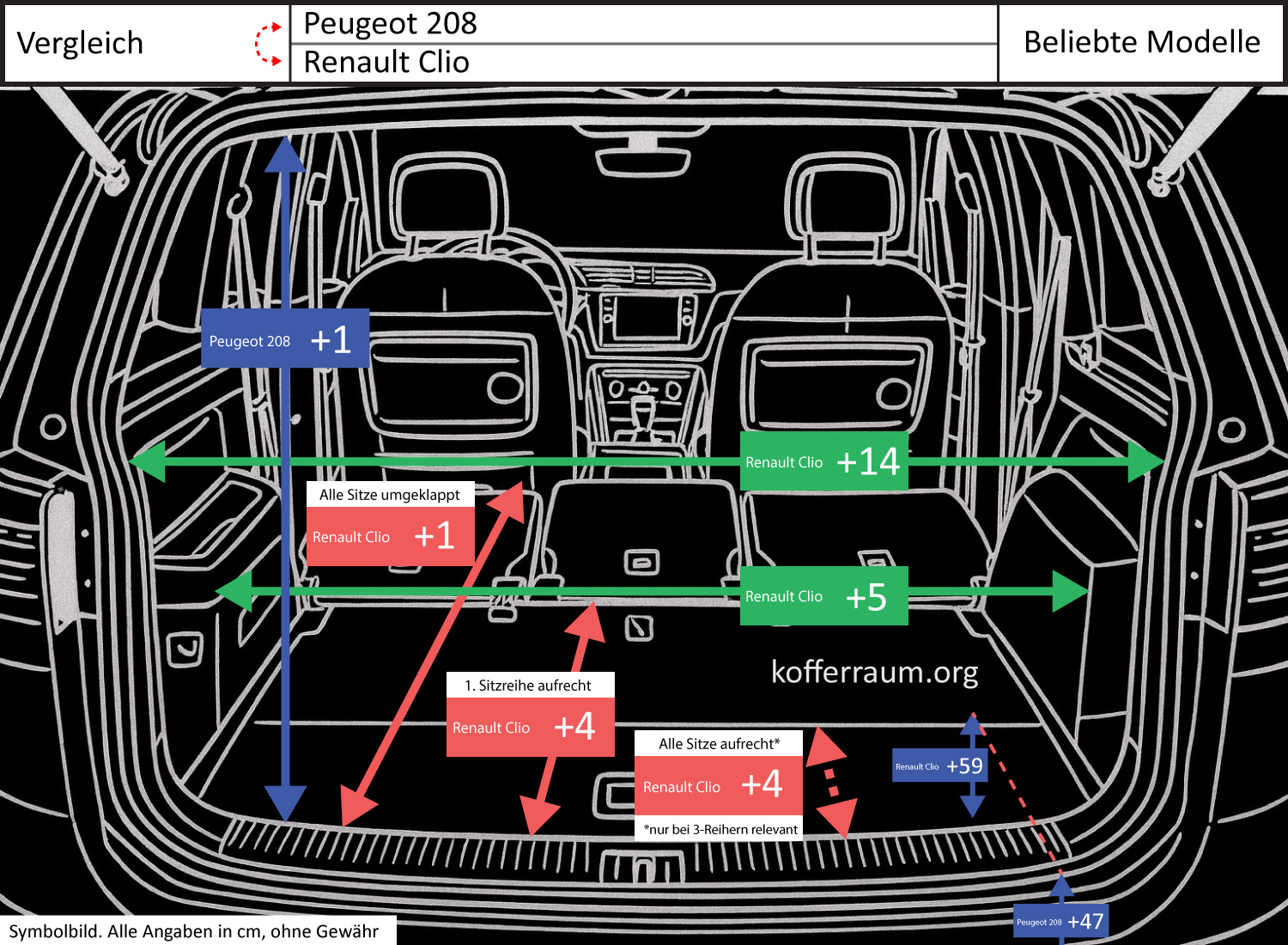
Significantly greater depth in the Renault Clio: The trunk of the Clio is +23.2 in (+328%) deeper (loading edge to trunk floor) than that of the Peugeot 208. This is a substantial difference in usable cargo volume and loading area.
Higher loading edge on the Peugeot 208: The loading edge of the Peugeot is +18.5 in (+196%) higher above the road than that of the Clio. This significantly affects the lifting and sliding angles when loading and unloading.
Wider trunk opening on the Renault Clio: The opening of the Clio is +5.5 in (+16%) wider than that of the 208, which makes maneuvering wider or bulkier items much easier.
What are the usability implications?
Thanks to the significantly greater depth, longer cargo can be better accommodated and utilized in the Clio — longer items lie flatter, and the storage volume is more flexibly usable. Combined with the wider opening, the Clio allows easy loading of bulky or wide cargo without complicated turning or tilting.
The higher loading edge of the Peugeot 208, on the other hand, makes lifting heavy or awkward items into the trunk more difficult: more effort, less favorable angles, and a higher risk of tipping when lifting. For frequent loading and unloading of heavy loads, the Clio is thus more practical in everyday use.
Other, smaller differences
The length of the trunk differs only slightly: with the rear seat folded down, the Clio is +0.4 in (≈1%) longer, with the front seat upright +1.6 in (≈6%).
The height of the trunk opening is +0.4 in (≈1%) greater on the Peugeot. The narrowest width in the trunk is only +2 in (≈5%) larger on the Clio — noticeable, but not decisive.