
Trunk comparison: Peugeot 208 vs Skoda Octavia Wagon
Key Differences
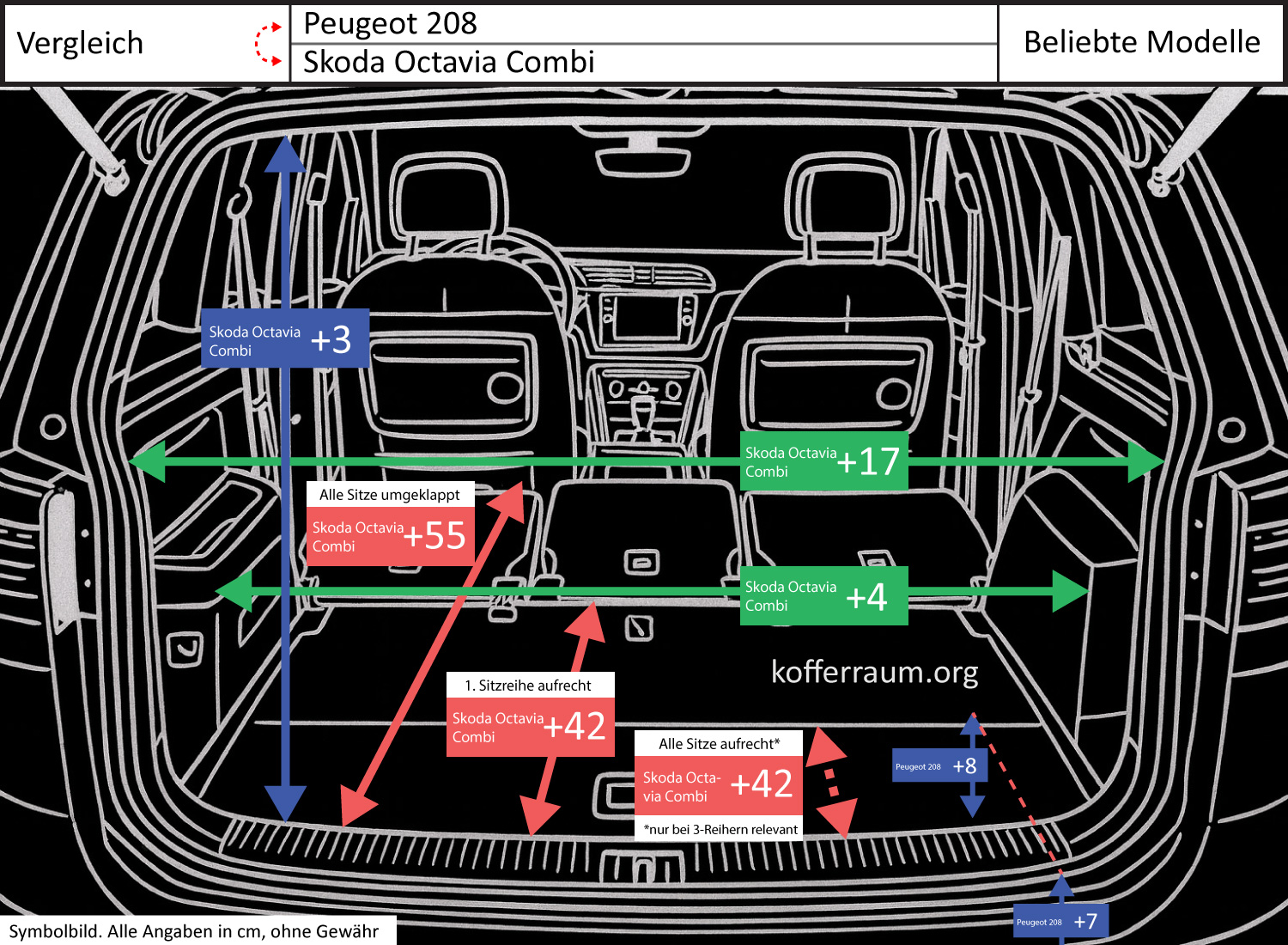
The Škoda Octavia Wagon offers significantly more cargo space in length: with the seats folded down, the cargo area is 21.7 in (42%) longer, and with the first row of seats upright, even 16.5 in (63%) longer than in the Peugeot 208. The cargo opening of the Octavia is also 6.7 in (20%) wider than that of the Peugeot.
In the Peugeot 208, the depth of the trunk (from the loading edge to the trunk floor) is 3.1 in (80%) greater, and the loading edge is 2.8 in (11%) higher above the ground than in the Octavia.
Smaller differences (e.g., opening height +1.2 in / 4% in favor of the Octavia, narrowest width +1.6 in / 4% in favor of the Octavia) exist but are not pronounced.
Impact on Usability
For long or bulky items (boards, skis, furniture parts), the Octavia is clearly advantageous: the significantly greater interior length and the wider opening make loading long and wide cargo easier and allow for more flexible, space-saving transport.
The lower loading edge height of the Octavia makes loading and heavy lifting generally easier.
The Peugeot scores with greater trunk depth: the lower trunk floor relative to the loading edge creates a deeper cargo well, which offers more usable volume for stacked or bulky but not too long cargo and allows luggage to be stored further down.
However, the higher loading edge makes lifting heavy items more strenuous and loading larger objects less practical.
Conclusion: Those who frequently transport long or wide loads or often load and unload will benefit more from the Škoda Octavia Wagon.
Those who mainly need voluminous, stackable luggage and a deeper cargo well will find an advantage in the Peugeot 208—albeit at the expense of comfort when lifting due to the higher loading edge.