Trunk comparison: Peugeot 208 vs Volvo XC40
Key Differences
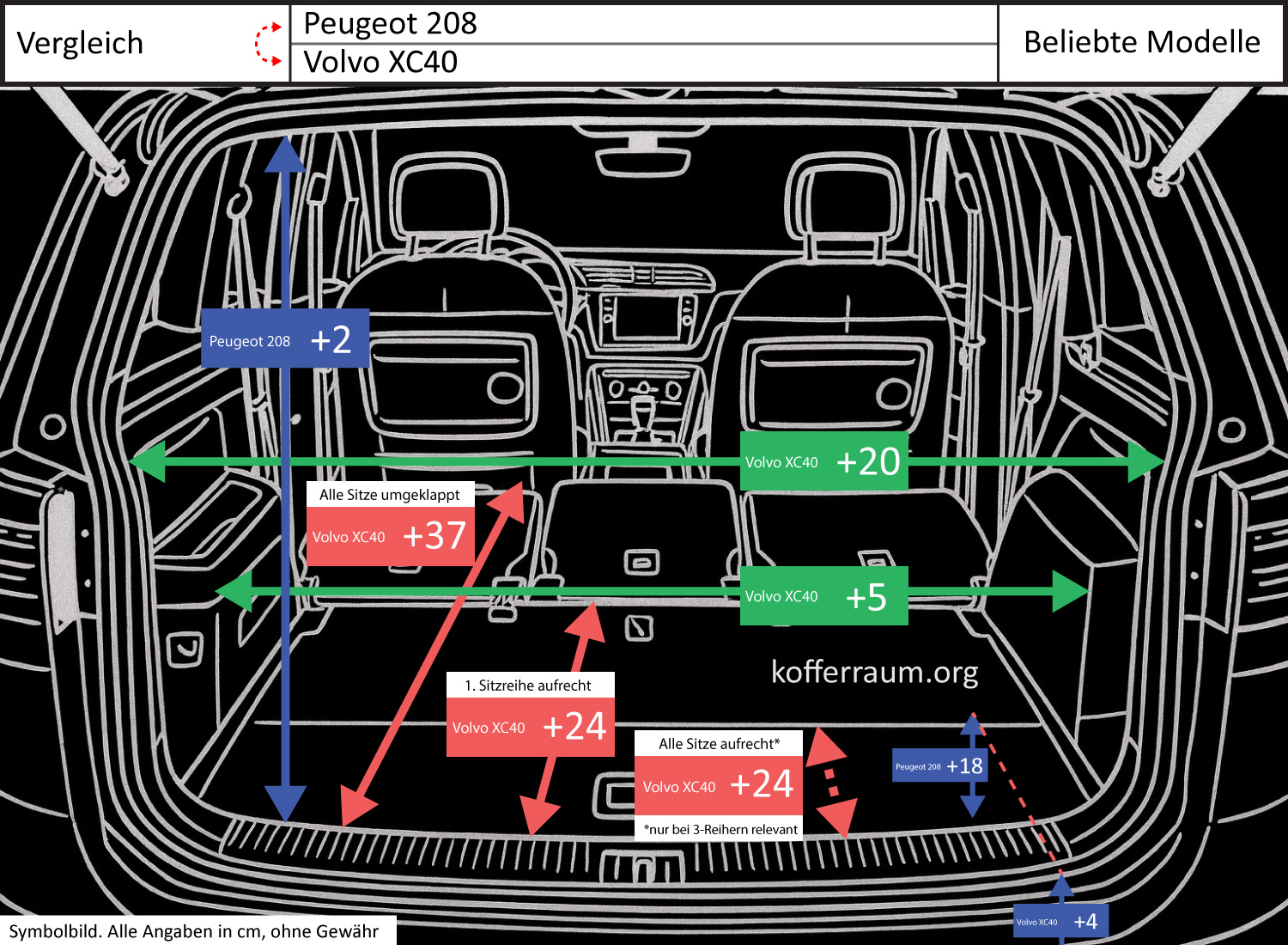
In terms of cargo space, the Volvo XC40 is significantly longer: with the seats folded down, the XC40 offers +14.6 in (28%) more loading length and with the first row of seats upright, +9.4 in (36%) more than the Peugeot 208. The width of the trunk opening also favors the XC40: it is +7.9 in (23%) wider at the opening, which makes loading wider items easier.
Another striking difference is the depth of the cargo area (distance from loading edge → trunk floor): the Peugeot 208 has +7.1 in (1700%) more here than the XC40. Smaller differences: the trunk opening of the Peugeot is +0.8 in (3%) higher, the loading edge of the XC40 is +1.6 in (6%) higher above the ground, and the narrowest interior width of the XC40 is +2 in (5%) larger.
Impact on Usability
The longer loading dimensions and significantly larger opening width of the XC40 make it more practical for long or wide items (e.g., furniture panels, longer sports equipment, or bulky boxes).
Those who frequently transport bulky or long cargo benefit from this because such items can be more easily fully loaded and placed crosswise.
The significantly greater depth in the Peugeot (loading edge → trunk floor) means that the 208 has a deeper cargo well. This creates more "stackable" storage space below the loading edge and keeps luggage lower in the vehicle — advantageous for visibility and a lower center of gravity.
At the same time, a deeper cargo well can make lifting very heavy items somewhat more cumbersome because more reach is required.
The slightly lower loading edge of the Peugeot (XC40 loading edge +1.6 in higher) reduces lifting when loading lighter loads. Conversely, the wider opening of the XC40 facilitates handling bulky objects despite the somewhat higher loading edge.
In short: For regular transport of long or wide items, the Volvo XC40 is the better choice. For compact, deeper-stowed cargo or frequent loading and unloading of lighter loads, the Peugeot 208 can be more practical.