Trunk comparison: Peugeot 208 vs VW ID.3
Biggest Differences
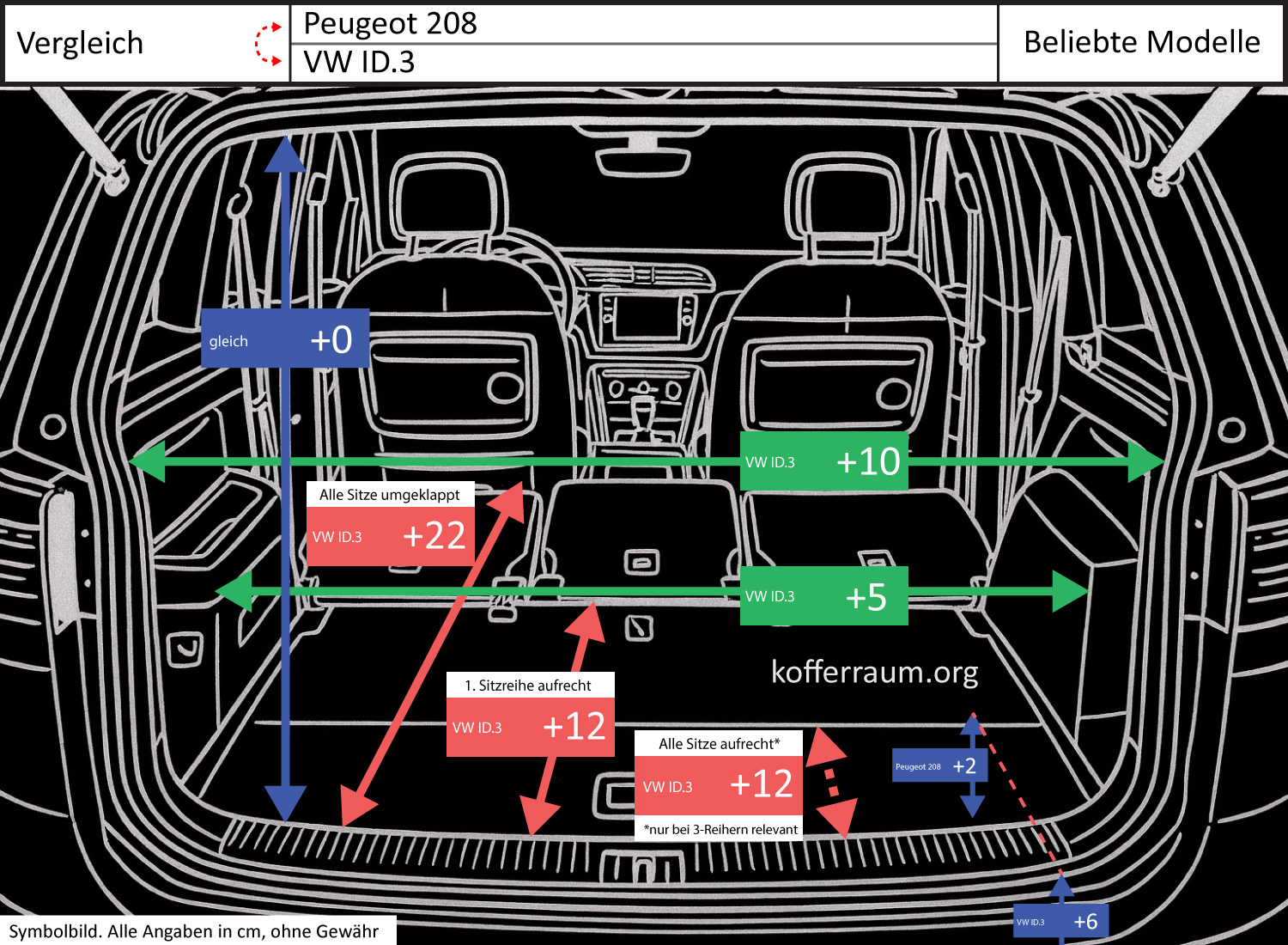
The VW ID.3 offers significantly more space in the length of the cargo area: With the rear seat folded down, the trunk of the ID.3 is **8.7 in (+17%) longer** than that of the Peugeot 208, and with the front seats upright, it is **4.7 in (+18%) longer**.
The width of the trunk opening is also noticeably larger on the ID.3: **3.9 in (+12%) wider** than on the Peugeot 208. Conversely, the Peugeot 208 has a deeper trunk floor (distance from loading edge to trunk floor) — this is **0.8 in (+13%) higher** on the 208 than on the ID.3. The height of the trunk opening is the same on both models.
Impact on Usability
The greater cargo length of the ID.3 makes it significantly more practical for long items such as skis, slats, furniture panels, or when transporting bicycles (with appropriate modifications): It offers more pass-through length both with folded seats and in everyday use with the rear seat upright.
The wider opening of the ID.3 makes loading and unloading bulky or wide items easier and reduces the risk of cargo getting stuck on the sides.
The deeper trunk floor of the Peugeot 208 increases the usable vertical volume and ensures that smaller luggage and boxes are better "recessed" and less visible.
Additionally, the loading edge on the 208 is lower (although the difference to the loading edge height of the ID.3 is smaller here), making it easier to lift heavy items — in other words: lifting effort is somewhat more ergonomic in the 208.
In practice, this means: Those who regularly transport long or wide items or frequently load bulky cargo will find the VW ID.3 the better choice.
Those who more often handle smaller suitcases, shopping bags, or delicate cargo and prefer shorter lifting distances benefit from the deeper floor and lower loading edge of the Peugeot 208.