Trunk comparison: Peugeot 208 vs VW T-Roc
Key Differences
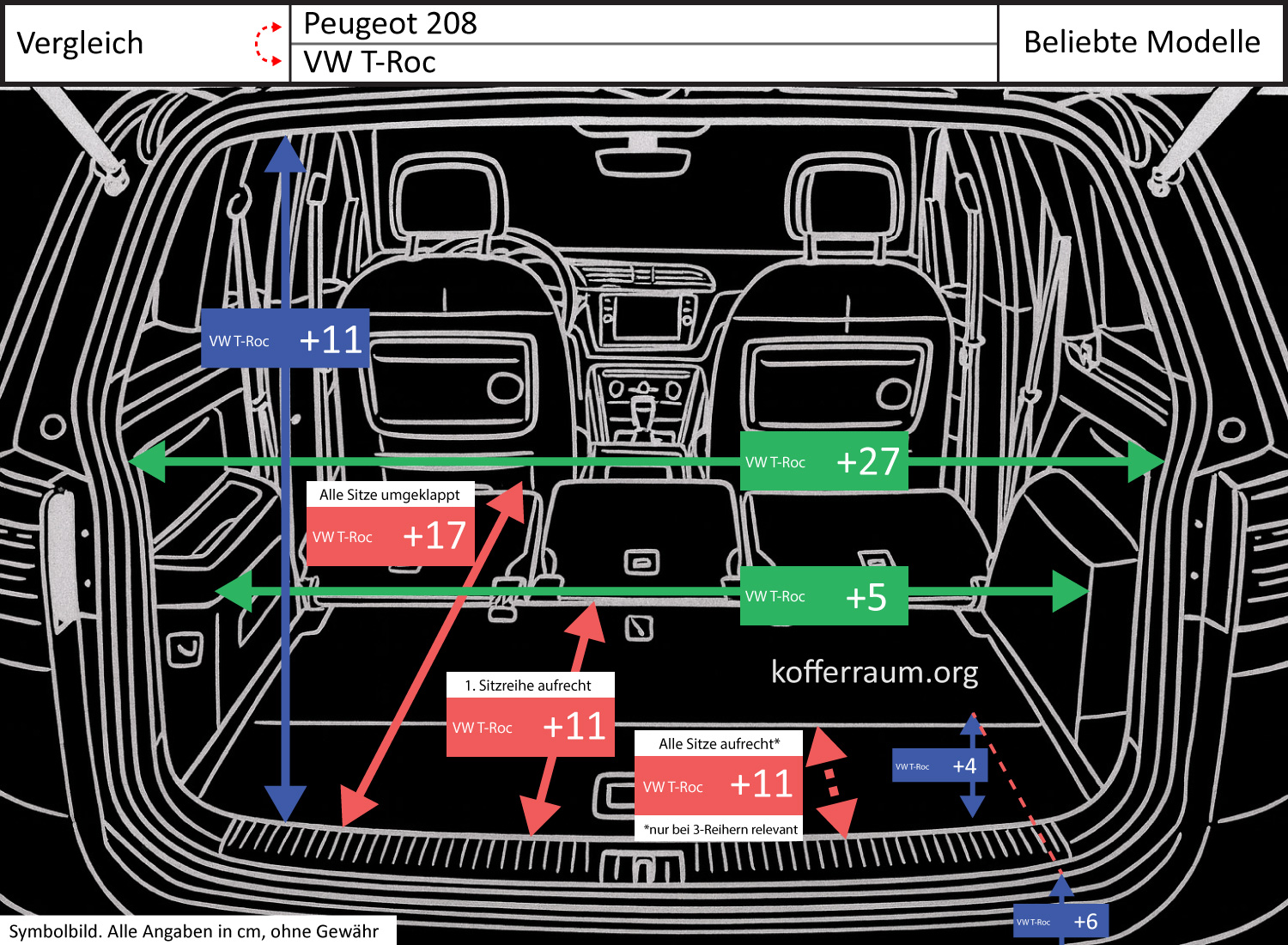
The VW T‑Roc offers significantly more cargo space in several relevant dimensions: with the seats folded down, the trunk is 6.7 in (13%) longer, and with the rear seat upright, 4.3 in (16%) longer than the Peugeot 208. The height of the trunk opening is 4.3 in (15%) larger, and the depth from the loading floor to the edge is 1.6 in (22%) higher.
Additionally, the width of the trunk opening in the T‑Roc is 10.6 in (31%) larger. Smaller differences include the loading sill being only 2.4 in (8%) higher above the ground in the T‑Roc and the narrowest trunk width being just 2 in (5%) wider.
Implications for Usability
The longer loading options (with seats folded +13% and with rear seat up +16%) make the T‑Roc noticeably more flexible for long or bulky items – such as furniture parts, long packages, or skis.
The significantly larger opening height and especially the much wider opening (+31%) greatly facilitate loading wide objects and bulky luggage, as fewer edges and tight spots need to be negotiated.
The greater depth (+22%) means more usable vertical volume: boxes or bags can be stacked better and less often reach the tailgate.
On the other hand, the slightly higher loading sill (+2.4 in, 8%) makes lifting heavy items a bit more strenuous — but this disadvantage is relatively minor and is usually offset by the significantly larger opening and the additional interior volume.
The marginally larger narrowest width (+2 in) is unimportant for most loading cases.
Conclusion: Those who frequently transport long, wide, or stackable loads will noticeably benefit from the VW T‑Roc. For pure city or occasional luggage transport, the Peugeot 208 remains suitable but loses out in flexibility and handling of heavy/bulky loads.