
Trunk comparison: Peugeot 3008 vs Skoda Karoq
Key Differences
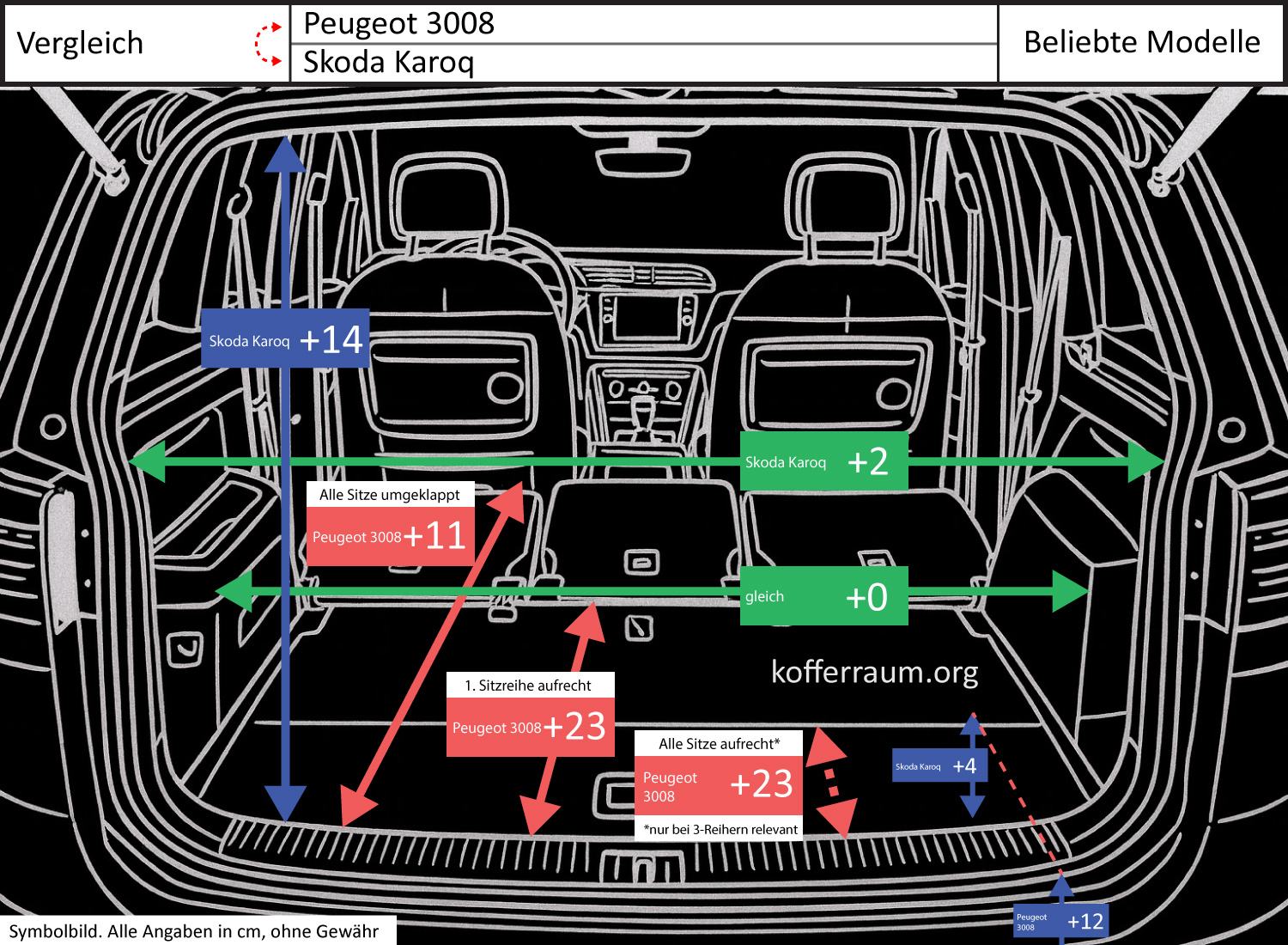
When it comes to cargo space, there is a clear picture: The Peugeot 3008 offers a cargo floor length that is 9.1 in (≈30%) longer with the rear seat upright than the Škoda Karoq.
The Karoq, on the other hand, has a significantly higher trunk opening (+5.5 in / ≈18%) and a greater depth from the loading edge to the trunk floor (+1.6 in / ≈36%).
The loading edge of the Peugeot is also about 4.7 in (≈18%) higher above the road. Smaller differences: With the seats fully folded down, the Peugeot is only about 4.3 in (≈7%) longer and the width at the narrowest point is the same; the opening width of the Karoq is only about 0.8 in (≈2%) larger.
Impact on Usability
The longer cargo floor of the Peugeot with the rear seat upright makes it more practical if you regularly need to transport long items without folding down the rear seats (e.g., skis, long boards, or furniture parts).
For transport tasks where the seats are often occupied and length is still needed, the 3008 has the advantage.
The Škoda Karoq wins in vertical storage space and when loading taller or bulkier items: The higher trunk opening provides more headroom when placing tall boxes or equipment inside, and the greater depth (loading edge→floor) increases the usable volume inside. This is practical for bulky or stackable cargo.
The higher loading edge of the Peugeot (4.7 in) negatively affects lifting heavy items: loading requires more lift height and thus more effort. The Karoq with its lower loading edge is more ergonomic here and easier to handle for frequent lifting or heavy loads.
Since the interior width at the narrowest point is the same and the opening width differs only minimally, width and loading wide items play hardly any role in model choice in practice.
Conclusion: For longer items with the rear seats in use, the Peugeot 3008 is advantageous. For vertically bulky, stackable, or frequently lifted cargo, the Škoda Karoq is more practical.