Trunk comparison: Peugeot 308 SW 3-row vs Durchschnitt Compact SUV
Key Differences
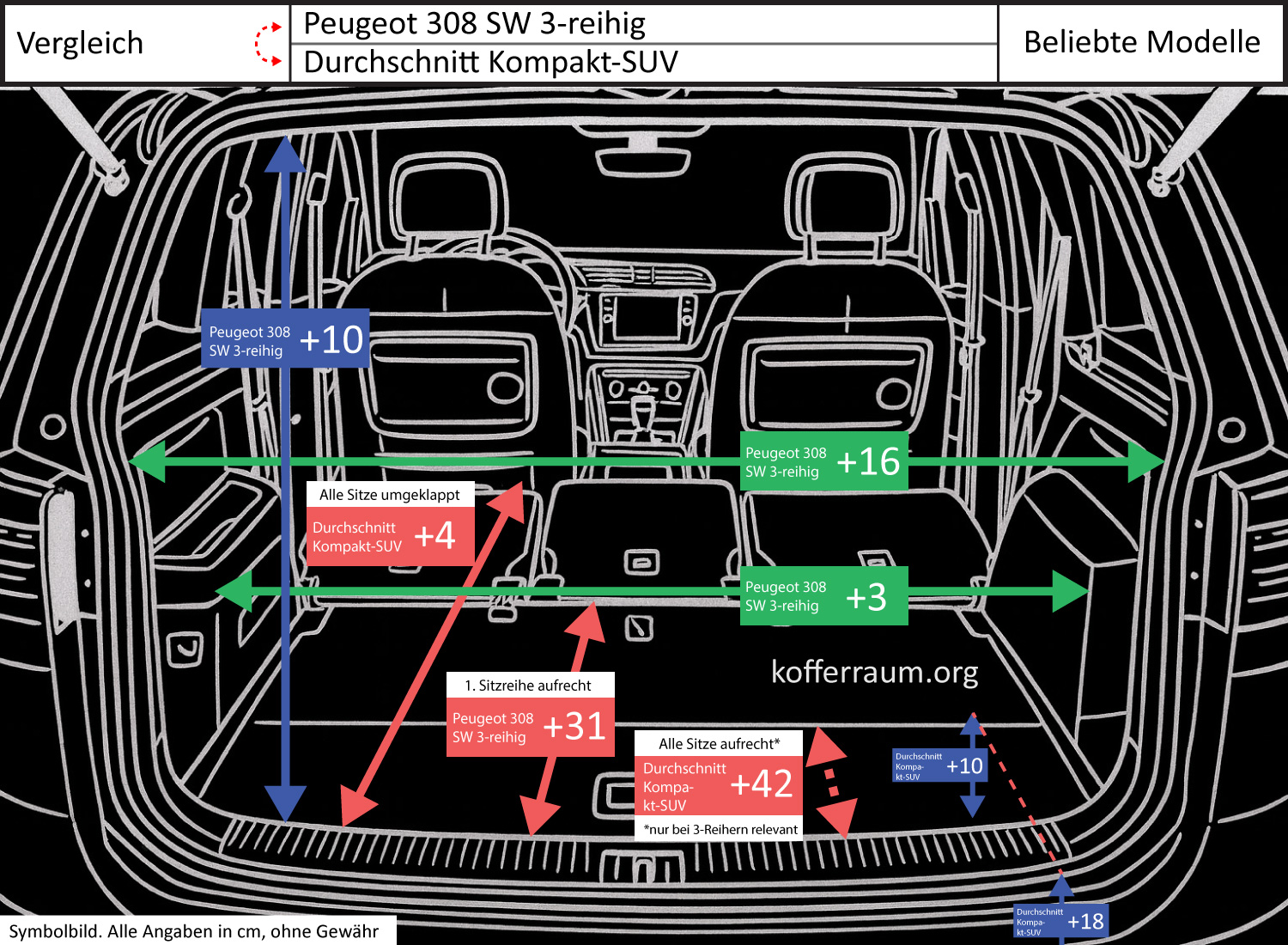
When comparing the cargo space parameters, several clear differences stand out: The Peugeot offers with the front row seats upright a cargo space length that is 12.2 in (40%) longer than the average compact SUV, while the compact SUV with all seats upright has a cargo space length that is 16.5 in (120%) longer than the Peugeot.
The trunk opening of the Peugeot is 3.9 in (13%) higher, and the width of the trunk opening is 6.3 in (16%) larger than that of the SUV.
Inside, the compact SUV shows a significantly greater depth (loading edge to trunk floor) — plus 3.9 in (250%) — while its loading edge is 7.1 in (32%) higher above the road than the Peugeot's. Smaller differences like +1.6 in (3%) with folded seats or a 1.2 in (3%) narrower bottleneck are negligible.
Impact on Usability
These differences lead to specific usability consequences: The Peugeot, with its lower loading edge, higher trunk opening, and wider opening, is ergonomically more favorable for loading and unloading heavy or bulky items — less lifting effort and more space to maneuver larger parts through the opening.
The longer length measurement with the front seats upright also makes the Peugeot advantageous when transporting longer items without moving the front seats.
The compact SUV scores when all seats are needed: With significantly more usable cargo length with all seats upright and especially with much greater interior depth, it offers more volume for luggage when fully occupied.
However, the higher loading edge of the SUV makes lifting heavy loads more cumbersome; the greater interior depth can offset this disadvantage with lighter, stackable luggage.
In summary: For frequent loading of heavy, bulky items and comfortable loading with less physical effort, the Peugeot is more practical. For maximum cargo space with full seating and more interior volume (at the expense of less ergonomic loading height comfort), the compact SUV is the better choice.