Trunk comparison: Peugeot 308 SW 3-row vs Skoda Kamiq
Key Statements
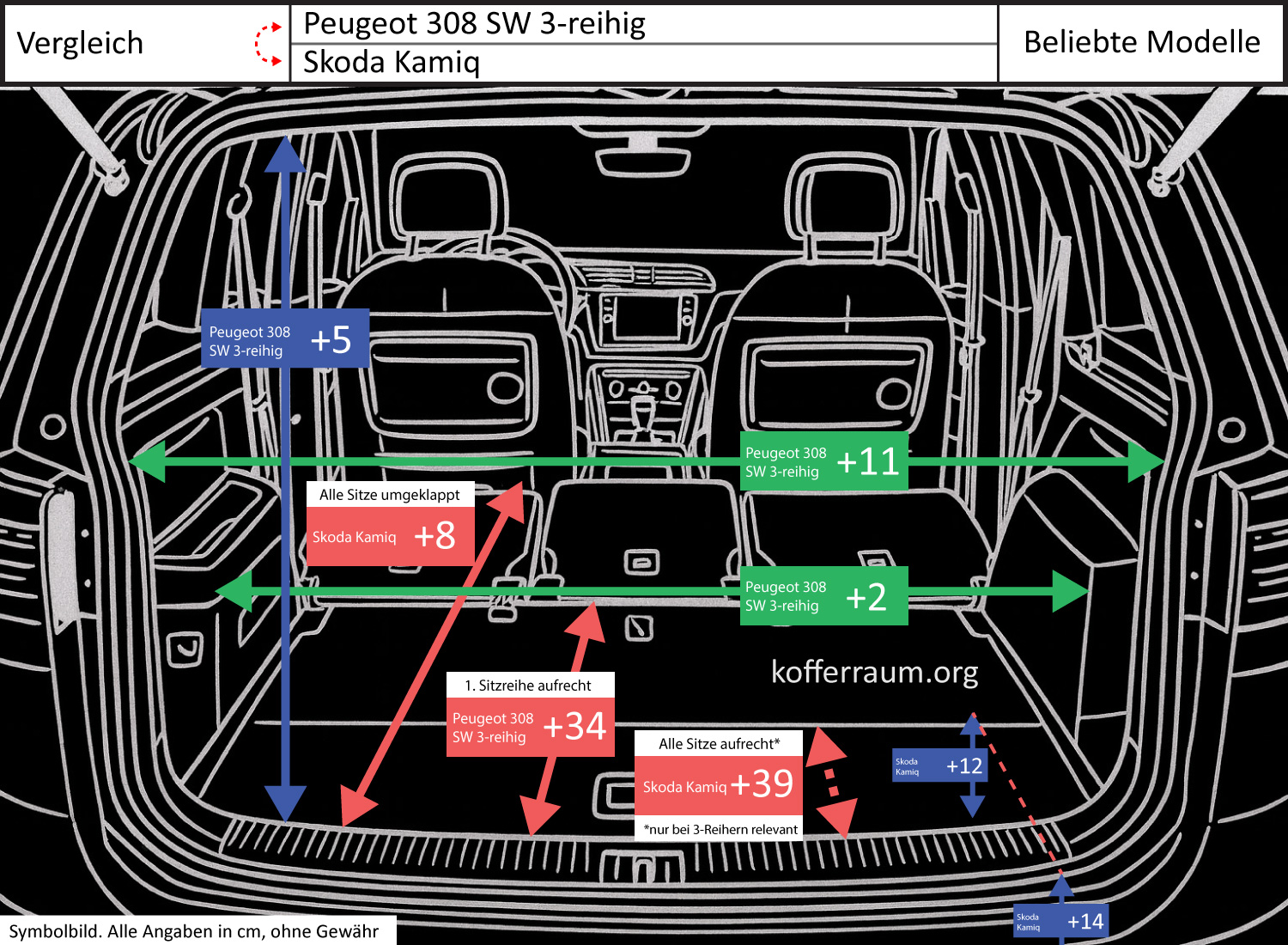
Several clear differences stand out from the measurements. The Peugeot 308 SW offers a significantly longer cargo area with the first row of seats upright: +13.4 in (46%) compared to the Škoda Kamiq. In contrast, the Škoda has a significantly larger trunk when all seats are upright: +15.4 in (111%).
Furthermore, the geometry of the loading zone differs greatly: the depth from the loading edge sill to the trunk floor is +4.7 in (300%) greater in the Škoda, and the loading edge itself is +5.5 in (25%) higher above the road surface. The loading opening of the Peugeot is also wider: +4.3 in (11%).
Implications for Usability
The significantly larger cargo area of the Peugeot in the mentioned seat configuration makes it more practical when transporting longer items or when parts of the rear seat rows need to be used flexibly to accommodate longer cargo.
Combined with the wider loading opening, this facilitates loading wider or bulkier items.
The Škoda scores points when all seat rows need to be used: with more than twice the space with upright seats, it is clearly advantageous for trips with multiple passengers plus luggage (e.g., everyday family use).
The greater depth of the cargo area also creates more usable volume vertically but can practically mean that items lie deeper and are harder to access when securing them.
The higher loading edge of the Škoda makes lifting heavy suitcases or groceries onto the cargo area more strenuous compared to the Peugeot, whose lower loading edge makes loading and unloading easier.
Overall: those who frequently transport long or wide items and prefer easy access benefit more from the Peugeot; those who regularly travel fully occupied plus with a lot of luggage and need more volume with upright seats are better served by the Škoda.