Trunk comparison: Peugeot 308 SW 3-row vs VW Polo
Significant Differences (>10%) and Implications for Usability
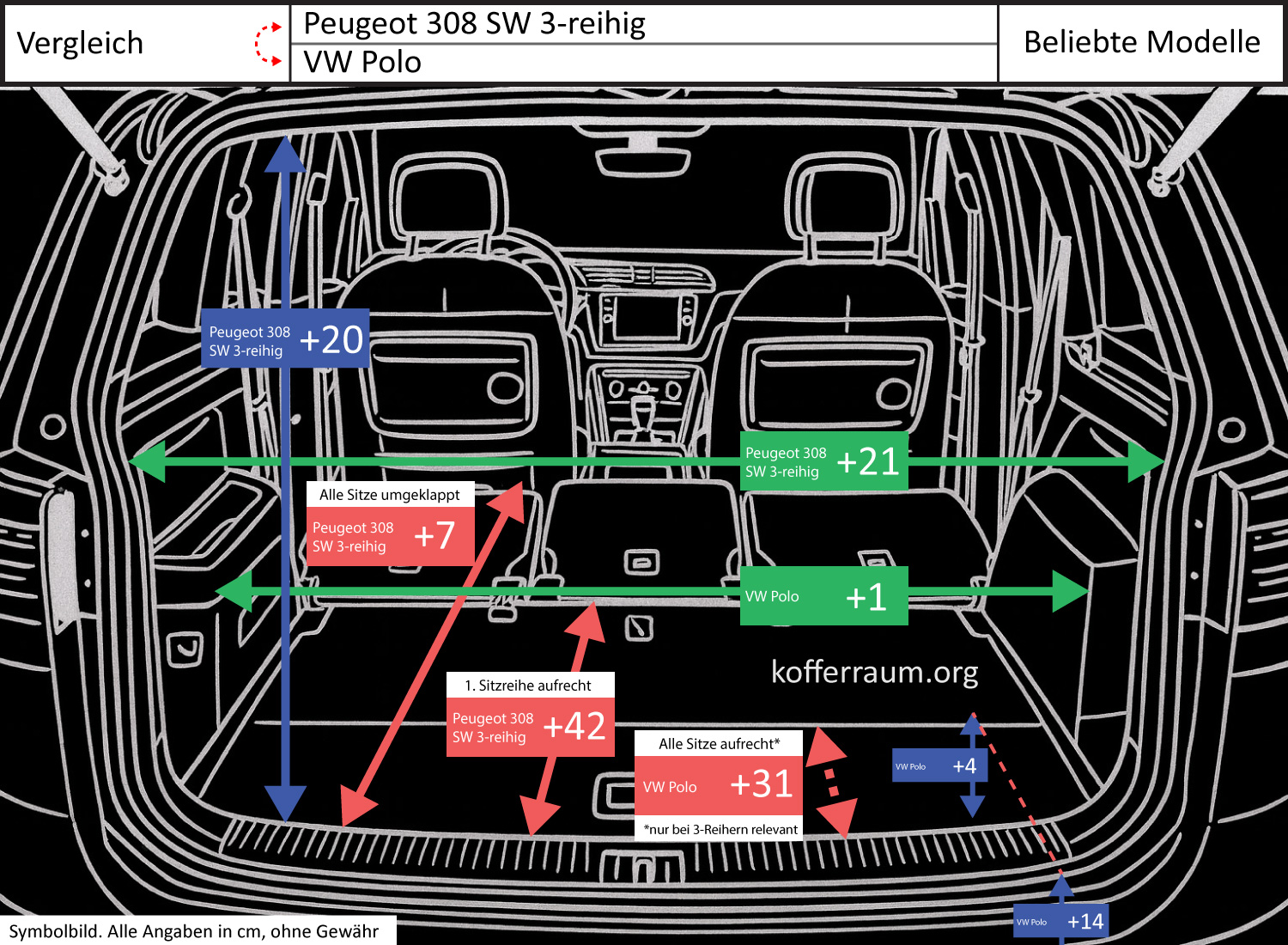
The Peugeot offers +16.5 in (64%) more trunk length when the first row of seats is upright, providing significantly more space for long cargo with the rear seats folded down or pushed forward.
This makes the Peugeot more practical for transporting longer items (e.g., furniture parts, skis) without extreme rearrangement of the seating configuration.
The VW Polo, on the other hand, has +12.2 in (89%) more trunk length when all seats are upright.
This makes the Polo more straightforward to use for everyday situations with full seating and luggage: it offers more usable cargo space without needing to fold down seats — practical for trips with multiple passengers and luggage.
The trunk opening of the Peugeot is +7.9 in (29%) higher and also +8.3 in (23%) wider than that of the Polo.
Together, this means it is significantly easier to load and unload wide and tall items (boxes, cartons, bulky furniture parts). A wider opening plus greater height reduces maneuvering when loading and increases the maximum cross-stacking capability of large items.
In the VW Polo, the trunk depth (loading edge to trunk floor) is +1.6 in (100%) greater and the loading edge overall is +5.5 in (25%) higher above the road.
The greater installation depth can offer more volume in the lower area; however, the higher loading edge makes lifting heavy items onto the cargo area more difficult. For frequent lifting of heavy loads or easy rolling in and out of luggage, this is a disadvantage compared to the lower Peugeot loading sill.
In summary: Peugeot scores when loading bulky, tall, or wide items thanks to a significantly larger opening height and width as well as greater length with the first row of seats upright.
The Polo is advantageous when all seats are to be used, as it then offers more usable trunk length; it also has a deeper cargo well, but at the cost of a higher loading edge, which complicates handling heavy loads.