Trunk comparison: Peugeot 308 SW 3-row vs VW T-Roc
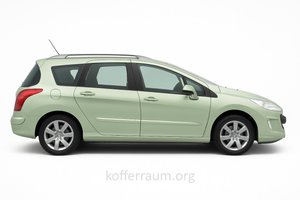
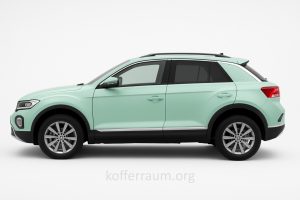
Key Differences (>10%)
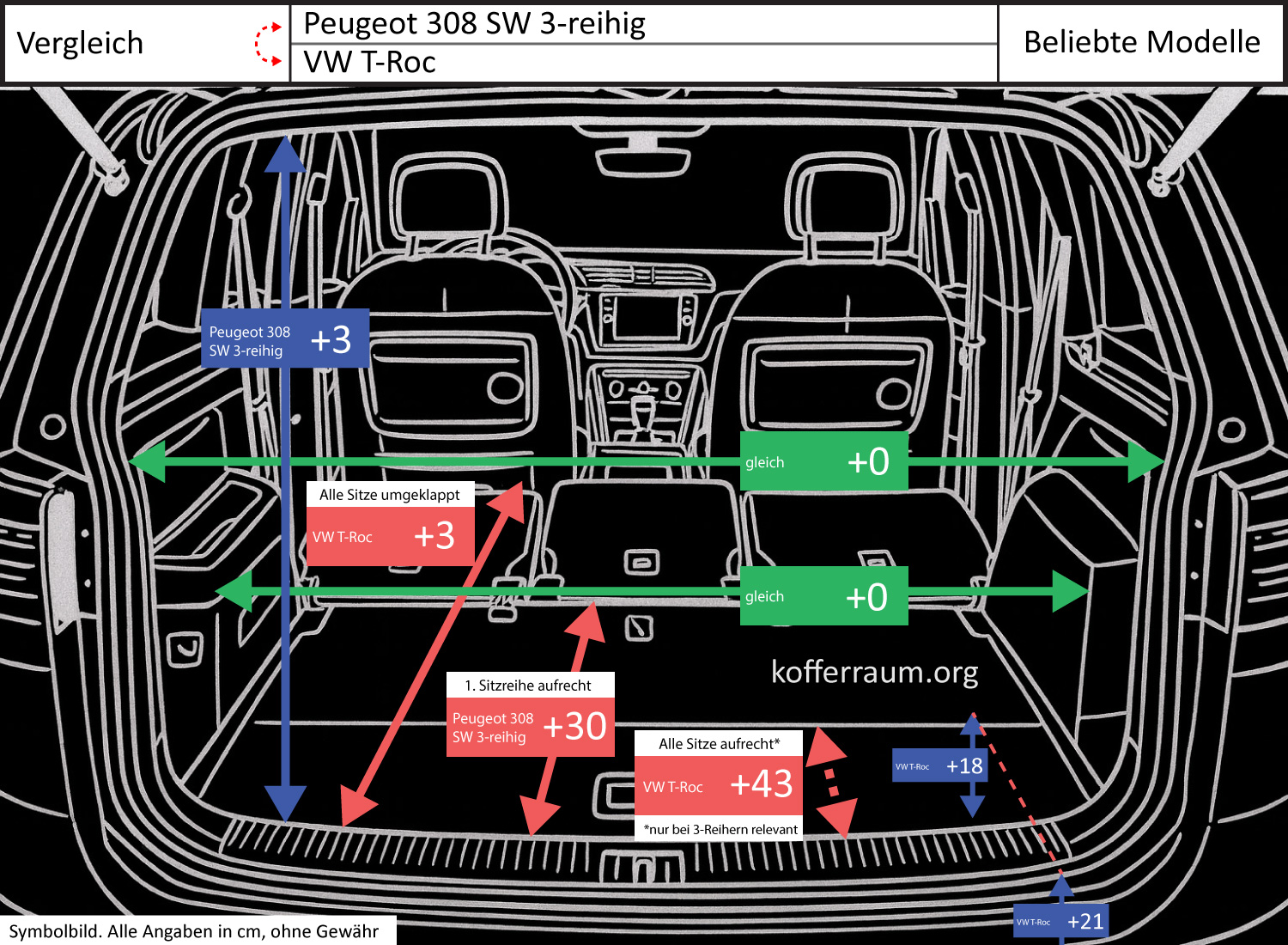
Significant differences mainly concern the usable cargo volume in certain seating configurations and the loading geometry: With all seats upright, the VW T‑Roc offers a significantly larger trunk (+16.9 in / +123%) compared to the Peugeot 308 SW 3-row.
Conversely, the Peugeot has a larger cargo space (+11.8 in / +38%) than the T‑Roc in the "first row upright" configuration. The trunk depth (loading edge to trunk floor) is +7.1 in or +450% greater in the VW, and the loading edge of the VW is +8.3 in or +38% higher above the road.
Impact on Usability
The significantly larger loading capacity of the VW T‑Roc with all seats upright makes it more practical when all seats are occupied and a lot of luggage still needs to be transported – for example, on family trips with full occupancy.
The Peugeot, on the other hand, scores in the mentioned seating configuration ("first row upright") with more cargo space and is therefore advantageous when certain rows are used differently or folded down and longer items need to be transported.
The greater depth in the T‑Roc means more vertical or usable space in the cargo area – better for stacking or tall items. However, the simultaneously higher loading edge of the VW makes lifting heavy loads more strenuous and complicates sideways sliding of low, heavy items.
The Peugeot, with a lower loading edge, is more ergonomic when loading and unloading heavy or bulky items but offers less stacking space due to the shallower depth.
Width and opening width are the same in both models, and the smaller differences (e.g., +1.2 in in trunk length with folded seats or +3% opening height) are hardly relevant for everyday use.
In summary: VW T‑Roc = more volume with full occupancy and more vertical space; Peugeot 308 SW 3-row = better lifting ergonomics and more usable length in certain seating configurations.