Trunk comparison: Peugeot 5008 vs VW T-Roc
Key Differences
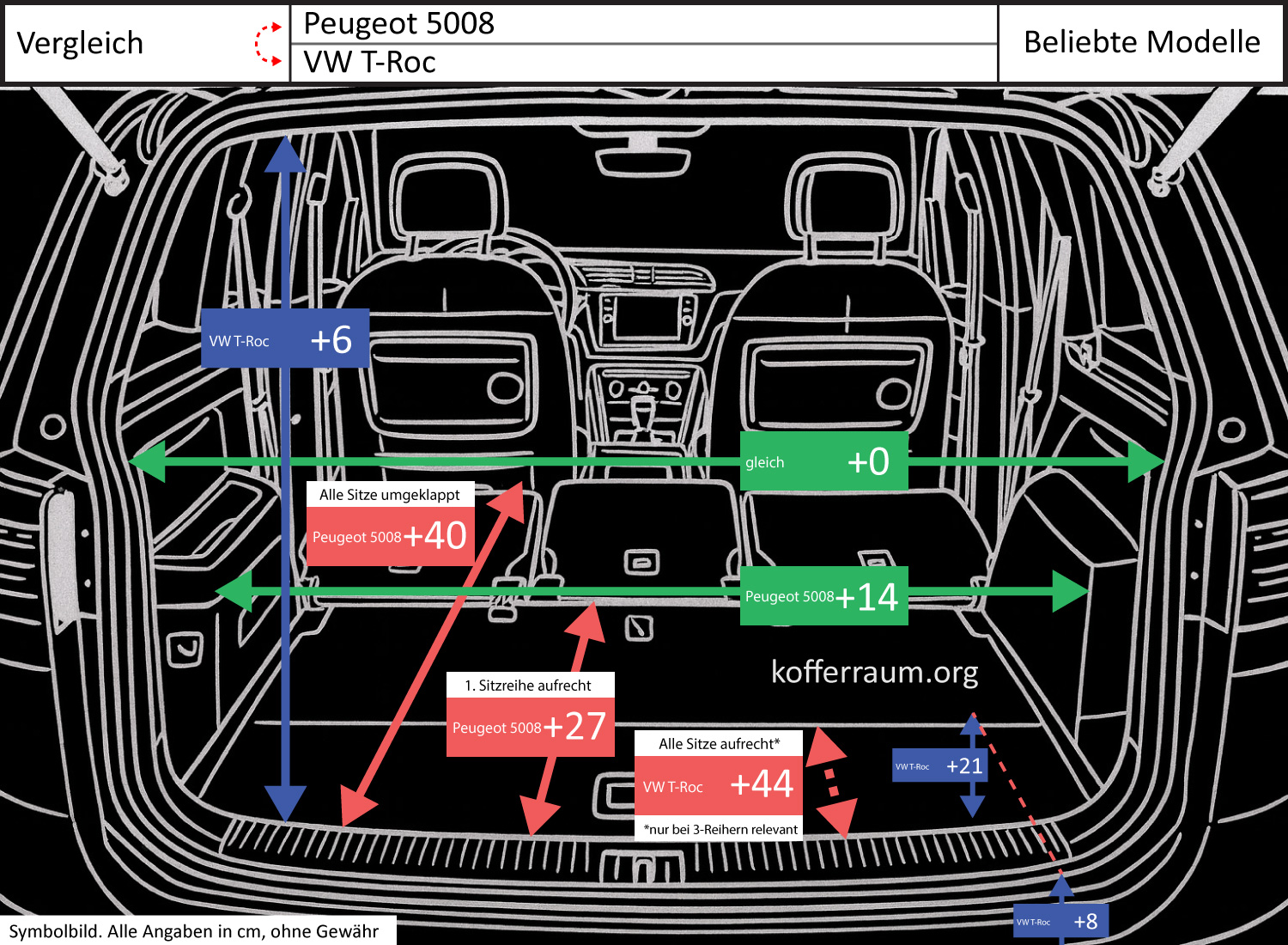
The Peugeot 5008 offers significantly more cargo length with the seats folded down than the VW T‑Roc: +15.7 in (27%). Even with the first row of seats upright, the 5008 has a longer trunk space: +10.6 in (35%).
Conversely, the VW T‑Roc has a significantly larger trunk with all seats up: +17.3 in (129%) compared to the 5008. Additionally, the loading edge and floor geometry differ: the depth (loading edge to trunk floor) of the T‑Roc is considerably greater (+8.3 in / 2100%), and the loading edge itself sits higher (+3.1 in / 12%) than in the 5008. The narrowest width in the trunk is larger in the Peugeot (+5.5 in / 14%), while the width of the trunk opening is the same in both models.
Impact on Usability
For transporting with folded seats or longer cargo (e.g., furniture, long packages), the Peugeot 5008 is more practical: the longer cargo floor makes it easier to store longer items without having to consider seat configurations.
The larger narrowest interior width of the 5008 also makes it more suitable for wider parts that would otherwise be problematically tight.
The VW T‑Roc scores when the seats remain upright and luggage still needs to be accommodated: its significantly larger trunk with full seating makes it better suited for passengers plus normal luggage (vacations, shopping with multiple passengers).
The greater depth of the T‑Roc’s trunk means more vertical space behind the loading edge but can make lifting heavy items more difficult because the loading edge and floor clearance are higher.
The higher loading edge of the T‑Roc generally requires more effort when loading heavy loads but is advantageous for stacked cargo or tall boxes.
In summary: For flexible long loads and wider parts, the Peugeot 5008 is more advantageous. For more usable storage space with full passenger capacity and higher stackable cargo, the VW T‑Roc is more practical, but this comes with compromises in loading comfort and handling low, heavy loads.