
Trunk comparison: Renault Austral vs Durchschnitt SUV

Key Differences
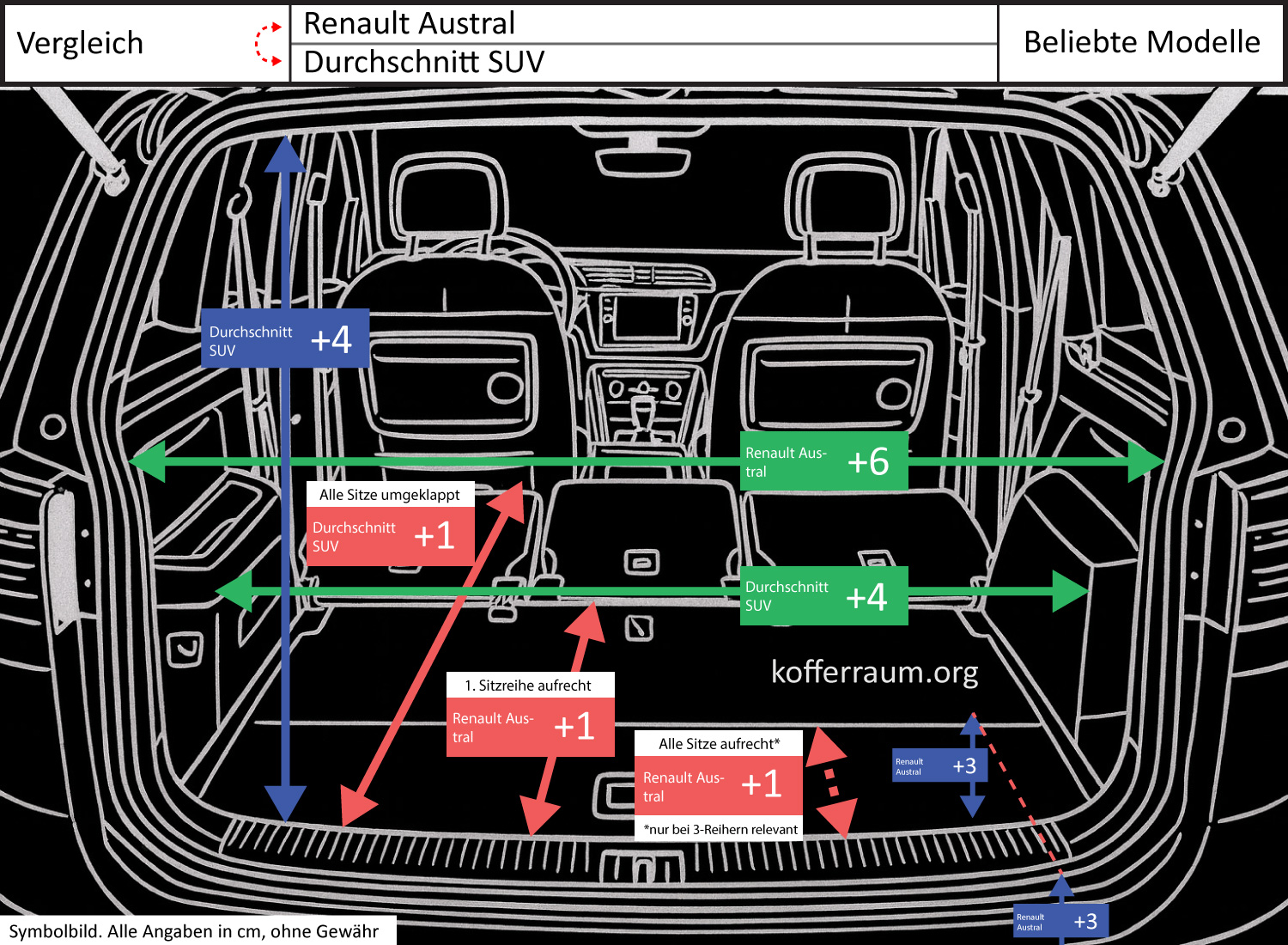
The models differ only slightly in length and width, with few relevant exceptions. The trunk is 0.4 in longer in the Renault Austral with the first row of seats folded up, while the trunk is 0.4 in longer in the average SUV with the seats folded down — both negligible.
The trunk opening of the average SUV is 1.6 in (5%) higher than that of the Austral, and the narrowest interior width is also 1.6 in (4%) larger in the average SUV.
The Renault Austral has a 2.4 in (6%) wider tailgate opening and a 1.2 in (4%) higher load lip above the road.
Particularly notable is the difference in trunk depth: the distance from the load lip to the trunk floor is 1.2 in greater in the Renault Austral — this corresponds to an increase of 60% compared to the average SUV; this deviation is the only one significantly above 10% (significant deviation).
Implications for Usability
Deeper loading floor (Renault Austral): The considerably greater depth between the load lip and the trunk floor means that cargo sits deeper in the Austral.
This reduces the visible height of the load, improves securing luggage against shifting, and creates a lower center of gravity for the contents — advantageous for stable loading and transporting smaller, stackable goods.
Because the load lip in the Austral is simultaneously 1.2 in higher, these two effects partially offset each other in practice: the actual lifting effort from the road to the trunk floor height may thus be closer to average.
Height of trunk opening (Average SUV): The 1.6 in higher opening makes loading very tall items easier (e.g., furniture pieces, larger boxes). Those who frequently transport bulky, tall objects have an advantage with the average SUV.
Opening width vs. interior width: The Renault Austral offers a 2.4 in wider opening — this facilitates maneuvering wide, flat cargo through the tailgate.
However, the narrower interior width at the tightest point (-1.6 in compared to average) can restrict placing very wide items inside. Result: Austral more easily accommodates wide, flat parts through the opening, while the average SUV offers somewhat more space inside for bulky items.
Practical conclusion: For everyday and family-related use, the differences are minor. The Renault Austral scores with a deeper loading position and wider opening — good for secured, low-lying cargo and wide items when sliding through.
The average SUV has advantages when loading very tall items and offers slightly more interior width at the narrowest point. Differences in cargo length (±0.4 in) are negligible.