
Trunk comparison: Renault Austral vs Skoda Fabia


Main Differences
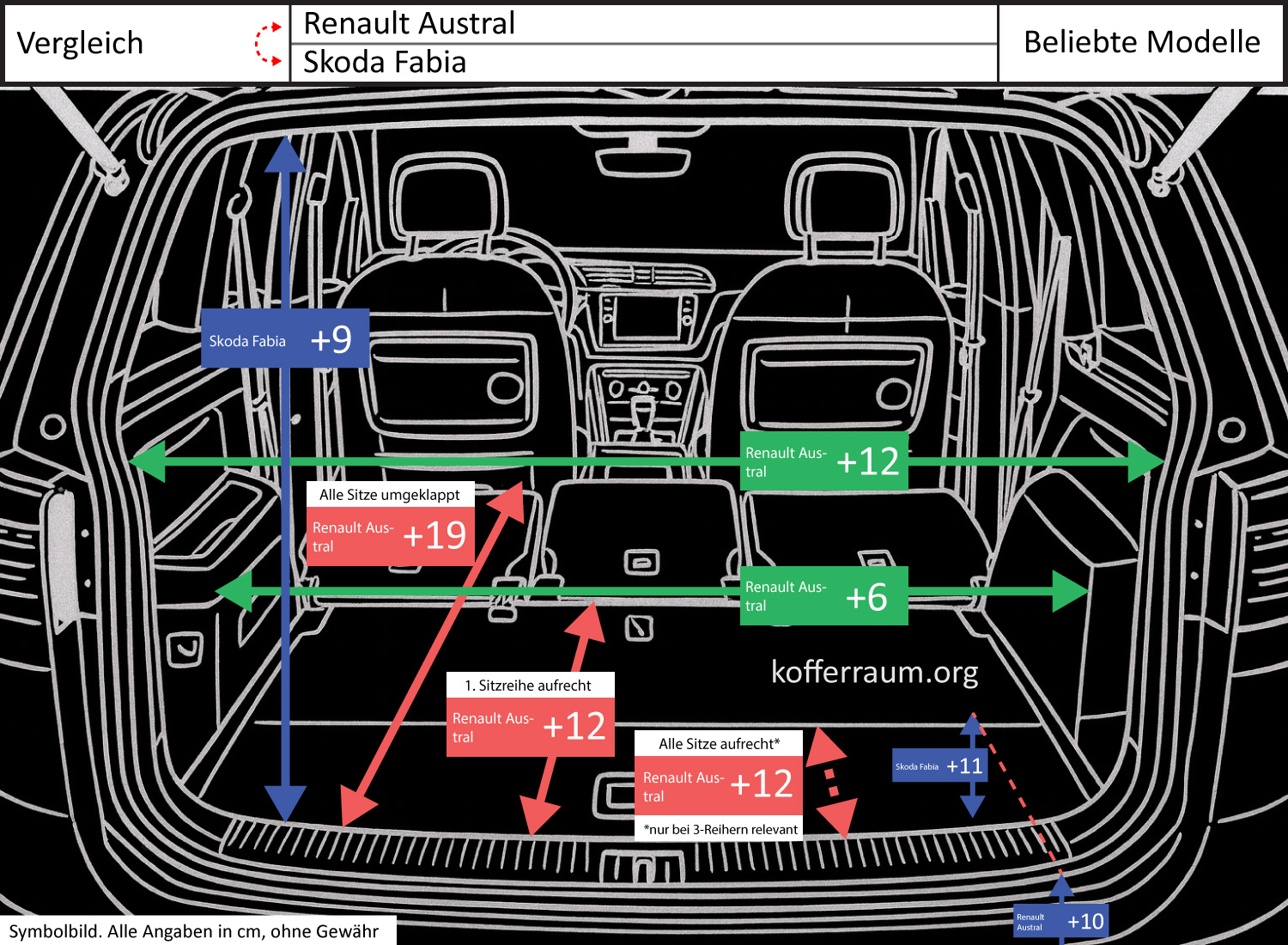
The Renault Austral offers a significantly larger cargo area when the seats are folded down: +7.5 in (13%) longer trunk than the Skoda Fabia.
Even with the front seats upright, the Austral is +4.7 in (16%) longer. The width of the trunk opening is +4.7 in (12%) larger on the Austral, making it easier to load wide items.
The Skoda Fabia has two other values that are clearly advantageous: the trunk opening is +3.5 in (12%) higher, and the depth between the loading edge and the trunk floor is +4.3 in (138%) significantly greater than on the Austral.
Additionally, the loading edge of the Renault Austral is +3.9 in (15%) higher above the ground than that of the Fabia.
Impact on Usability
The longer cargo space of the Austral (with folded seats and with the front row upright) as well as the larger opening width make it clearly better suited for long or wide loads such as furniture parts, long sports equipment (e.g., skis), or wide boxes.
The larger opening width reduces maneuvering when loading and unloading bulky items.
The Skoda Fabia scores in height and depth: The higher trunk opening facilitates sliding through tall items and reduces the risk of hitting the upper edge when loading.
The significantly greater depth between the loading edge and the trunk floor means that heavy or bulky items can lie deeper in the cargo area — this can provide more lateral stability and somewhat more usable volume, but at the same time makes access to items lying on the floor somewhat more cumbersome.
The higher loading edge of the Austral (3.9 in) means that more lifting force is required when handling heavy loads; loading and unloading heavy items is overall more comfortable in the Fabia due to the lower loading edge.
In summary: the Austral is more practical for long and wide cargo, while the Fabia is more comfortable when handling tall or heavy items and for frequent loading and unloading thanks to the lower loading edge and deeper cargo well.
Small differences such as the narrower bottleneck (Austral +2.4 in / 6%) are less relevant for everyday use and hardly change the overall assessment.