
Trunk comparison: Renault Austral vs Volvo XC40


Key Differences
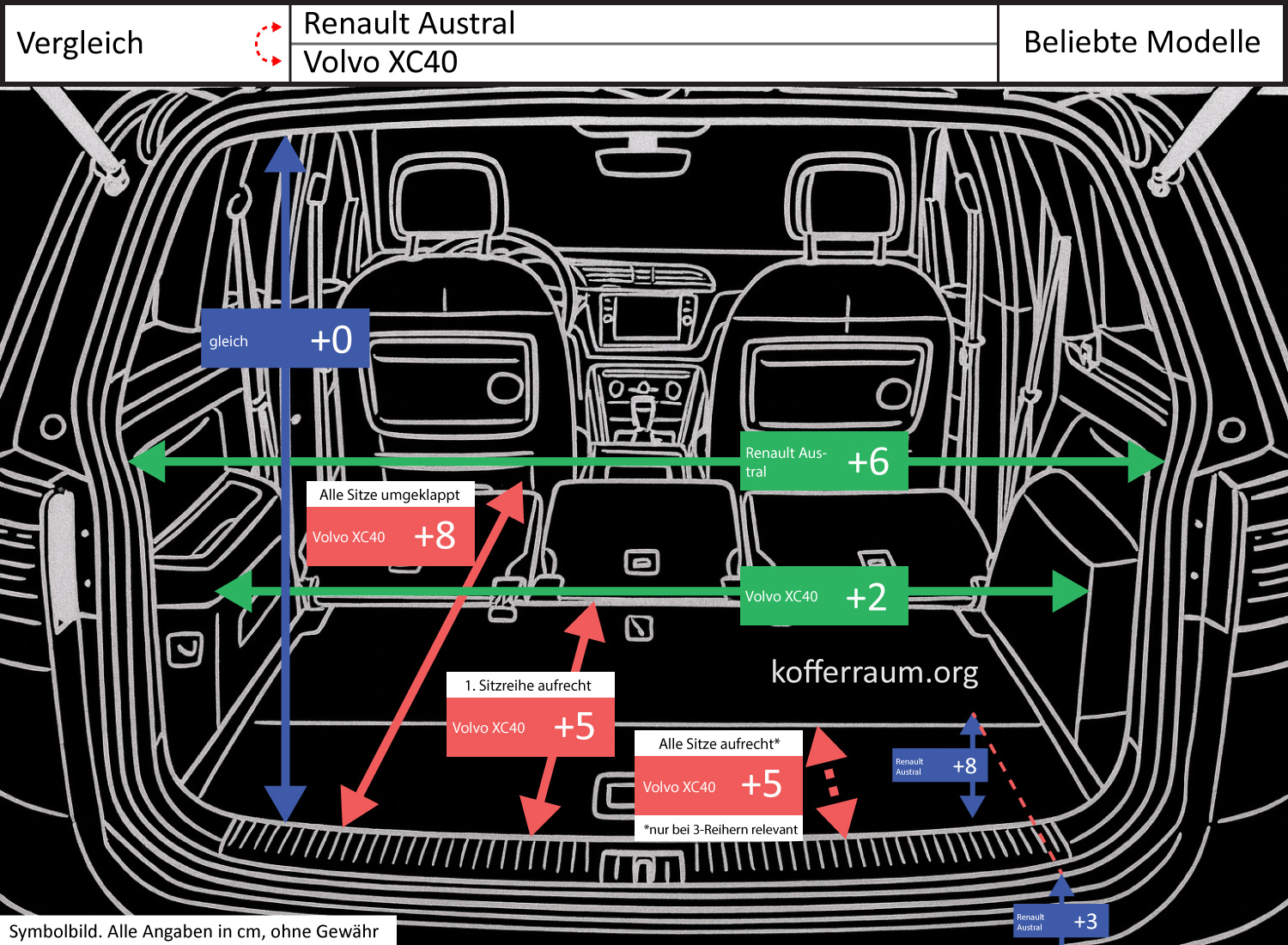
The most noticeable difference lies in the depth of the trunk (distance from loading edge → trunk floor): The Renault Austral is +3.1 in or about +700% larger here than the Volvo XC40.
Other, smaller differences (under 10%) are:
- Volvo XC40 offers a longer loading area: +3.1 in (≈5%) with seats folded down and +2 in (≈6%) with the front seat row upright.
- The height of the trunk opening is the same in both models.
- The loading edge of the Renault Austral is +1.2 in (≈4%) higher above the road than the XC40.
- Volvo XC40 is +0.8 in (≈2%) wider at the narrowest point; Renault Austral, on the other hand, has a trunk opening that is +2.4 in (≈6%) wider.
Impact on Usability
Deeper trunk floor in the Renault Austral (highlighted): The significantly greater depth means the Austral has a "deeper well." Advantages include better sinking and securing of smaller items, more usable volume when cargo is stacked high, and less risk of light parts sliding out during turns.
Disadvantages can be that heavy cargo must be lifted slightly higher (the loading edge is also marginally higher) and very flat, long items more often hit the trunk opening if the total loading length is limited.
Volvo XC40 — longer loading area, lower loading edge: The slightly greater length with seats folded down makes the XC40 more practical for longer items (slats, skis, furniture parts).
The somewhat lower loading edge makes lifting heavy items into the trunk easier. However, due to the shallower well, the XC40 offers less "entry depth" for small or loose items and slightly less usable depth.
In summary: Those who need more "depth" and secure sinking options for loose/stacked cargo benefit from the Renault Austral. Those who better accommodate longer items and prefer somewhat easier lifting are better served by the Volvo XC40. Other differences are marginal and have little practical impact.