
Trunk comparison: Renault Austral vs VW T-Roc

Comparison (Summary)
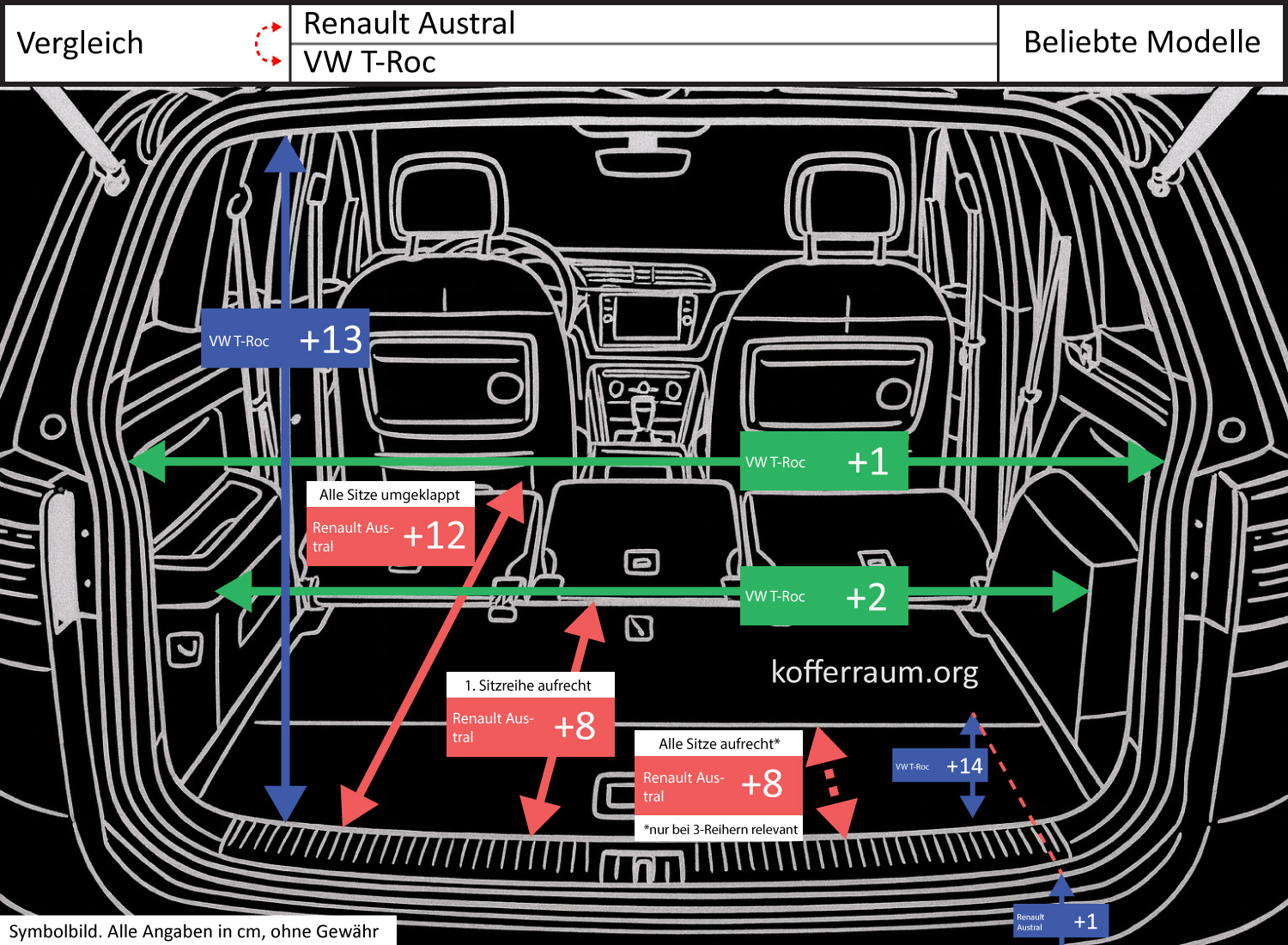
The VW T‑Roc offers a significantly different form of cargo space than the Renault Austral. The two most telling differences are: The trunk opening of the T‑Roc is
than that of the Austral, and the distance between the loading edge and the trunk floor is
in the T‑Roc. These two deviations clearly exceed the 10% mark and shape practical use. Smaller differences: The Austral is somewhat longer in the cargo area (with folded seats +4.7 in / 8%; with the first row upright +3.1 in / 10%) and the loading edge of the Austral is slightly (0.4 in) higher above the road; the width differences favoring the T‑Roc are marginal at 1–0.8 in.
Impact on Usability
The higher trunk opening of the T‑Roc makes it easier to load tall or bulky items: larger boxes, furniture parts, or bulky luggage can be loaded more upright without too many angled maneuvers. Combined with the significantly greater depth (larger height difference between loading edge and floor), this means on one hand more usable interior height behind the loading edge — thus better storage for taller items — on the other hand, there is a practical disadvantage when lifting heavy loads: if the floor is significantly lower, heavy items must be lifted higher when removing them, making loading and unloading more strenuous and not ideal for those with lower back concerns. The Renault Austral scores with the longer loading surface, especially with folded seats, which facilitates transporting longer items (e.g., boards, skis, furniture parts lengthwise). Since the differences in loading edge height and width are very minor, they have practically little impact on everyday usability. Overall: Those who frequently load tall or bulky but rather light items benefit from the T‑Roc (higher opening, more interior height); those who prefer longer, flat-loadable items or easier-to-use cargo space have advantages with the Austral.