
Trunk comparison: Renault Austral vs VW Tiguan
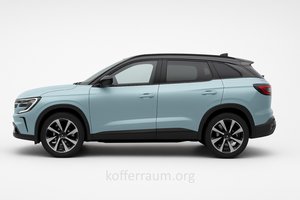
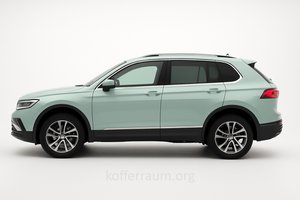
Key Differences
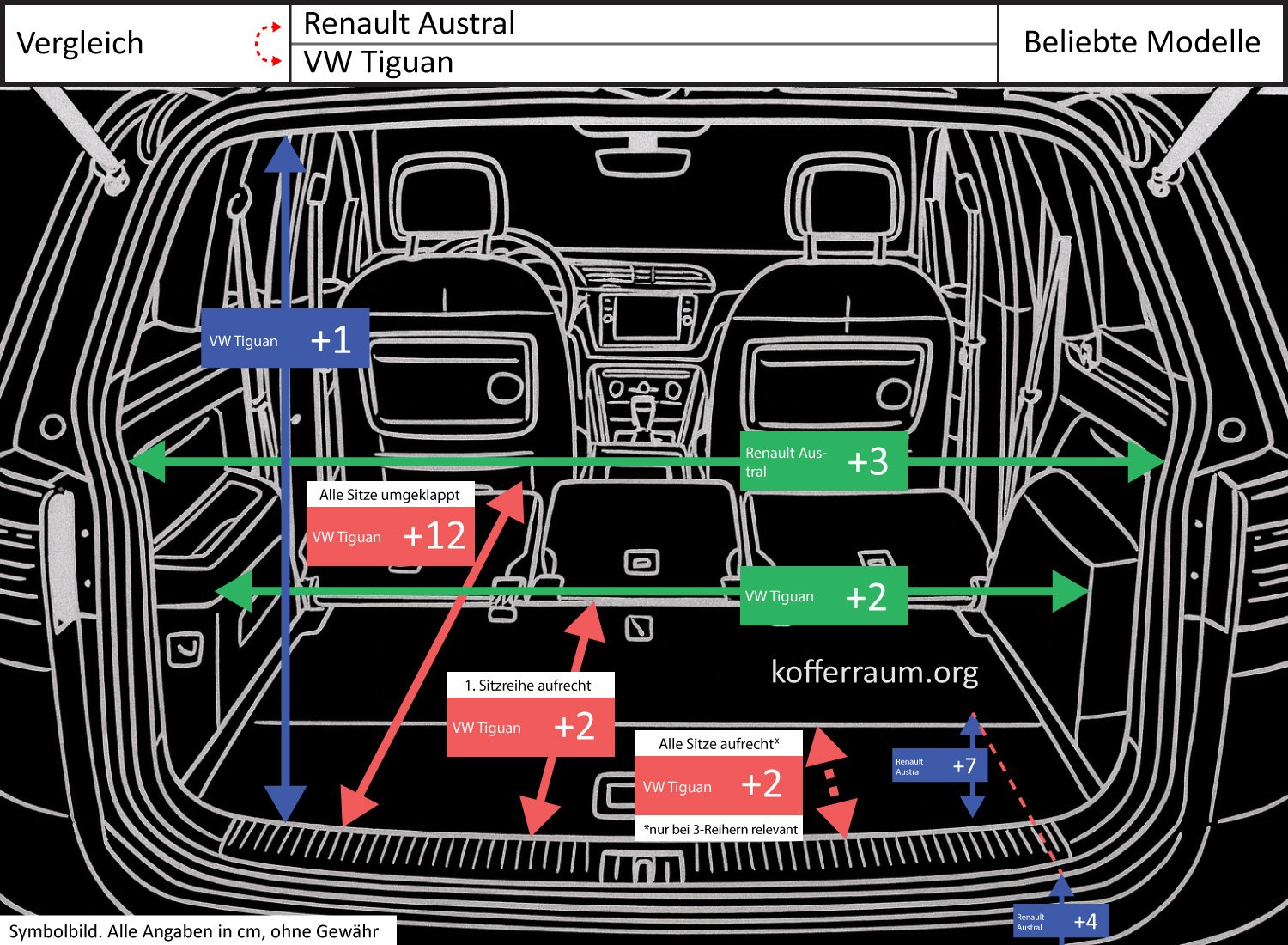
The most noticeable and only difference over 10% concerns the trunk depth: The depth (loading edge to trunk floor) of the Renault Austral is +2.8 in (specifically +700%) greater than that of the VW Tiguan.
This is the clearly largest relative deviation and has significant consequences for the usability of the cargo space.
Other differences (under 10%) are: The VW Tiguan has a +4.7 in longer cargo floor length when the seats are folded down and +0.8 in more length with the first row of seats upright.
The height of the trunk opening is +0.4 in greater on the Tiguan, the narrowest width in the trunk is +0.8 in greater on the Tiguan, the width of the trunk opening is +1.2 in greater on the Renault, and the loading edge of the Renault is +1.6 in higher above the road.
Impact on Usability
The significantly greater depth of the Renault Austral means more usable vertical length between the loading edge and floor: This facilitates loading tall or stackable items and increases the effective volume for bulky but not necessarily long loads.
However, this is offset by the higher loading edge of the Austral (+1.6 in), which makes lifting heavy items when loading more difficult and must be considered with low garages or ramps.
The VW Tiguan offers the longer cargo floor, especially when the seats are folded down (+4.7 in). This makes it better suited for long, flat items (e.g., furniture or construction panels).
The slightly greater narrow width and the slightly higher trunk opening support inserting bulky, narrow parts. However, the differences in width and opening are minor and only have practical effects in edge cases.
In summary: For heavy, tall, or stackable cargo with a focus on volume, the Renault Austral is more advantageous due to the greater depth, despite the higher loading edge. For longer, flat items and somewhat better accessibility lengthwise, the VW Tiguan is the more practical choice.